
CHASE SECURITY CENTER
How to spot financial scams
Know what to watch for to help avoid them

Even security experts can get caught off guard by a scam
It’s often not about “missing something,” it can be more about how our brains are naturally programmed to react.

Familiarity
Your brain relaxes when you feel you “know” who’s contacting you. It’s why scammers join social media groups, and impersonate your bank and your friends or government organizations.

Urgency
Urgency can shut down your rational or critical thinking so scammers create deadlines or pressure to push you into making quick decisions.

Fear
A scared brain focuses on fixing something fast, so scammers trigger panic: fraud alerts, threats, account freezes or unpaid bills to get you to “fix it now” without checking first.

Protection
We’re programmed to believe that banks can recover money sent through services like Zelle®, wires or account-to-account transfers. Most often, they can’t.
When something feels off, our free guides can help
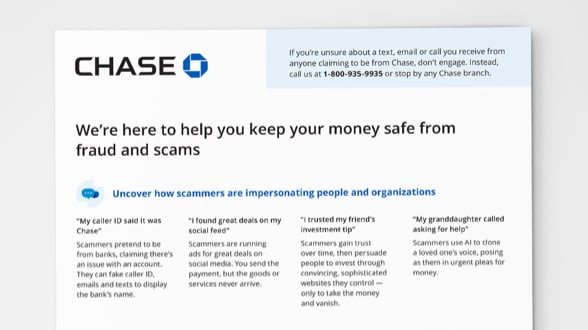
Know what to look for before you act
This guide walks through common scam scenarios, what to watch for and questions to ask.
We share real-life scam stories
The more you know how scams really unfold, the more confidently you can protect your money and information.

Bank impersonation scams: When scammers pretend to be your bank
They’ll pretend there’s an issue with your account and your money is at risk. They may claim there’s fraud on your account and put pressure on you to act fast so you don’t lose the rest of your money.

“My phone rang. My caller ID said Chase”
How it can happen
The man on the line told me they suspected fraud on my account. I confirmed the transactions weren't mine, but I wasn’t sure if the call was real. When I hesitated, he offered to connect me with his supervisor.
She sounded calm and professional and told me I could go into the branch and transfer my money to a new account they had created for me to fix the issue. However, she said they believed someone at my local branch might be involved so I should go to a different branch but not tell them why I was making the transfer. I went to another branch, filled out a form for an account-to-account transfer and handed it to the teller to complete.
When I got home, I felt uneasy. I called the number on the back of my card and the employee confirmed the account I transferred the money to wasn’t in my name. That’s when I realized I’d sent my money to a scammer. By then, the funds had already been moved and I couldn’t get them back.
I wish I’d known
- Scammers are impersonating banks. They claim there’s fraud on your account and say you have to move money to “fix” the problem. Legitimate banks will never ask you to move money to resolve a fraud issue.
- Scammers can make caller ID, emails and texts display as messages from your bank. If you are ever unsure, call us using the number on the back of your card.
- Banks, police and government agencies never run “sting operations” with customers or ask you to distrust employees.
- Treat account-to-account transfers, Zelle®, checks, wires, cashier’s checks, gift cards and crypto like cash. Once scammers get the money, you probably won’t get it back.
Frequently asked questions
Check the sender's actual email address (not just the display name), look for artificial urgency or threats and verify that any links go to the official website by hovering over the link. Never click links or download attachments if something feels off.
Start by considering the tone of the message, as well as the request it's making. Scammers will act aggressively to get you to send them money, while most emails from us will simply tell you about products and services we think you'll be interested in. If you're unsure, call us using the number on the back of your card or account statement.
Phishing is a type of cyberattack where bad actors use deceptive emails or messages to trick individuals into revealing sensitive information. To avoid falling victim, be skeptical of unexpected emails, verify sender information, avoid clicking on suspicious links and don’t provide personal information to those you don’t know. Phishing emails, text messages and fake websites are designed to steal personal and financial information, as well as login credentials.
Each situation is different but if you think you’ve given the scammer account information, please contact the company or financial institution to help assess your situation.
JPMorganChase (JPMC) does not buy, sell, or exchange Iraqi dinar (IQD) banknotes and currently has no plans to offer this service in the future. You may have read or have heard that Chase Bank buys, sells or exchanges this currency, this information is incorrect. You may have been also told that JPMC is opening branches and offices in Iraq to aid in the revaluation process, this information is also incorrect.
We urge you to seek the advice of your professional investment advisor before making any investments. You should always consult with professionals prior to joining any investment schemes you may have heard about online and before you send any money to people claiming to facilitate the purchase of all foreign currencies.
Multiple local agencies, state agencies, major financial institutions, and consumer protection groups have warned that this behavior is a scam.
Identity theft occurs when someone uses your personal information without your permission. This can include opening credit accounts, applying for loans, accessing financial accounts, filing fraudulent tax returns or making purchases in your name. You can get our free guide (PDF) to helping protect you from identity theft and what to do if it happens.
Review our Identity Theft Kit (PDF) and take action to help protect yourself.
Forward the email to phishing@chase.com.
Explore the Chase Security Center


Help safeguard seniors
Information, resources and tools for older adults and caregivers.

Students/young adults
Guidance for teens, students and parents.

Protect your business
Resources and tools to help protect your business from fraud and scams.


We’re here to help
When in doubt, contact us before you share your account information or send money. Call us using the number on the back of your card or account statement.
Nearly 50% of scams reported to Chase originate on social media
Many of our customers are reporting to us that scammers on social media asked them to send their payment with Zelle® or by wire.
If you’re buying, be cautious if…
If you’re selling, be cautious if…
If you’re contacted by someone new, be cautious if…
If you’re considering an investment, be cautious if…