How to navigate stock market sell-offs in 2026: Key strategies and considerations for investors

Editorial staff, J.P. Morgan Wealth Management
- Unlike a stock market correction – which is defined by a decline of at least 10% – or a bear market – which refers to a decline of 20% or more – a sell-off is a period of broad, rapid selling activity with no official percentage threshold.
- Sell-offs are common occurrences that can be triggered by a range of forces, including economic data surprises, shifts in Federal Reserve (Fed) policy, geopolitical shocks and disappointing corporate earnings.
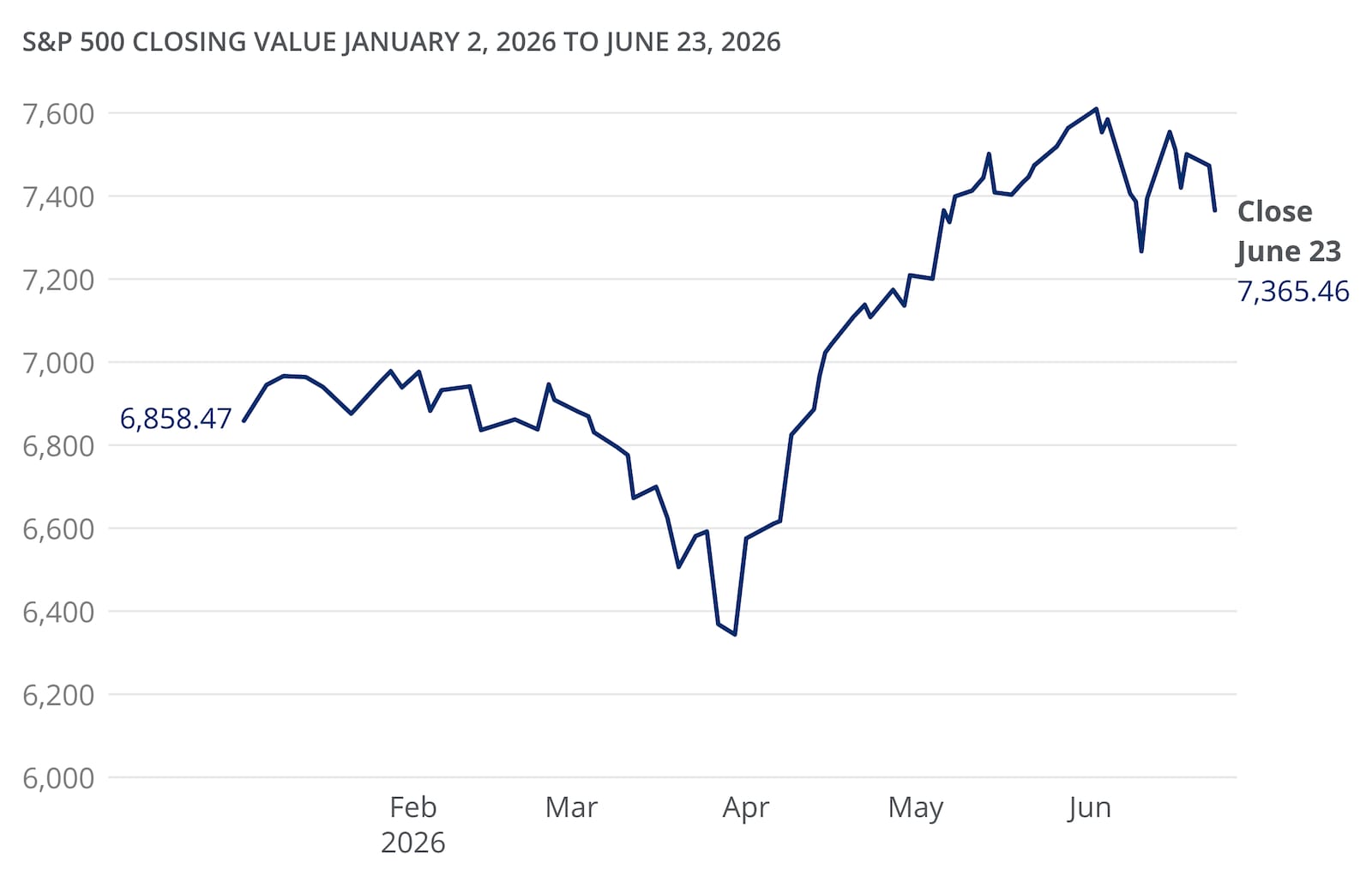
- While the stock market hit record highs in June, it also experienced a tech sell-off when investors seemingly hit pause on artificial intelligence (AI) and chip stocks, though that sell-off was short lived. This can happen at any time, so it’s important to understand that while the market can hit records one day, it can also slump the next.
- Maintaining a long-term perspective, staying diversified and following a predetermined investment plan tend to serve investors better during a sell-off than making reactive decisions.

A stock market sell-off is a broad market decline that happens over a relatively short period. While sell-offs can be driven by many factors, they are a normal part of investing and have occurred throughout market history.
In early June, the S&P 500 hit a new record high after closing strong in May. However, there have still been bouts of market volatility. For example, major markets closed lower on July 7, tied to several chip stocks shedding gains, just two weeks after the tech sell-off that happened on June 23 when the S&P 500 fell 1.4% and the Nasdaq Composite fell 2.2%. Sell-offs like this can happen at any time and can be based on a variety of factors, such as if investors seem to be wary of the momentum in different sectors. It’s important to stay focused on your long-term goals and macro conviction, since market sell-offs can be short-lived and a rebound can come as soon as the next trading session.
“While the tech trade can be volatile on any given day, we continue to believe we are in the early stages of a generational opportunity for the AI ecosystem that can unlock opportunities both at home and abroad,” J.P. Morgan Wealth Management Chief Investment Strategist Phil Camporeale said. “We would encourage investors to look through short-term volatility and continue to focus on earnings driving returns and find ways to invest in this theme over coming years.”
Understanding what causes a stock market sell-off, when they have happened in recent months and how you can respond can help put periods of volatility into perspective.
Stock market sell-offs, explained
A stock market sell-off is a period when a large number of investors sell stocks, leading to widespread price declines. Unlike a typical down day in the market, a sell-off tends to involve broader participation across sectors and can unfold quickly as investors react to new information or changing expectations.
There isn’t an official threshold that determines when a market decline becomes a sell-off. Generally, the term is used when losses are broad-based, sentiment deteriorates and selling pressure accelerates across the market.
For investors, a sell-off often reflects uncertainty about future economic conditions, corporate profits, monetary policy or other factors that influence stock valuations. While prices may fall sharply in the short term, sell-offs don’t necessarily indicate that long-term market fundamentals have permanently changed.
Stock market sell-off vs. correction vs. bear market: What’s the difference?
The terms “sell-off,” “correction” and “bear market” describe different levels of severity for a market downturn.
A sell-off is the most informal of the three terms and doesn’t suggest a specific percentage threshold. It describes the behavior of the market, not the depth.
A correction officially takes place when an index or asset reverses its preceding trend by at least 10% from a recent peak before resuming its trend. Corrections can be relatively short and are not uncommon.
A bear market represents a deeper, more sustained decline. Generally, a drop of 20% or more in a broad market index like the S&P 500 signals bear market territory. Bear markets can, though not always, coincide with recessions and can last considerably longer than corrections.
Comparison: Sell-off, correction and bear market
Sell-off | Correction | Bear market |
|---|---|---|
Basic description | ||
Broad and often rapid selling activity | Market decline from a recent high | Extended market downturn |
Typical magnitude | ||
No official threshold | About 10% or more | About 20% or more from a recent high |
Scope | ||
Can affect one sector or the broader market | Usually refers to a major market index | Often affects broad equity markets |
Get up to $1,000
When you open a J.P. Morgan Self-Directed Investing account, you get a trading experience that puts you in control and up to $1,000 in cash bonus.
What causes a sell-off?
Market sell-offs can occur for many reasons. Macro factors like economic data surprises (such as a hotter-than-anticipated inflation report), changes in Fed policy expectations and recession fears are among the most powerful triggers. When investors conclude that interest rates are rising more than expected, stock prices can become vulnerable because an increase in the rate used to discount future company earnings can weigh on valuations. Higher rates can also slow economic growth, which can put pressure on corporate earnings.
Company and market-level factors can also weigh on investor psyche. Disappointing earnings reports, downward revisions to forward earnings guidance from major companies or the sense that valuations have overshot the underlying fundamentals can trigger selling. Because most major equity benchmarks are market-capitalization weighted, a meaningful miss from an influential company can ripple quickly across the broader market.
Finally, there are external shocks to consider. Things like geopolitical events, large moves in commodity prices, financial market illiquidity and unexpected policy announcements can all trigger a sell-off with little warning. These shocks can introduce sudden, hard-to-quantify uncertainty into markets, causing rapid repricing as investors reassess potential outcomes.
It is also worth noting that sell-offs can feed on themselves. For instance, when investors fear a rapid price decline, they may offload large quantities of shares without fully analyzing whether selling is the right move for their portfolio. This widespread selling may drive prices lower and can lead to more selling.
Examples of stock market sell-offs
Market sell-offs have occurred throughout history. Earlier in 2026, for instance, when the conflict in Iran escalated and shipping through the Strait of Hormuz effectively came to a halt, the S&P 500 declined roughly 9% from late February through late March. As often occurs following these brief market interruptions, the S&P 500 quickly rebounded, returning to nearly pre-conflict levels in approximately 11 trading sessions.
In June, markets experienced a few sell-offs, including a tech sell-off on June 23 on concerns that the momentum with AI and chip stocks could be less stable than originally thought. There was also a downturn earlier in June on concerns about inflation and the possibility that the Fed could keep interest rates higher for longer than investors had expected. Recent volatility has been led by sell-offs in technology, chip and semiconductor stocks, contributing to losses in major indexes including the S&P 500, the Dow and Nasdaq Composite.
The S&P 500 has already experienced a few sell-offs in 2026
How to manage your portfolio during a market sell-off
For many investors, one of the most important considerations during a sell-off is maintaining a long-term perspective. Short-term market movements can be difficult to predict, and emotional decisions made during periods of volatility may disrupt a carefully constructed investment strategy.
Investing is a long-term game, so it’s important to stay the course and follow your plan. While research has shown that the average intra-year decline for the S&P 500 since 1980 has been around 14%, the index still finished positive in roughly 75% of those years.
Selling during a sell-off can lock in losses, and investors may miss out on the recovery. Diversification tends to be especially valuable when volatility is elevated, and a well-constructed portfolio is designed specifically to weather these downturns.
It’s best to revisit your risk tolerance and time horizon regularly – so you’re not making big decisions in the middle of a sell-off. When markets do pull back, it can still be a helpful moment to calmly confirm your portfolio is tracking your plan and goals. Investors with longer time horizons can often stay patient through volatility, while those closer to retirement or with near-term cash needs may want to make sure their equity exposure and liquidity cushion still fit their timeline.
The one potential opportunity that comes with a market sell-off could be a chance to “buy the dip.” For those with available cash and a long time horizon, for example, a sell-off could mean that you’re able to invest more at lower prices through regular, consistent contributions rather than trying to pick an exact bottom. This approach, known as dollar-cost averaging, may also help reduce the impact of short-term market fluctuations and remove some of the emotion from investing decisions.
If you’re unsure how a market sell-off could affect your financial plan, speaking with a financial professional may help you evaluate your options and determine whether any adjustments are appropriate for your situation.
The bottom line
Stock market sell-offs are typically brief periods of turmoil that can be uncomfortable for investors. However, sell-offs are a normal part of market cycles that tend to be shorter-lived than market corrections and bear markets. Remembering this is critical for long-term investors because sell-offs, in most cases, have been followed by recovery periods. Reacting quickly is rarely the right response. Instead, revisiting your long-term investing plan, understanding what is driving the decline and leaning on a diversified, goal-aligned strategy tend to serve investors better than trying to time market moves.
Frequently asked questions about stock market sell-offs
A stock market sell-off is a broad and unusually fast decline in prices across markets, without a specific percentage threshold. A crash typically refers to a sudden, extreme single-day or very short-term decline, often triggered by a specific shock or panic event, in which investors rapidly offload large quantities of shares without necessarily analyzing whether selling is the wisest move. Both involve fast price declines driven by widespread selling, but crashes are more severe and are often described as exceptional, rather than routine, market events.
Diversification across asset classes, sectors and geographies remains one of the most practical ways to reduce exposure to any single source of volatility. Remaining true to an asset allocation that reflects your actual long-term goals and risk tolerance, rather than your tolerance during calm periods, is also key.
No. Many sell-offs occur without a recession following, and some recessions arrive without being clearly preceded by a dramatic sell-off.
Investors can watch inflation data, Federal Reserve policy decisions, employment reports, corporate earnings, credit market conditions and measures of market volatility. These are some of the indicators that can provide insight into the factors driving market sentiment and future expectations.
Invest your way
Not working with us yet? Find a J.P. Morgan Advisor or explore ways to invest online.