The cost of capital is rising. Did stocks get the memo?

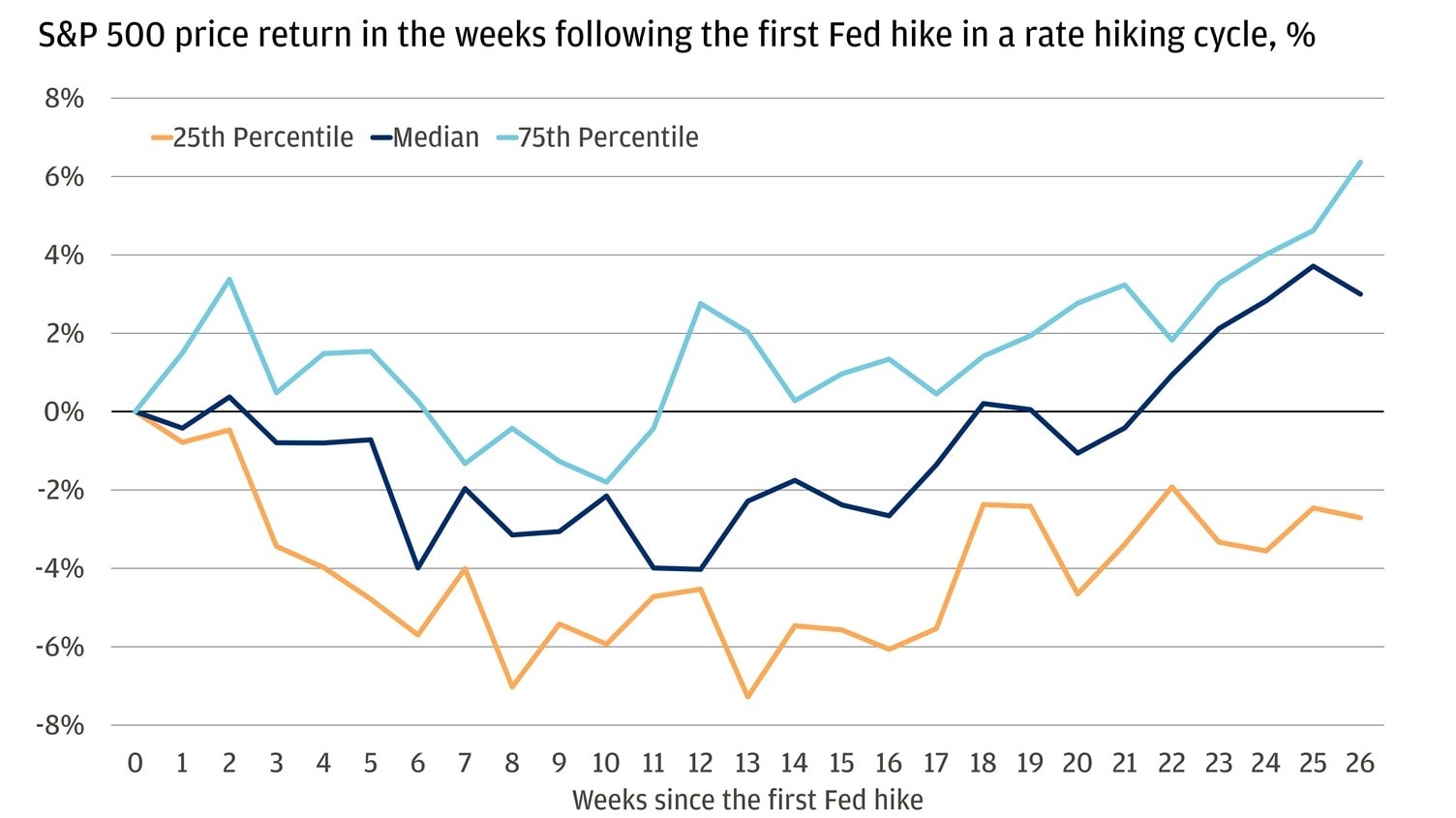
Interest rate hikes are not traditionally welcomed by risk assets. Since 1972, the S&P 500 has historically fallen about 4% in the six weeks following the first interest rate increase of a hiking cycle as investors factor in higher borrowing costs and discount rates. While stocks frequently sell off in the opening stages of a hiking cycle, median returns over the subsequent six months have historically been positive. Ultimately, investors care less about the direction of policy rates and more about why those rates are rising.
If tighter monetary policy reflects stronger economic growth, resilient demand and healthy corporate earnings, the stock market can withstand higher bond yields. This time around, after a widely anticipated 25-basis-point interest rate hike at the September Federal Open Market Committee (FOMC) meeting, the stock market has remained relatively resilient – perhaps because this is not a typical hiking cycle driven solely by concerns around inflation or the labor market, but rather because the Federal Reserve’s policy path is only one factor shaping the interest-rate environment.
After initial declines, equities have risen in hiking cycles
Now add in approximately $315 billion of expected bond market issuance from the hyperscalers in 2027 (on top of $280 billion in 2026), ongoing conflict in the Middle East and its effects on energy prices, and a booming equity market. Whereas the Federal Reserve may have initiated the move higher in interest rates, it is no longer acting alone. The interaction between these other forces is increasingly shaping the direction of real yields, which may end up proving more important than the next 25 basis points from the Fed.
Not just the Fed
Even in the face of a historic stock market rally and bond market pivot, the most consequential move in financial markets may just be the relentless rise in real yields. Representing the true cost of capital by accounting for inflation, this has the most direct impact on businesses, consumers and governments alike. Whereas a hawkish Federal Reserve has increasingly taken a back seat in driving bond yields, other factors have pushed to the front:
- The U.S. economy has been surprisingly difficult to slow: Rather than collapsing under the weight of higher interest rates and energy prices, U.S. economic activity remains relatively resilient. Consumers are still spending.
- Extraordinary demand for capital: Artificial intelligence (AI) infrastructure, data centers, semiconductors, power generation and grid modernization are absorbing large amounts of investment. A stronger investment cycle paves the way for longer-term productivity.
- Competing for funds: The U.S. government is issuing large quantities of debt, putting Treasury supply in direct competition with private-sector investment demand. Bond investors have more choices of who to lend to.
- Energy prices continue to rise: The ongoing conflict in the Middle East and elevated commodity prices across the world mean investors are demanding additional compensation for owning longer-duration assets that are subject to the uncertainty.
Taken together, the result is simple: The cost of capital is rising. The last comparable move was in 2023, when 10-year real yields rose nearly 90 basis points in less than a year as investors repriced growth, fiscal deficits and the prospect of a higher-for-longer interest rate environment. That episode ultimately pressured equity valuations, but stronger earnings helped cushion the impact. We’re seeing something similar happen today.
Ready to take the next step in investing?
We offer $0 commission online trades, intuitive investing tools and a range of advisor services, so you can take control of your financial future.
A bigger buffer
At first glance, a rise of more than 70 basis points in real yields should have been problematic for equities. In theory, when real yields rise, borrowing becomes more expensive for consumers and businesses. Over time, that can slow spending, investment and corporate earnings growth, creating a headwind for stocks. And when real yields rise by that margin in a span of months, it can often weigh on equity returns.
Yet stocks have remained unusually resilient. That’s because of corporate earnings, stronger economic growth and AI-related investment spending. Higher real yields can pressure equity valuations lower, but strong profit growth is proving to be an offset. After all, S&P 500 net profit margins at 17% mark an all-time high.
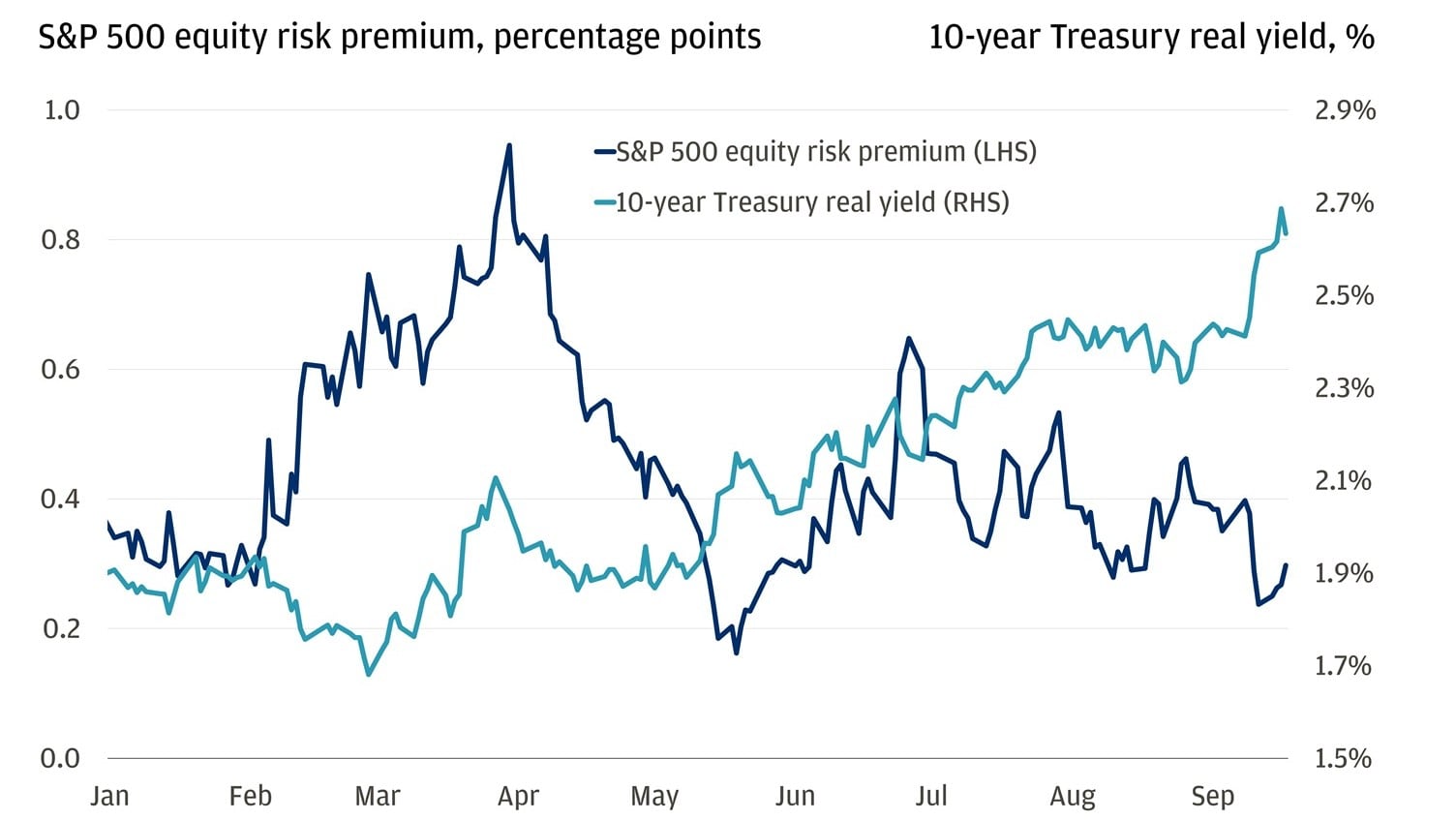
One way to see this is through the S&P 500 equity risk premium, a simple measure of how much more investors are compensated for owning stocks rather than a 10-year Treasury bond. Bonds have naturally become more attractive as yields continue to climb. But so have equities, as multiples have compressed. As such, the equity risk premium is roughly where it began the year. In other words, on a relative basis, bonds are no more attractive to equities on this framework despite the significant rise in real yields.
Equity risk premium is back to where it started the year
History suggests stocks can withstand higher interest rates when those rates reflect stronger economic growth and healthier corporate profits. So far, that has been the case. But the balancing act becomes increasingly difficult as real yields continue to rise. Strong earnings, accelerating AI investment and a resilient economy have provided a cushion for risk assets. The question for investors is whether that cushion remains large enough if the cost of capital continues moving higher. For now, earnings are winning the battle, but real yields remain in the driver’s seat.
All market and economic data as of 09/17/2026 are sourced from Bloomberg Finance L.P. and FactSet unless otherwise stated.
You're invited to subscribe to our newsletters
We'll send you the latest market news, investing insights and more when you subscribe to our newsletters.