U.S. earnings are exceptional. Stocks are playing catch-up

Executive Director, Global Investment Strategist, J.P. Morgan Private Bank

By: Kriti Gupta and Nick Roberts
By the numbers, it’s been an exceptional earnings season. Revenue across the S&P 500 has grown 16% year over year. Earnings growth is approaching 52%. Even when adjusting for one-time investment-related gains from two of the major index weights, the figure is approximately 32%. Net profit margins are near record highs, and the stock market is showing signs of breadth: 86% of companies have posted better-than-expected earnings per share with all 11 sectors having reported positive revenue growth. It’s a bull market’s paradise.
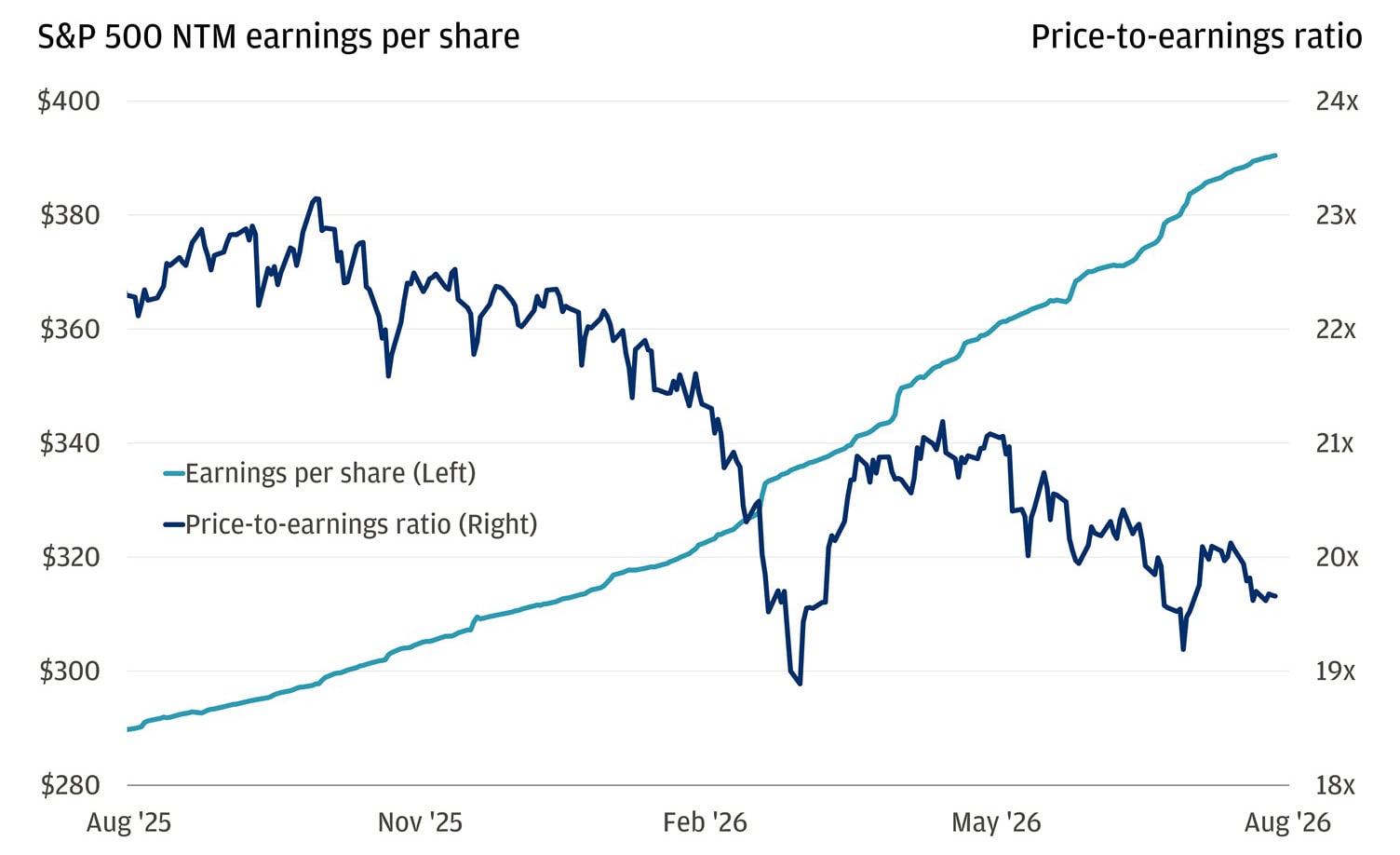
Yet despite the strength of the underlying fundamentals, investors have yet to fully reward it in the stock market. Forward earnings expectations continue to move higher, but the multiples of those earnings that stocks trade at have compressed. The result is an unusual backdrop: Earnings are accelerating while valuations move in the opposite direction.
Surging earnings have driven valuations lower
Why so strong?
The second-quarter earnings season has delivered one of the strongest fundamental backdrops of the post-pandemic cycle. Earnings growth at this pace is typically a phenomenon seen at the start of an economic expansion, occurring most often as the economy rebounds post-recession. But not this time – thanks to a once-in-a-generation capital expenditure boom, tax policies, a spike in energy prices and pent-up demand.
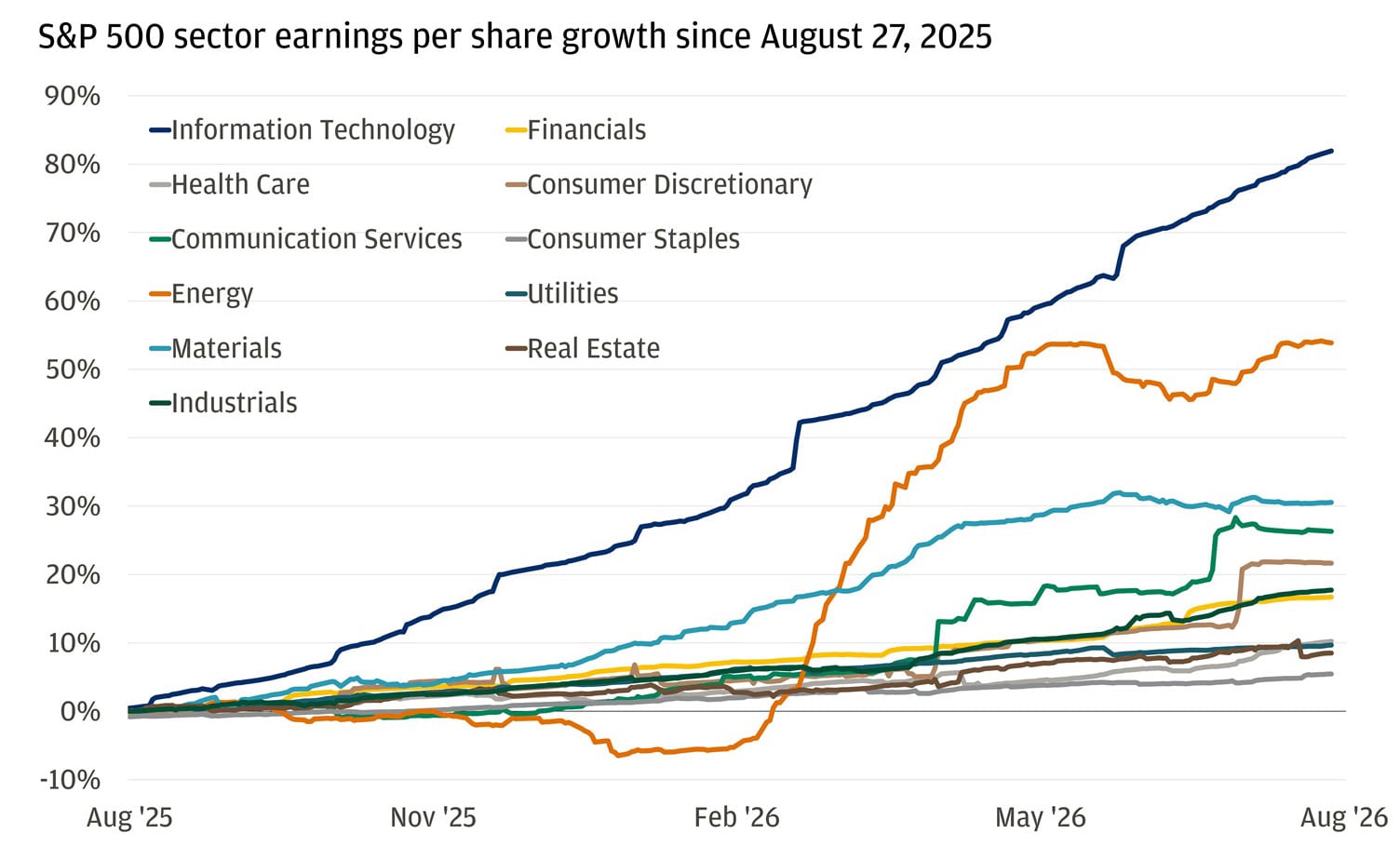
The biggest driver is the artificial intelligence (AI) infrastructure buildout. Semiconductor, networking and cloud-related spending continues to expand as hyperscalers race to deploy capacity. Capital expenditure expectations for the largest technology companies are expected to cross over $1 trillion in 2027 as investor speculation shifts from whether spending will continue to how long supply constraints will persist. That shift demonstrates renewed faith in the AI trade that’s driving semiconductor sales higher by over 66% year over year and tech revenue up 21%. AI-related spending is also increasingly generating secondary benefits across industrials, utilities, logistics, construction and other areas connected to the buildout of digital infrastructure.
But it’s not AI alone. Energy has also played an important role. Elevated oil and gas prices following the conflict in Iran have provided a substantial earnings tailwind for the sector. Earnings per share for the energy sector rose 71% year over year, the highest since 2022. And in the Financials sector, trading revenue is near record levels, while a revival in investment banking is yielding a wave of mergers and acquisitions and a busy IPO calendar.
Record profitability across sectors has pushed the S&P 500’s margins to historic highs, allowing earnings growth to significantly outpace revenue growth. And the fact that all 11 sectors are growing revenue signals a still-resilient consumer and provides the cleanest “the economy is still growing” signal – crucial for investors concerned about concentrated growth and risk.
Ready to take the next step in investing?
We offer $0 commission online trades, intuitive investing tools and a range of advisor services, so you can take control of your financial future.
Tech and energy have led, but all sectors are growing
Battling other forces
Years of worry around rate and recession risk are still being worked through. Despite the strong earnings fundamentals, investors are still digesting other factors. Elevated oil prices as a result of the ongoing conflict in Iran and bond yields inching higher are in part keeping stocks capped in the short term. The way that manifests is in the response to earnings beats, which have generated less upside than usual, even as underlying results continue to surprise positively and any misses are punished more severely.
Some of those headwinds may be beginning to ease as oil prices retreat and signs of stabilization in long-end yields potentially reduce pressure on valuations. The larger concern is around the sustainability of the AI buildout. The hyperscalers and semiconductor companies have demonstrated clear demand for compute and chips, but the durability of the AI cycle depends on whether customers can prove the economic benefits from deploying those tools.
There is no doubt that adoption of the technology is broadening across industries, with more companies citing productivity improvements. But only a small percentage have reported a meaningful impact on their earnings. That gap may represent one of the most important metrics for investors over the next year. A meaningful acceleration in those metrics would provide the clearest signal that the current infrastructure buildout will indeed generate lasting economic returns.
For now, the fundamental story remains intact. Earnings continue to exceed expectations, margins remain near record highs and AI investment shows few signs of slowing. Should bond yields become less of a headwind and more conviction emerges in the long-term productivity benefits of AI, the stock market can catch up to reflect the strong earnings growth expected going forward.
All market and economic data as of 08/27/2026 are sourced from Bloomberg Finance L.P. and FactSet unless otherwise stated.
You're invited to subscribe to our newsletters
We'll send you the latest market news, investing insights and more when you subscribe to our newsletters.