A balancing act: The trade-off between debt and defense

Executive Director, Global Investment Strategist, J.P. Morgan Private Bank

The conflict in Iran, an ongoing war in Ukraine, counter-narcotics operations across Latin America and the question of Taiwan – these are just a few of the reasons that have led investors to view the global defense sector as an obvious beneficiary of an uncertain world.
Escalating conflicts and rising geopolitical fragmentation have spurred ambitious spending proposals. After all, it’s the structural spend that supports a multiyear uptrend. Unless, of course, it doesn’t come to fruition.
That’s the fear across advanced economies already burdened with elevated debt levels and supply chains that extend around the world. The idea of a sustained, multiyear rearmament cycle naturally invites skepticism. It’s that tension that sits at the heart of today’s defense investment debate.
Big promises
The debate is most visible in the United States, where proposals for a materially higher defense budget have prompted a simple question: How do you pay for it?
It’s no secret that the United States spends the most on defense in the world, allocating approximately $1 trillion in fiscal year 2026 alone – already a record amount. That amount could increase by almost 50% in 2027 as a $1.5 trillion budget proposal is presented to Congress. And that doesn’t account for expected supplemental funding requests expected around financing the operations in the Middle East.
Latest defense budget proposal marks a ~50% increase
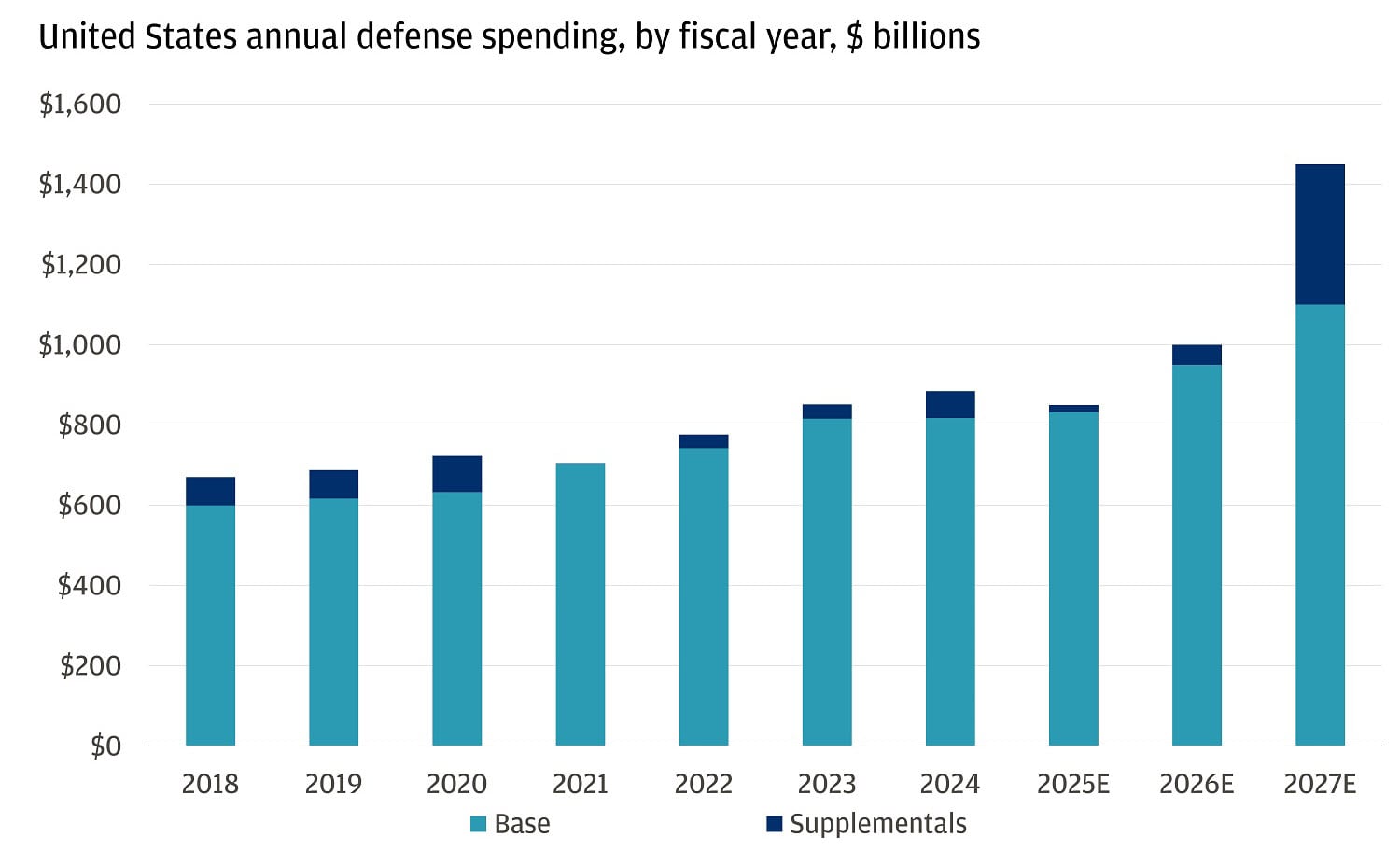
This defense proposal is unlike its predecessors in both scale and priorities. In prior years, supplemental funding, which traditionally adds on to funds allocated to defense in the national budget, has been focused on conflicts abroad, aiding allies like Ukraine and Israel. The $1.5 trillion budget proposal, however, leans further into the domestic agenda. It’s looking to fund modernization priorities such as multilayered missile defense systems like the Golden Dome for America to protect from aerial threats, space capabilities, shipbuilding, a 5%–7% pay raise for troops, artificial intelligence (AI) technology and nuclear funding, among other goals. But passage of the full request remains far from assured.
With a Republican majority in both the U.S. House of Representatives and Senate, it’s natural to assume an increase in defense spending would not only be welcome, but encouraged given the party has generally advocated for a stronger national defense. But this time, the scale of the spend competes with the fiscal priority of bringing down the national debt.
With the U.S. debt-to-GDP ratio at over 120% and a global market that has proven more sensitive to balanced budgets (or the lack thereof), increasing the defense budget by such a margin could face pushback by Congressional policymakers, especially during a midterm election year. That said, even a scaled-down compromise would still represent an acceleration in procurement, investment and research spending.
Ready to take the next step in investing?
We offer $0 commission online trades, intuitive investing tools and a range of advisor services, so you can take control of your financial future.
Ramp-ups and backlogs
Across the Atlantic, the investment case looks somewhat different. Europe’s shift toward higher defense spending reflects a more strategic reassessment after decades of underinvestment. Unlike in the United States, where defense infrastructure is already mature, Europe’s challenge lies in capacity rebuilding – from munitions and maintenance to logistics and integration.
The onset of the war in Ukraine and a push to increase contributions to the North Atlantic Treaty Organization (NATO) has created a crisis-driven urgency. But uneven industrial readiness in the region has slowed execution. As a result, the European rearmament story may be more gradual, but potentially more durable, especially with Germany’s fiscal pledge.
The German government boosted military spend in 2025 by 20%–25%, using both its traditional budget and special funds for the Bundeswehr, its armed forces. In doing so, Germany – a country renowned for its budget discipline – left its largest public-sector deficit since reunification. For some, the trade-off between debt and defense is worth it. After all, even with the investment, Germany’s debt-to-GDP ratio only sits at 64% – a far cry from the global average of G7 economies of 128%.
Even as the nation and broader European continent mobilizes, slower implementation and long-term investment plans breed capacity restraints. Take a look at the book-to-bill ratio of Rheinmetall, one of the world’s largest defense manufacturers, as one example of the broader trend. It’s the measure to show how quickly new orders are accumulating relative to current production, which has spiked since German spending priorities zeroed in on defense.
Orders are coming faster than manufacturers can fill them
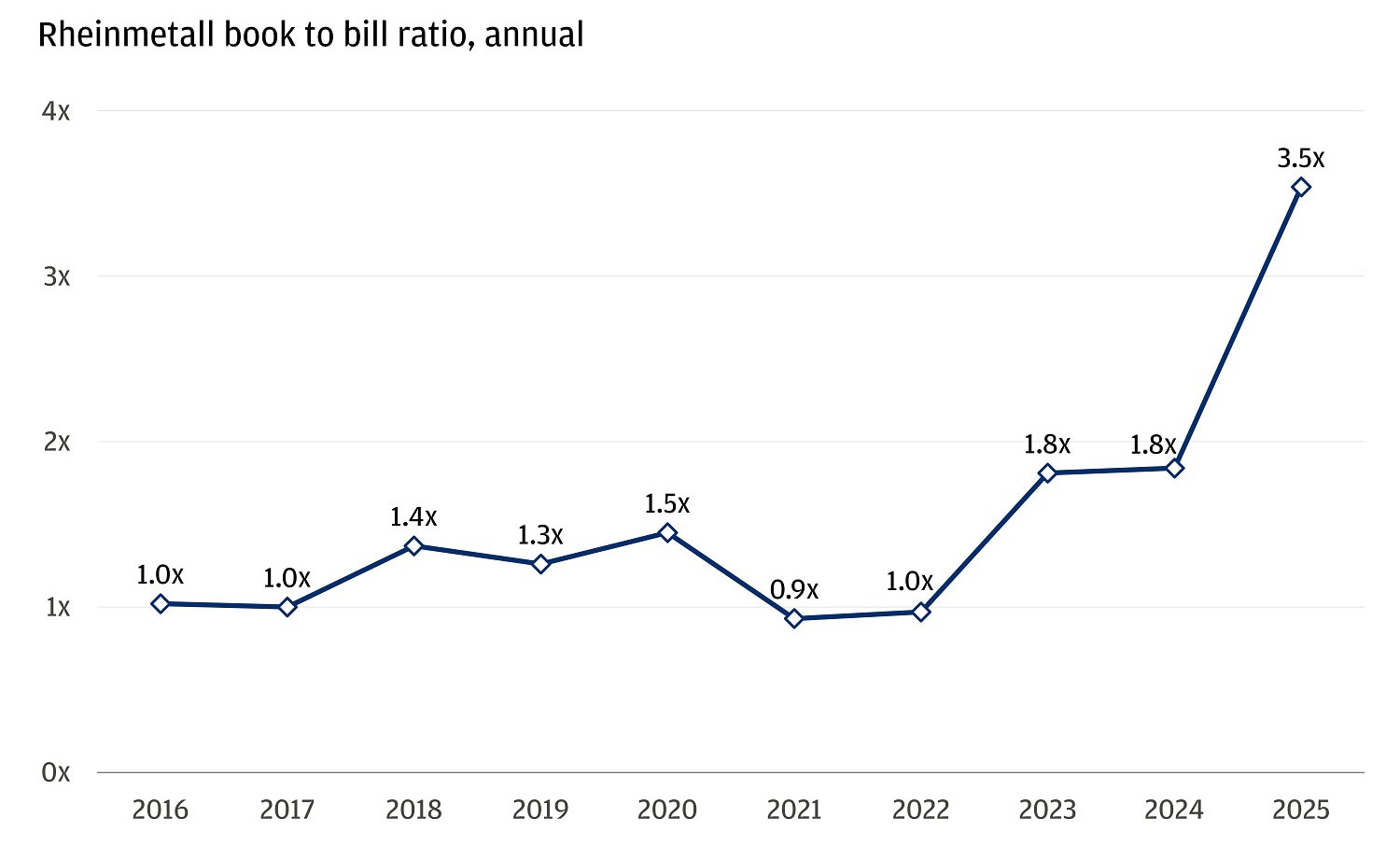
The backlogs are so large, ensuring future contracted revenue, that the sector’s stock market value has surged. As an illustrative valuation datapoint only (not a recommendation), it’s worth noting Rheinmetall has been trading at a higher valuation than even Nvidia – the largest company in the world by market capitalization – for the last 12 months.
Balancing ambition & affordability
And it's not alone. Even Japan has changed its tune. Grappling with a debt burden, low purchasing power, reliance on foreign energy and aging demographics, Japan is ramping up its defense spending with a 2026 budget at a record 9 trillion yen (around $58 billion), marking a 10% annual increase. Even with political consensus to invest in maritime security and strengthening deterrence against China and North Korea, its economic constraints prove to be the biggest hurdle. Japan has to balance its 2% of GDP goal with its 237% of debt-to-GDP.
Japan is just the latest example of a fragmenting world that’s prioritizing defense. Global spend is expected to rise at a 5% compound annual growth rate by 2030 with earnings expected to grow in double digits after posting an average of 8% annual growth over the past decade. And that doesn’t yet take into account the latest $1.5 trillion defense proposal from the White House.
Even with these global increases, it's still the United States that tops the list of defense spending as it places an emphasis on security across the Western hemisphere, maritime and counter-narcotics operations, encouraging NATO contributions and a broad rearmament cycle around the world. And the market is not only pricing that in, but awaiting the green light on additional funding that could take the sector even higher.
All market and economic data as of 04/10/2026 are sourced from Bloomberg Finance L.P. and FactSet unless otherwise stated.
You're invited to subscribe to our newsletters
We'll send you the latest market news, investing insights and more when you subscribe to our newsletters.