Rotation, not reckoning: What’s testing the AI trade?

Executive Director, Global Investment Strategist, J.P. Morgan Private Bank

By: Kriti Gupta and Nick Roberts
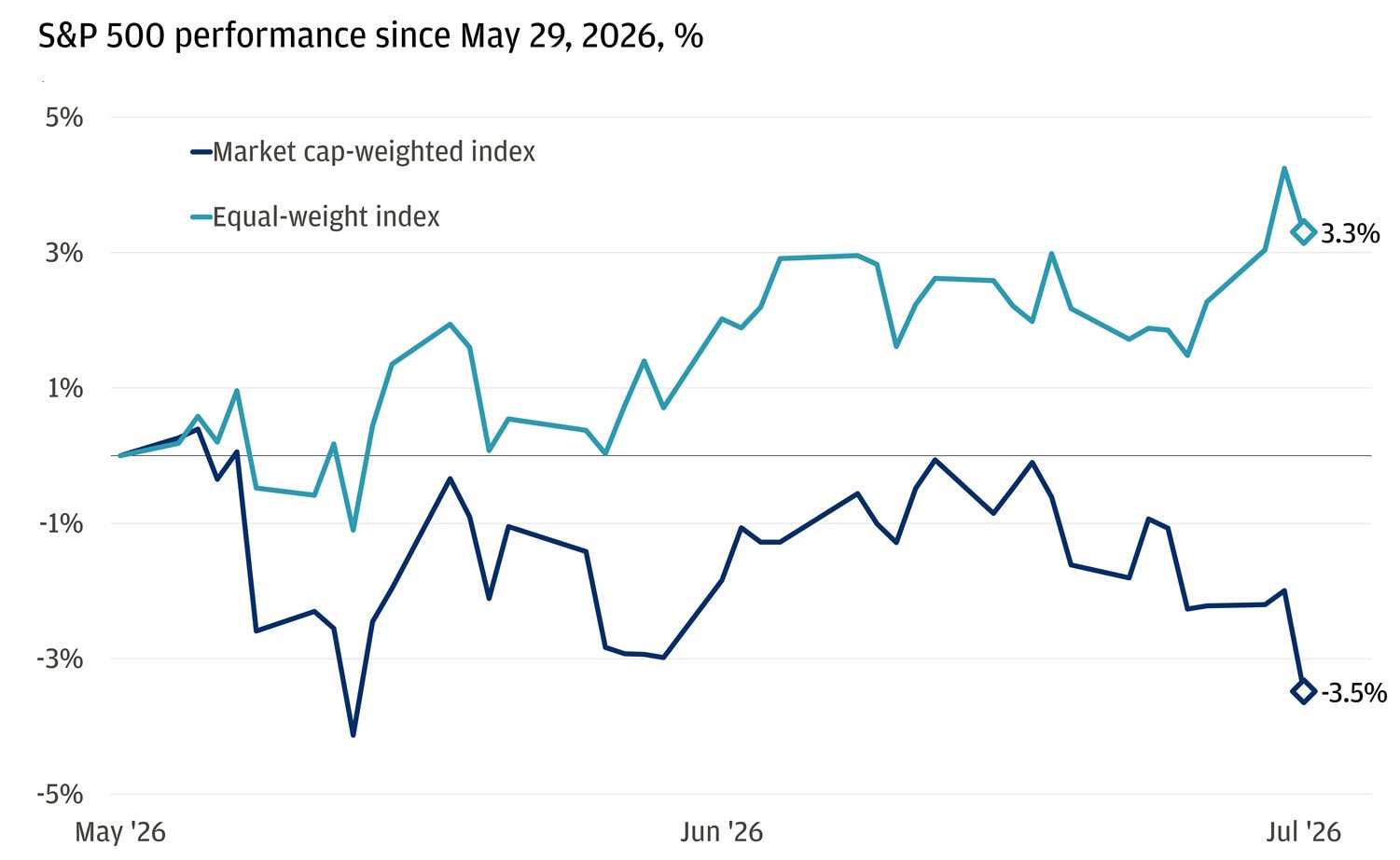
As the S&P 500 sits just below its recent all-time highs, and its equal-weighted counterpart hit a new record, it may seem like the stock market is enjoying some summer calm. But underneath the hood, the market is experiencing one of its most significant rotations in years.
Some of the biggest sector winners from the first half of the year have underperformed in the last month, while underloved sectors have outperformed as capital flows into the laggards and more cyclical stocks. Take chips: the Philadelphia Semiconductor Index has dropped nearly 24% since late June. Over the same period, healthcare and financials have posted gains of about 9% and 5%, respectively.
Tech has dragged while the broader market has gained
Past performance is no guarantee of future results. It is not possible to invest directly in an index.
What looks like a sell-off in technology is actually a repricing of artificial intelligence (AI) economics. Investors still believe AI will reshape the economy, but they are no longer rewarding spending alone. In a world of higher real rates, the market is shifting from pricing potential to demanding proof of profitability. That’s fueling a rotation away from concentrated AI trades and toward other sectors while leaving the broader bull market intact.
From spending to returns
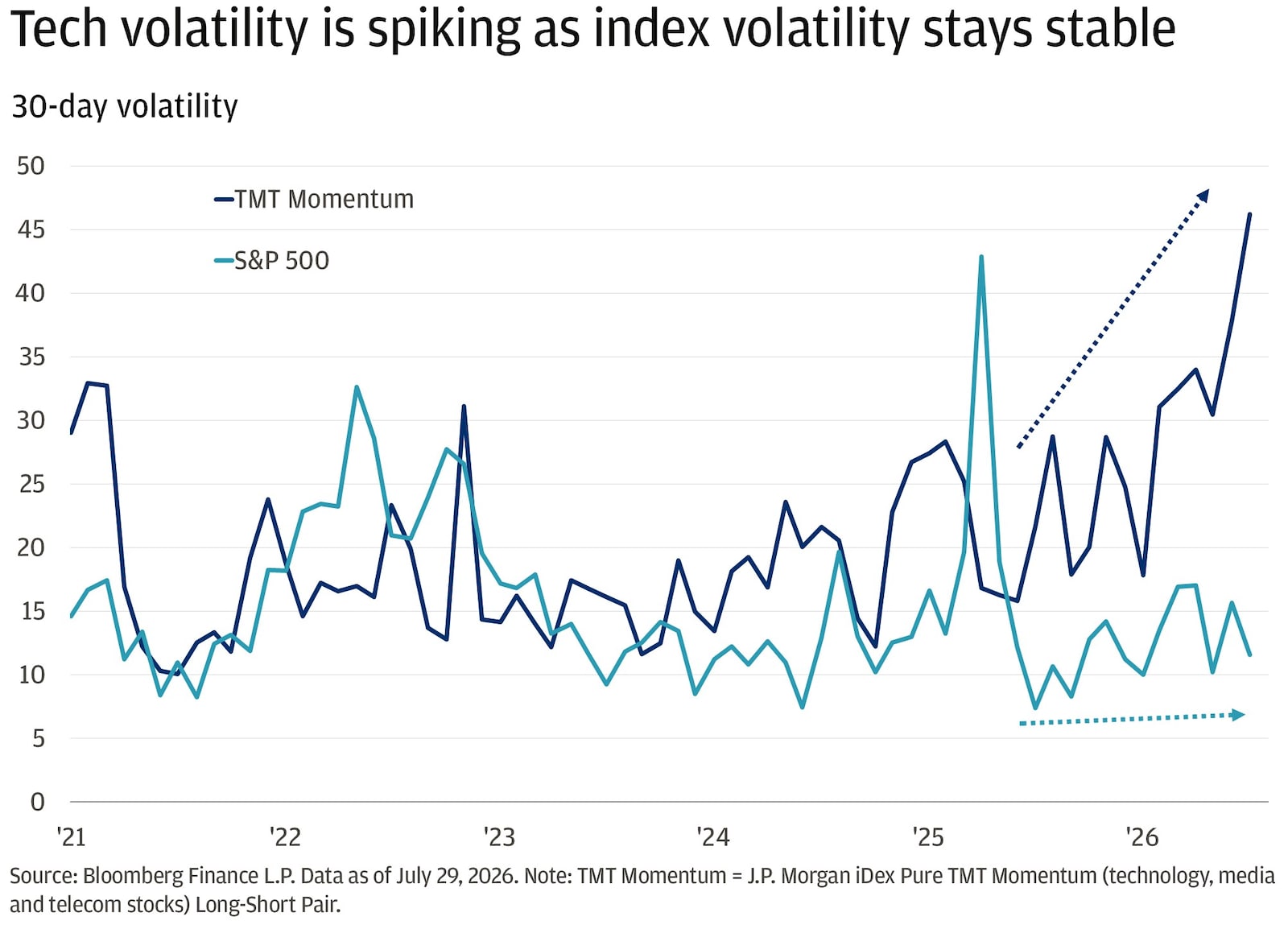
While S&P 500 volatility remains towards the lower end of its historic range, volatility in tech has sharply spiked. With a sell-off driven by crowded positions, fundamental concerns over AI spend and a rising cost of capital, the magnitude of the downside move in technology stocks stands in stark contrast to the momentum-driven gains investors have become accustomed to.
Tech volatility is spiking as index volatility stays stable
Past performance is no guarantee of future results. It is not possible to invest directly in an index.
The market is not suddenly concluding that AI has no economic value. It’s the opposite. The scrutiny is underscoring the inevitability of the innovation becoming a bigger part of the economy and everyday lives, not to mention a key tenet of broader stock market gains.
That acceptance has prompted investors to dissect who captures that value, how quickly it arrives and how much capital must be spent first – especially as competition among frontier models continues to intensify and increasingly capable open-source alternatives emerge. Those questions apply as much to infrastructure providers as they do to the companies funding the buildout.
Ready to take the next step in investing?
We offer $0 commission online trades, intuitive investing tools and a range of advisor services, so you can take control of your financial future.
A higher cost of capital
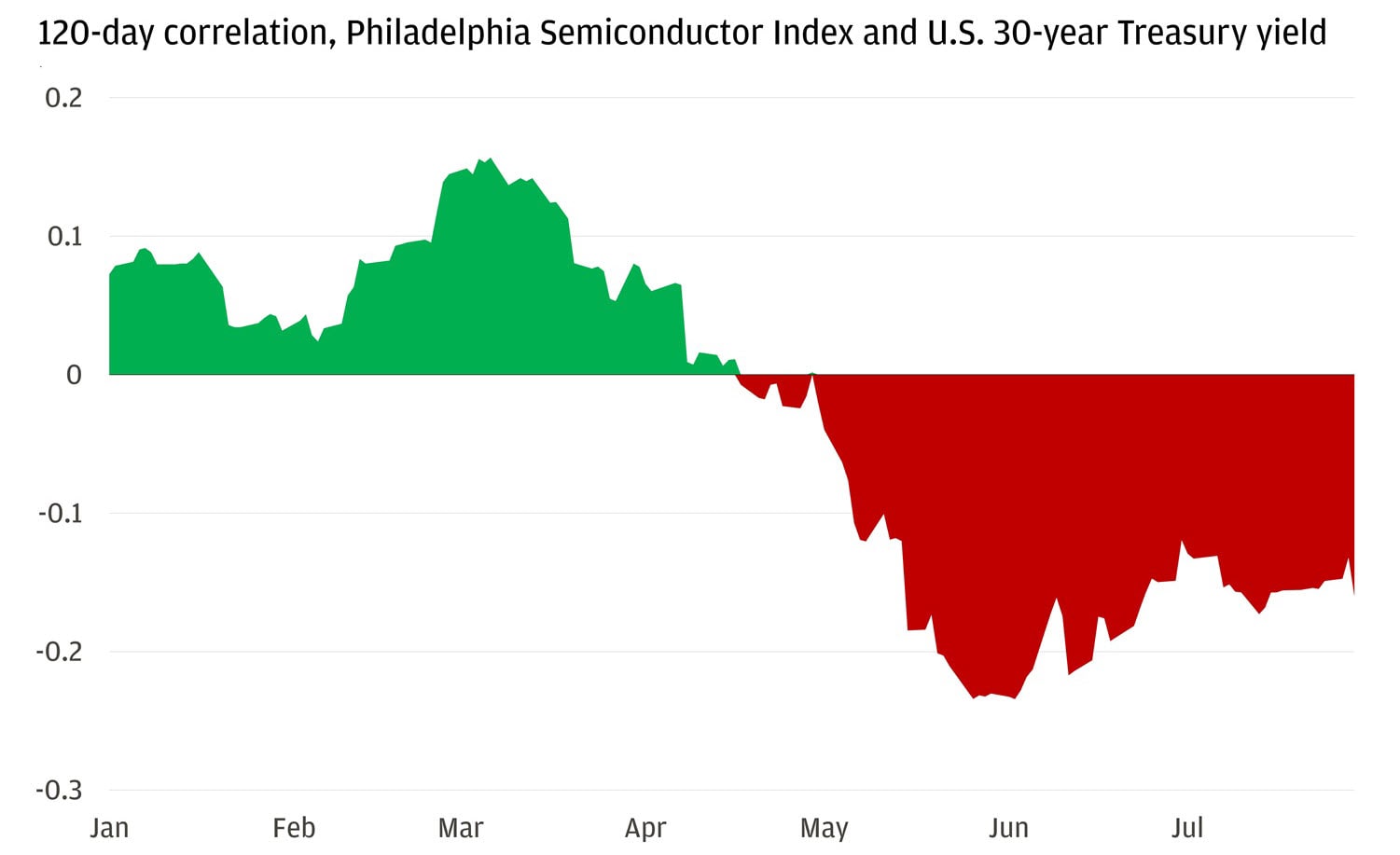
As investors digest skepticism in tech, potential change in the rates regime is also playing a role in the rotation. When rates rise, long-duration growth assets become more vulnerable. Technology falls into that category, as capital expenditures and earnings are modeled on a longer time horizon. In this macro backdrop, where the tone of the Federal Reserve has changed, that means sensitivity to rates has increased.
Momentum within the AI complex peaked shortly after the Federal Reserve adopted a more hawkish tone in Chair Warsh’s June debut. Ten-year real yields have moved 27 basis points over a span of six weeks. Whether driven by monetary policy expectations, rising energy prices or geopolitical uncertainty, higher real rates can create a difficult environment for long-duration growth assets. The math is straightforward: when discount rates rise, future earnings become less valuable today. It is no coincidence that some of the most speculative and heavily leveraged beneficiaries of the AI theme, including data-center operators and neo-cloud companies, have experienced the sharpest declines.
Semis are exhibiting sensitivity to long-end rates
Past performance is no guarantee of future results. It is not possible to invest directly in an index.
What ultimately stabilizes the trade is proof that AI spending is translating into measurable business outcomes. There is already evidence of that as productivity-driven margin expansion across corporate America emerges. More and more companies have begun guiding toward similar improvements, but the market is demanding broader confirmation.
Equally important is the return of positive earnings reactions. One defining feature of recent weeks has been companies beating expectations only to see their stocks fall. When strong results once again lead to higher share prices, it will mark one signal that investors are willing to reward fundamentals rather than simply reduce exposure and reposition.
This is a reset, not a reckoning. The AI theme is unlikely to disappear, but the market is transitioning from rewarding investment to demanding proof of returns while also balancing a shifting rate regime.
All market and economic data as of 07/31/2026 are sourced from Bloomberg Finance L.P. and FactSet unless otherwise stated.
You're invited to subscribe to our newsletters
We'll send you the latest market news, investing insights and more when you subscribe to our newsletters.