When will the Fed hike? It doesn’t matter

Executive Director, Global Investment Strategist, J.P. Morgan Private Bank

It’s a game of will they or won’t they. Will the Federal Reserve (Fed) hike interest rates? Will it hold them? When is a rate hike coming? It may not matter for investors betting on a continued stock market rally.
What matters more than whether or not the Fed hikes – or even when – is how much. As long as the central bank doesn’t raise interest rates more than two times in the next year, risk assets are likely to remain resilient.
What’s priced in?
Investors are still expecting one rate hike by the end of the year, with the potential for another in the next 12 months.
Odds of an interest rate hike in September have drifted lower after the July Consumer Price Index (CPI) report was in line with expectations at 3.4%. And after two back-to-back labor market and inflation reports that came in softer than expected, the chances of a meaningful hiking cycle (designed to combat an overheating economy) have substantially dropped.
In the two most recent rate-hiking cycles, the Fed raised interest rates by 225 basis points between 2015 and 2018 and over 500 basis points from 2022 to 2023. Driven by the rate change alongside a variety of other factors, the stock market saw over 20% drawdowns in the midst of those cycles.
A repeat of that margin of rate hikes and consequential market sell-off is highly unlikely in today’s macroeconomic environment. But it’s only natural for investors to be cautious of the impact of these expectations.
What would a 25-basis-point rate hike priced into market expectations do to market returns – if it were to materialize?
Ready to take the next step in investing?
We offer $0 commission online trades, intuitive investing tools and a range of advisor services, so you can take control of your financial future.
Measuring impact
Using the two most recent Fed-induced sell-offs in late 2018 and 2022 as a case study, the S&P 500 dropped about 20% and 28%, respectively. The average of the two episodes shows an S&P 500 decline of 3.3% per 25-basis-point rate hike. But, as the table below shows, most markets have already moved on par or higher than the implied move since mid-June. In other words, it’s already priced in.
Peak-to-trough moves in 2018 and 2022 vs. recent moves
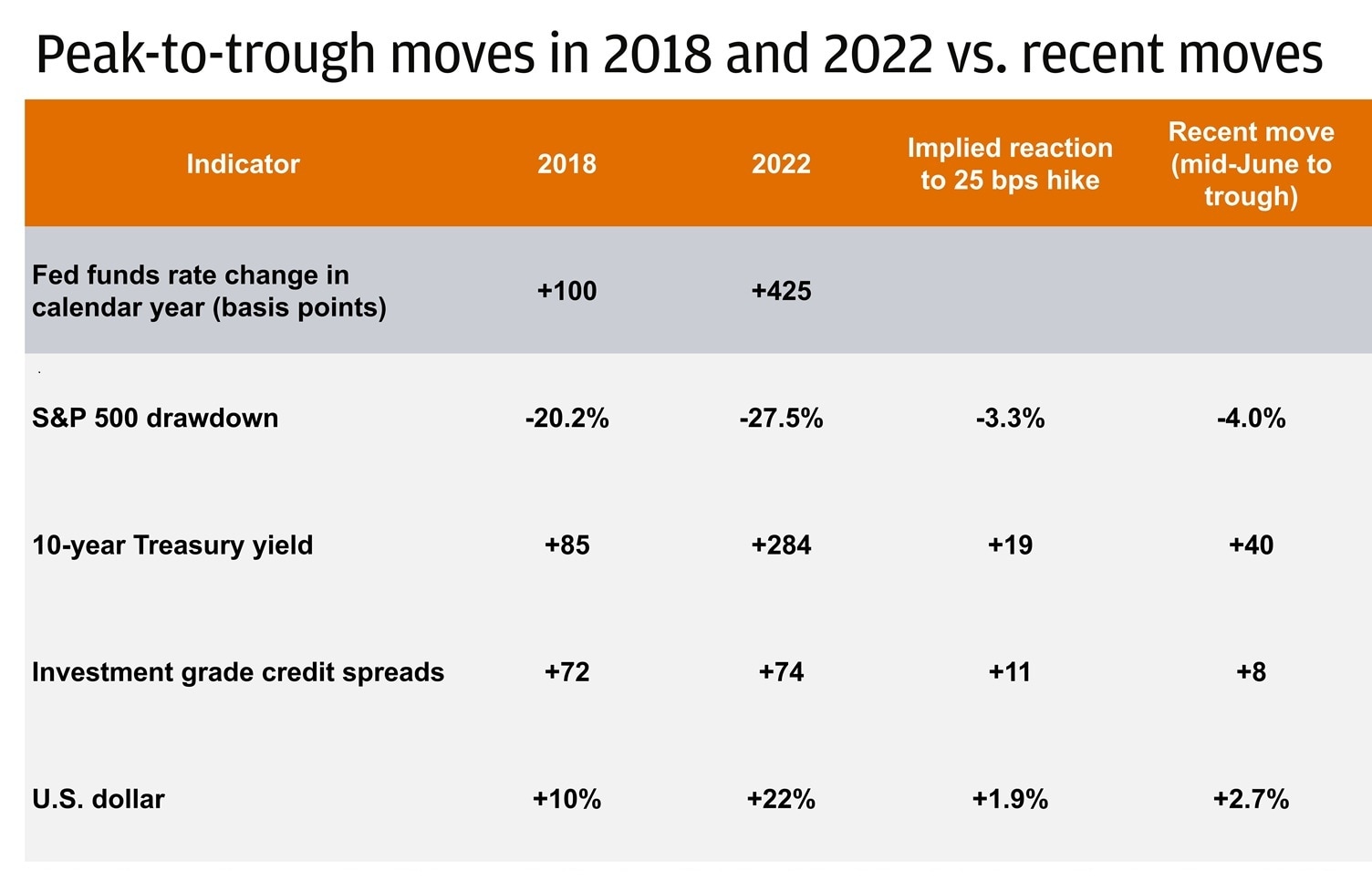
Even assuming a larger 5% pullback in response to a 25-basis-point hike, it’s worth noting the S&P 500 has seen pullbacks of 5% on average three times per year since the global financial crisis in 2008. They’re very common. And since mid-June of this year – when rate hike expectations first began to get priced into financial markets – the stock market has already seen a pullback of approximately 4%. While some of that move is due to concerns around artificial intelligence (AI) monetization and corporate earnings, the reaction is also partially linked to a change in bond pricing.
And that’s just in the stock market. When taking into account that the impact would be spread across asset classes, it could mean an even smaller reaction in the S&P 500. Furthermore, over time, financial markets have become much less sensitive to rate changes. That’s why the margin and the messaging ahead of time matters more than the hike itself: to give investors a chance to digest the move before it happens.
Note, that this is a very simplistic calculation and there are a multitude of factors that go into determining how any financial market will react and digest a change from the Fed.
As a result, dividing the drawdown by realized hikes could overstate the importance of each individual 25-basis-point move in that cycle. But the exercise stands to show what kind of move (even at its largest) can be expected. Other factors could include how much of the change in monetary policy was communicated and telegraphed in advance and how large of a rate hike is delivered (it hasn’t always come in 25-basis-point increments).
This is all to say interest rate changes could come at some point. And with macroeconomic developments and fresh jobs and inflation data, the timing can shift. But the impact remains digestible, as long as the Fed doesn’t change monetary policy by more than the market is already expecting.
All market and economic data as of 08/13/2026 are sourced from Bloomberg Finance L.P. and FactSet unless otherwise stated.
You're invited to subscribe to our newsletters
We'll send you the latest market news, investing insights and more when you subscribe to our newsletters.