Toto, I don’t think it’s the Fed anymore

Executive Director, Global Investment Strategist, J.P. Morgan Private Bank

By: Kriti Gupta and Nick Roberts
The upward march in bond yields continues to drive the market narrative, but the logic has shifted. The move began in the early summer with a Federal Reserve (Fed) that investors initially perceived as hawkish, but a series of softer jobs and inflation reports has cast it in a different light. Now, the drivers look a little different: They’re a combination of worries around global fiscal deficits, an increase in hyperscaler issuance and a rise in refined product prices. And that’s on top of U.S. economic growth.
Breaking down the drivers
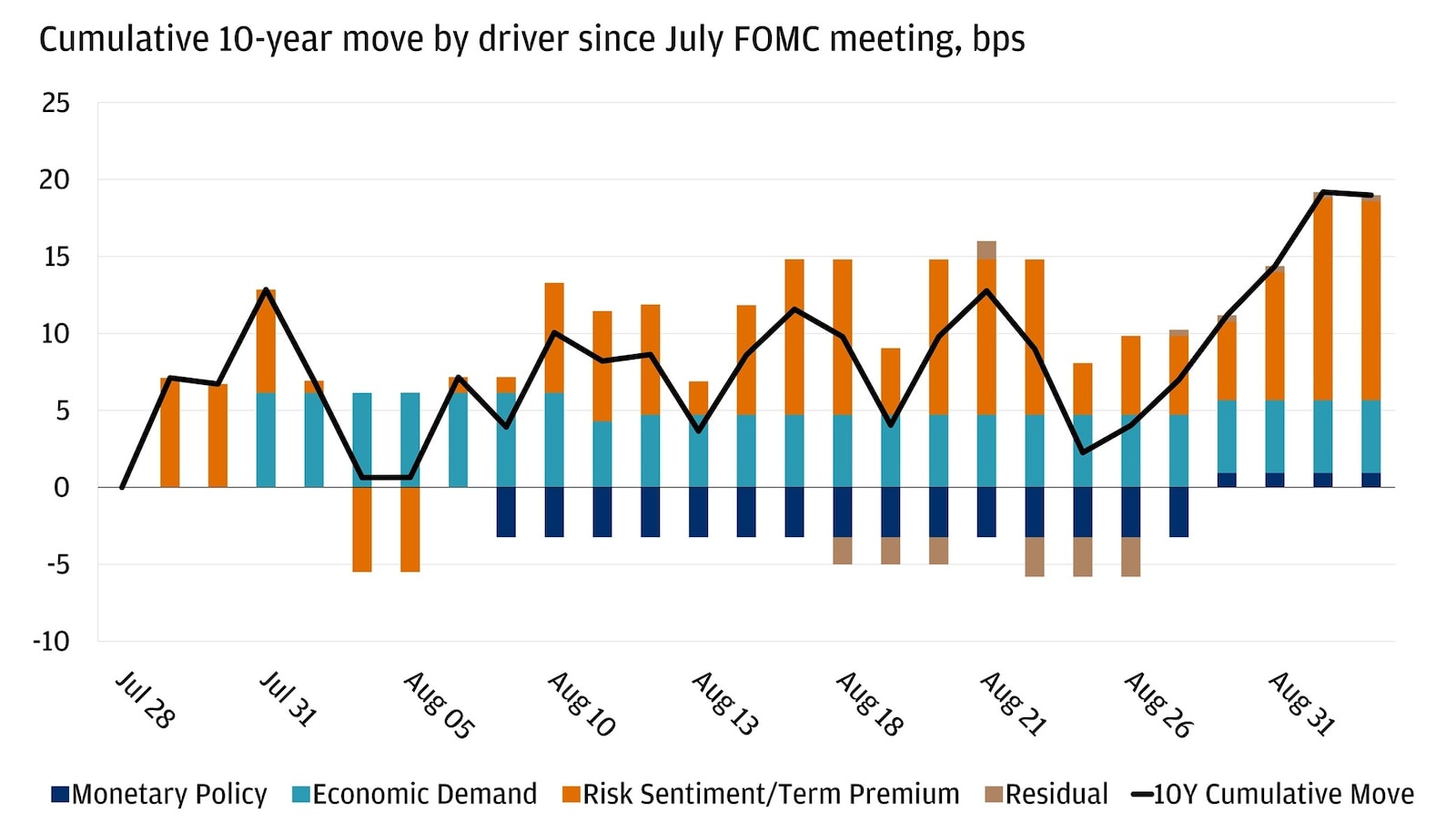
Using a sign-restriction model that determines the drivers of Treasury yields on any given day based on how yields behave relative to inflation expectations, the dollar and equity markets, different combinations can help distinguish whether higher yields reflect stronger growth, rising term premiums or changing expectations for monetary policy.
Since the July meeting of the Federal Open Market Committee (FOMC), by far the greatest driver of higher yields has been an increase in term premium – the extra compensation investors demand to hold longer-dated government debt amid elevated uncertainty. Second to that, it’s robust economic activity. Notably, and in contrast to most media narratives, upward pressure from explicitly more hawkish monetary policy hasn’t been a factor.
Risk sentiment and term premium drive the 10-year
But what’s behind the jump in term premium?
Ready to take the next step in investing?
We offer $0 commission online trades, intuitive investing tools and a range of advisor services, so you can take control of your financial future.
Energy is the culprit
The U.S. 30-year Treasury yield has risen over 20 basis points since the July FOMC meeting. At the same time, Brent crude has risen approximately 13% in response to developments in the Middle East.
On the surface, rangebound oil prices six months into the conflict in Iran haven’t spooked markets in the same way they did in March. Even with escalation in the Middle East conflict, Brent crude has traded within a range of $80 to $100 per barrel, to which both financial markets and the economy have adapted. Instead, the pressure is building underneath the hood – in the refined products space.
Whereas oil and gasoline prices have risen 32% and 37%, respectively, since the conflict began, diesel and jet fuel have risen by much more – by 50% and 60%, respectively. The problem is that the United States, although oil-rich and currently the largest producer and exporter of oil in the world, primarily has light crude.
American refineries, largely built to convert heavy crude into those refined products, are nearing their maximum capacity. So even though light crude is readily available, it doesn’t necessarily alleviate the rising prices of those refined products, or the potential readthrough into more consumer-facing products like airfares.
The relationship has created a synergy between refining margins and bond yields. As investors measure the impact of the conflict, the building relationship shows pressure in that part of the commodities market is starting to align with the move in bond yields.
Long-end yields move with refined product prices
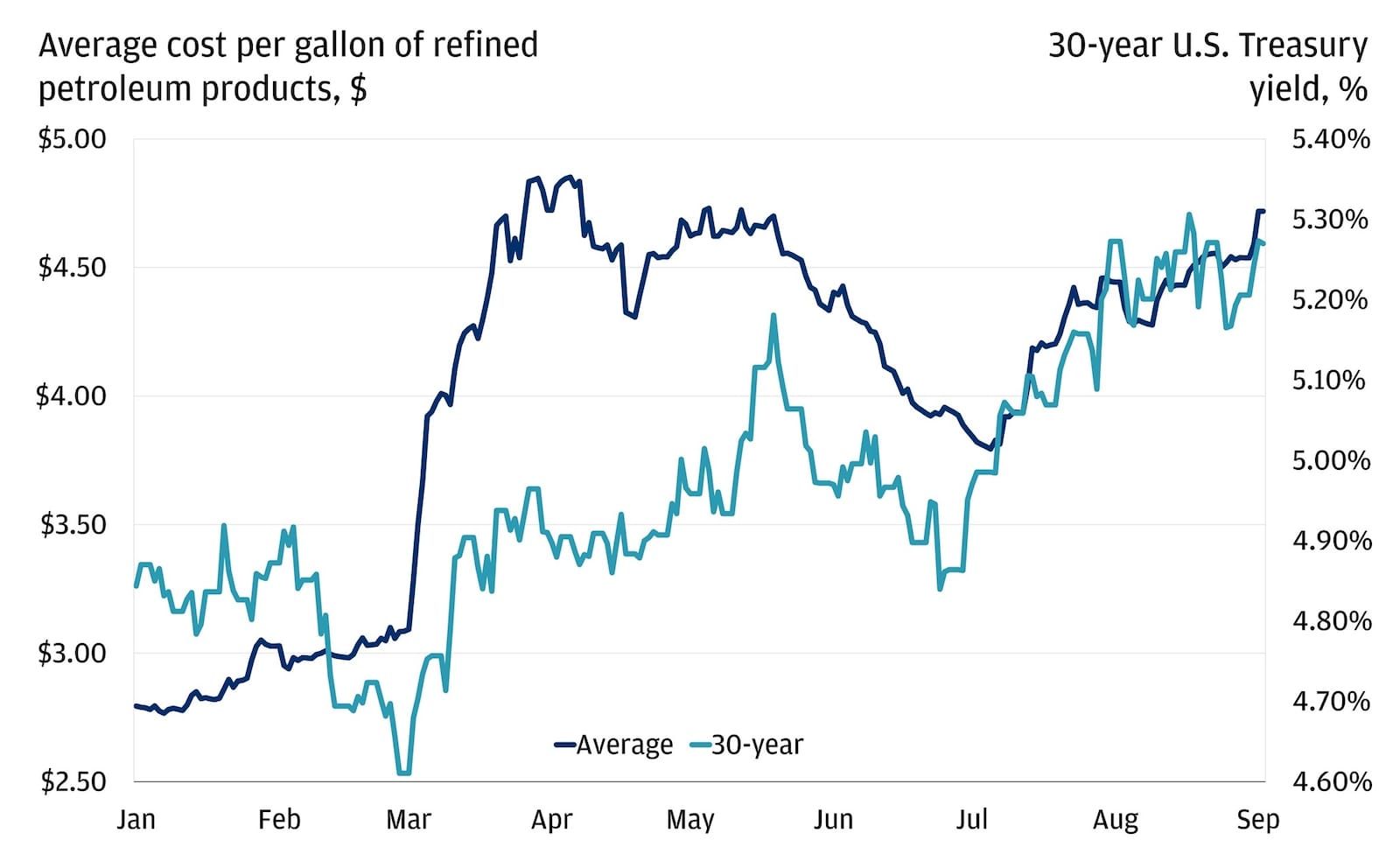
Higher energy prices across products are not necessarily signaling an imminent downturn. Instead, they’re reinforcing a market environment where growth remains firm enough to support consumer resilience and spending. That’s partially why term premiums have continued to rise.
The stock market readthrough
For equity investors, the key risk is not necessarily higher oil prices but higher discount rates that materialize quickly rather than gradually – especially as autumn approaches and the stock market faces what has historically been stocks’ weakest month of the year.
Seasonality is often dismissed as market folklore, but many calendar effects are rooted in predictable flows. Tax deadlines, pension contributions, portfolio rebalancing, corporate buybacks and options expiries all occur on known schedules, creating recurring shifts in liquidity and investor positioning. These dynamics rarely drive markets on their own, but they can amplify existing trends – like the effect of a move in bond yields – and tend to set the final quarter of the year up for gains.
The recent rise in bond yields is a reminder that not all inflation risks originate with monetary policy. Growing pressure in refined products markets, alongside resilient economic activity and higher term premiums, suggests the bond market and its effects across other financial spheres are responding to a broader set of forces than simply the path of Fed rate cuts.
All market and economic data as of 09/02/2026 are sourced from Bloomberg Finance L.P. and FactSet unless otherwise stated.
You're invited to subscribe to our newsletters
We'll send you the latest market news, investing insights and more when you subscribe to our newsletters.