Market concentration in 2026: Are you less diversified than you think? Consider whether to rebalance

Editorial Staff, J.P. Morgan Wealth Management
- In a market being driven by a handful of stocks, your portfolio may be less diversified than you think, even if you own multiple funds.
- Market-cap-weighted indexes can become top-heavy when a small group of high performers grows fast.
- You don’t necessarily need to abandon growth to manage concentration risk: You can reduce overlap by rebalancing intentionally.

If the stock market is being driven by a handful of companies, are you less diversified than you think? You might be, especially if your portfolio is heavily exposed to the same mega-cap names or one high-flying sector.
Simply owning funds doesn’t automatically protect you from concentration risk. Mutual funds and exchange-traded funds (ETFs) can overlap in meaningful ways, so a portfolio that looks diversified by ticker symbol may still rise and fall with the same group of stocks.
That’s why it’s important to understand what concentration risk is, how it shows up in markets today and what history suggests can follow. Plus, you can learn practical ways to rebalance without abandoning growth.
What is concentration risk – and why it matters for everyday investors
Concentration risk occurs when a large portion of your portfolio is invested in a single stock, sector, asset class, industry or geographic region. This can increase the risk of loss.
Among the most common types is security concentration, where investors have outsized exposure to just a few names (even indirectly through funds). Another is sector or style concentration, where investors heavily tilt to a single sector (like tech) or style (like growth or mega-cap stocks).
A common trap is the “diversification illusion,” where owning several funds can still mean owning the same underlying exposures. That overlap can lead to unintentional concentration in the same stocks, sectors or investing styles. Many popular funds hold many of the same names. For example, owning an index fund that tracks the S&P 500 and also owning a large-cap growth fund may leave you heavily tilted to the same mega-cap leaders unless you examine what each fund actually owns.
Many major benchmarks today are weighted by market capitalization, which means a company’s weight can climb as its stock rises. When a small set of stocks surges, indexes and portfolios built around those companies can become more concentrated over time. That’s one reason market concentration tends to increase during certain cycles and why it’s worth looking at today’s environment in historical context.
Get up to $1,000
When you open a J.P. Morgan Self-Directed Investing account, you get a trading experience that puts you in control and up to $1,000 in cash bonus.
Market concentration in 2026
Cap-weighted indexes mechanically allocate more to high performers as they grow: If a given company’s market value rises relative to others, it will subsequently account for a larger “slice of the pie.” Each company within the index makes up a different slice of the whole, with its size shifting based on the ups and downs of the market or through periodic index rebalancing.
Our strategists believe that today’s market environment can be understood through the lens of an ongoing artificial intelligence (AI) capital expenditure supercycle, where massive spending on the technology has helped drive corporate earnings and equities higher. Roughly 50% of the S&P 500 is exposed to AI in some capacity today. And what’s more, forecasts call for S&P 500 companies that are using the technology to achieve greater margin expansion over the next year than those not leveraging AI.
If market leadership is restricted to a handful of stocks or a particular sector leading gains, a concentrated position may boost returns. At the same time, that concentration increases vulnerability, especially if market leadership reverses, meaning you could be on the hook for intensified losses.
How today’s market concentration compares with history
Looking back at U.S. stock market data, there have been other periods of high concentration. Concentration – as measured by the overall market share of the top 10 U.S. stocks – peaked in 1932 at more than 35% following the stock market crash of 1929, which led to the Great Depression. During the following decades, the weight of the top 10 stocks regularly exceeded 25% of overall market value until the bear market of the 1970s. It wasn’t until the late-1990s tech bubble that concentration once again passed 20% before coming back down after the bubble popped in March 2000.
After peaks, outcomes have varied – sometimes leadership broadened, sometimes markets corrected and sometimes concentration persisted. While previous data can offer insight into market patterns and risks, investors may want to remember that historical lookbacks are not forecasts.
Historical market share of the top 10 U.S. stocks
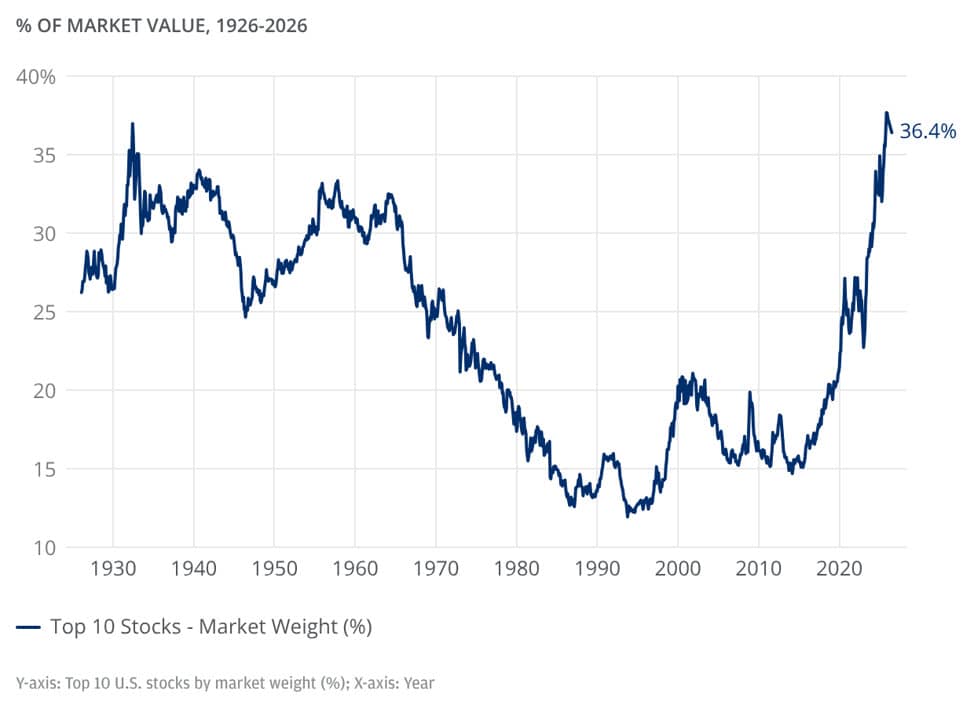
When concentration starts to ease, it often happens in one of two ways. Broadening means more stocks and sectors begin contributing to returns – often described as improving “market breadth,” or wider participation beyond just a few large names. Mean reversion is a theory that describes lagging areas catching up and recent leaders cooling off, reflecting the tendency of some measures to move back toward longer-run averages over time. That shift can make diversification feel more valuable than it did during a narrow, leader-driven run-up.
The ‘Magnificent Seven’ effect: How a handful of tech giants shape index performance
In recent years, market leadership has become increasingly tied to the group known as the “Magnificent Seven” – a handful of mega-cap companies whose size and performance can move major indexes.
The Magnificent Seven encompasses seven tech giants whose share prices have had outsized influence on markets: NVIDIA, Apple, Microsoft, Alphabet (Google), Amazon, Meta and Tesla. By the end of 2025, these seven stocks accounted for 31.7% of the entire S&P 500’s market value.
Because many investors own S&P 500 and total market funds, concentration in Magnificent Seven stocks can show up in everyday portfolios. Even investors who believe they’re broadly diversified may find they have sizable exposure to the same mega-cap names through multiple funds.
It’s also worth noting that these companies aren’t carbon copies of one another. They span different business models – hardware, software, cloud services, e-commerce and digital advertising – but their stocks can still react to similar forces, such as interest rate expectations, growth sentiment and the market’s appetite for risk.
How to tell if you’re overconcentrated – and what to do about it
To manage concentration risk, review your portfolio as a whole, not just one fund at a time. Start with your top holdings and sector breakdowns, then look for overlap across funds and accounts. Fund holdings can change, so use the most recent fact sheets or holdings pages when you do this check. And consider the following questions:
- Do my top 10 holdings repeat across funds? Consider reducing redundant funds if multiple products are giving you the same top holdings.
- Is my portfolio overly dependent on one sector or style? You may want to set target exposures you actually want (by stock/bond mix, region and style) so you’re not letting the market set them for you.
- Am I diversified across asset classes? You can rebalance with a rule (calendar-based or threshold-based), and consider taxes/transaction costs before making changes in taxable accounts.
Common mistakes to avoid when managing concentration risk
Managing concentration risk is often less about designing the perfect portfolio and more about avoiding preventable behavior mistakes.
Some common mistakes may include:
- Chasing what just worked (doubling down on leaders at peak enthusiasm)
- Overcorrecting (selling everything growth-related and creating a new concentration elsewhere)
- Ignoring costs and taxes (turnover, short-term gains, wash sale rules if tax-loss harvesting is part of your strategy)
The bottom line
Concentration risk can be accidental: You may own multiple funds and still be heavily exposed to the same stocks or sectors. The practical fix is to look through your holdings, decide what concentration you actually intend to take and rebalance in a way that widens your exposures.
Diversification can’t prevent losses, but it can reduce the chance that a single crowded corner of the market dictates your results, especially if you revisit your portfolio periodically as markets (and fund holdings) change. Investing involves risk, so factor in your time horizon, liquidity needs and taxes before you act, and consider speaking with a financial professional for more guidance.
Frequently asked questions about concentration risk
Compare the holdings of each ETF or mutual fund (start with the biggest positions and sector weights), and note how many names and exposures repeat across both.
Funds that are weighted by market capitalization allocate more to the most valuable companies, while equal-weighted funds spread weight more evenly. Which type is less risky often depends: Equal-weight funds can reduce single-stock concentration but may also bring higher turnover, costs and different performance swings.
A common approach is to rebalance on a set schedule, such as annually or semiannually. It may also be wise to rebalance when allocations drift beyond preset thresholds, though investors may want to consider taxes and transaction costs before trading.
Invest your way
Not working with us yet? Find a J.P. Morgan Advisor or explore ways to invest online.