The ‘Magnificent Seven’ effect: How the top handful of stocks reshaped the S&P 500

Global Investment Strategist
- AI is reshaping the S&P 500 because it is shifting where capital spending, profits and investor attention are concentrating across the economy – particularly among the “Magnificent Seven” (Alphabet, Amazon, Apple, Meta, Microsoft, NVIDIA and Tesla).
- While a more top-heavy index isn’t necessarily a problem, “owning the market” via a concentrated index fund can mean owning a smaller set of powerful themes than many investors realize.
- When it comes to potential concentration, don’t overhaul your long-term plans; instead, evaluate for overlap across investments, keep diversification intentional and stay invested through inevitable periods of volatility.

Every few decades, a technology wave changes more than just the products people use. It changes what businesses build, where profits collect and what investors are willing to pay up for. The internet did it. Smartphones did it. And now, artificial intelligence (AI) is doing it again. The story isn’t just that “software is getting smarter.” It also involves a very physical buildout of chips, data centers, networking equipment and power infrastructure.
When a trend becomes large enough in business investment and earnings growth, markets tend to reflect it. Over time, that shows up in two places at once: major indexes and real-world portfolios. Index weights can become more top-heavy, and investors’ portfolios can become more concentrated than they were intended to be – especially when investors own multiple U.S. equity funds whose holdings of the same “tech-plus” leaders overlap.
That overlap is important because it changes how “being diversified” feels in practice. A concentrated portfolio may still hold a wide range of stocks and funds, but outcomes can be driven by a narrower set of themes. The point here isn’t to make investors nervous; it’s to make the drivers of risk and return easier to see, so staying invested is simpler when markets get noisy.
Index concentration: What it means (and why it can surprise investors)
When it comes to investments, concentration refers to how much of an index (or a portfolio) is accounted for by its largest holdings. The S&P 500 is market-cap weighted, meaning larger companies receive larger weights and therefore have more influence on index returns.
As concentration rises within a smaller group of companies, or around one dominant theme, market performance can become more sensitive to what happens among those names. A helpful analogy can be a soccer team that relies on a single star player to score most of its goals: When that player is on the field, the team may be a heavy favorite to win. But if that player has an off day, gets injured or retires, the entire team’s results can change quickly.
Concentration isn’t necessarily good or bad, but it can help inform investors what is driving the moves in their portfolios. Understanding that dynamic helps explain why AI has had such a significant impact on the market’s composition in recent years.
Interested in working with an advisor?
Work 1:1 with our advisors to help build a personalized financial strategy that’s built around you.
How AI is reshaping the S&P 500
The growth of AI has become one of the defining investment stories of this decade. What began as excitement around a new technology is increasingly becoming a story about capital expenditure (capex), competitive advantage and earnings.
While a few names – many of which may make up the “Magnificent Seven” – may get the most headlines, AI’s impact on markets extends beyond a single stock or even a narrow definition of “technology.” Indeed, the larger AI ecosystem comprises semiconductors, cloud infrastructure, networking equipment, data centers, software and the companies building the physical capacity behind it all.
As investors have rewarded the companies they believe are positioned to benefit from these trends, those companies have become larger and more valuable; as a result, they have grown to occupy a larger share of the market itself. As of July 2026, the top 10 S&P 500 companies represent roughly 38% of the index’s total market cap, exceeding the dot-com era leaders by about 10 percentage points.
The S&P 500’s top 10 companies represent nearly 40% of market cap
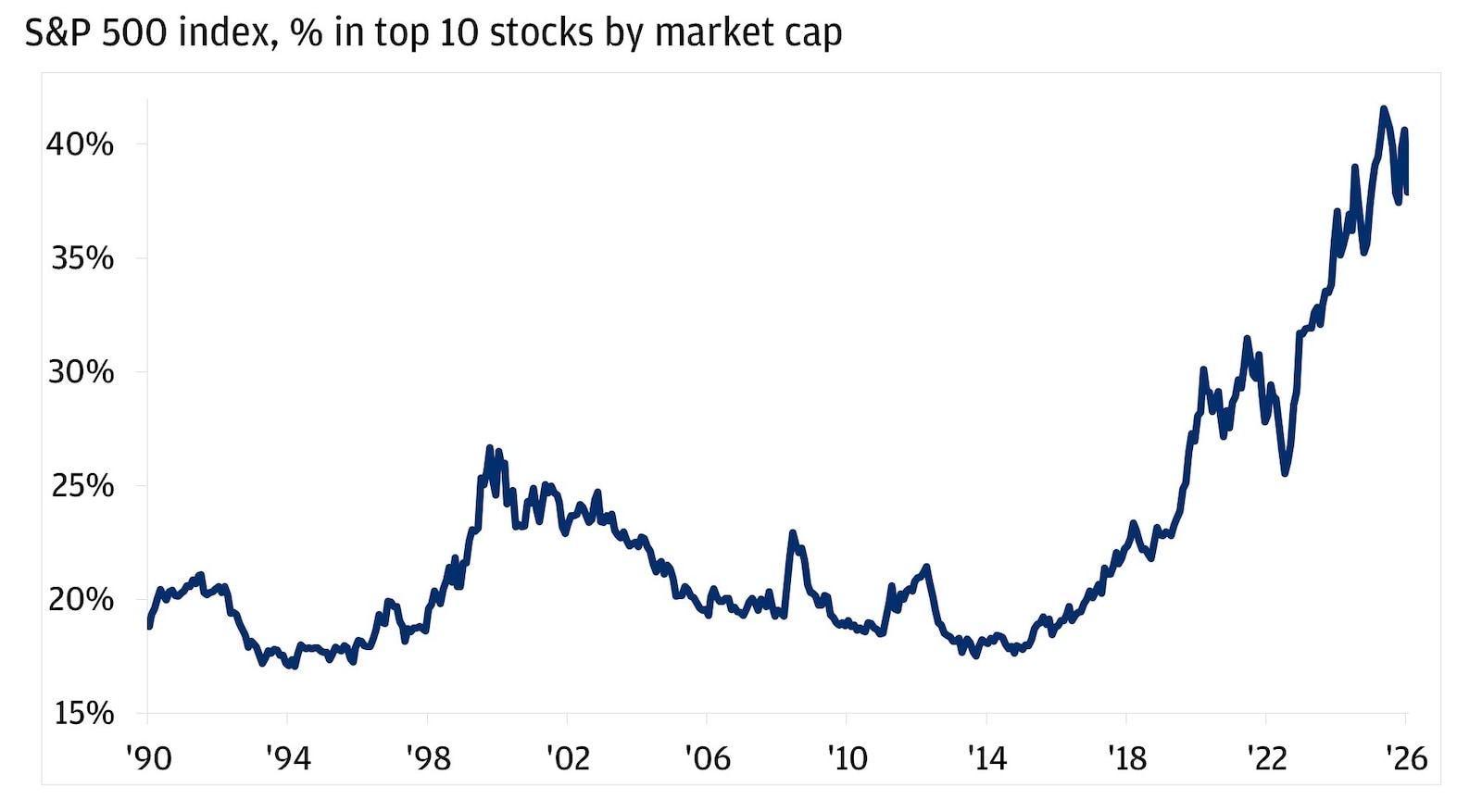
When an index is heavily weighted in a few companies, returns can potentially be more sensitive to what happens among the biggest holdings and the themes most associated with them.
Concentration isn’t automatically a warning sign
When exposure is concentrated in any single theme or a handful of companies, it can potentially create an unintended risk for some investors. However, concentration itself isn’t a reason to abandon a certain trade. We think a better question to focus on is why leadership has narrowed and whether that is being supported by fundamentals.
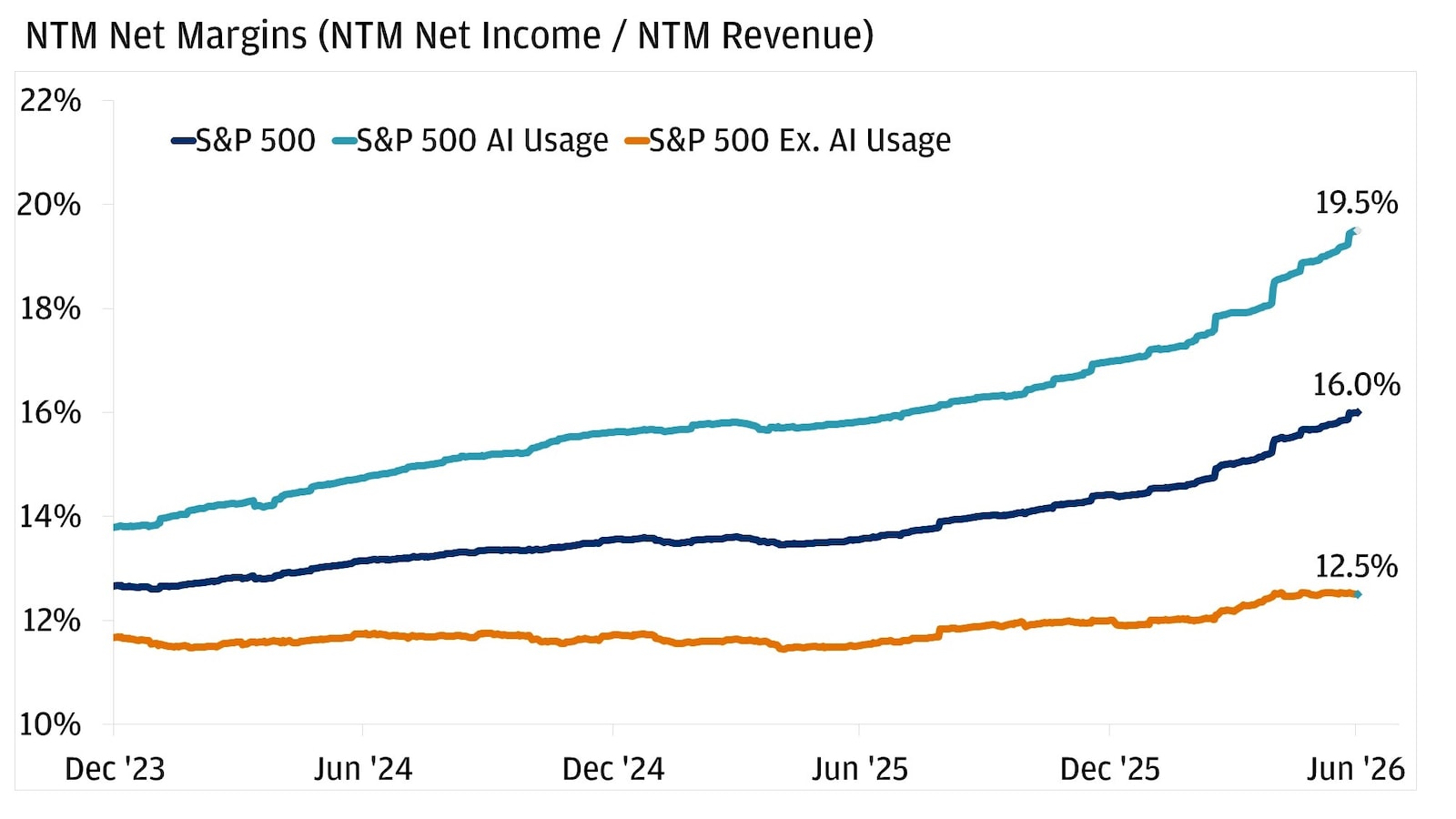
Our view is that today’s environment can be understood through the lens of a continued “AI capex supercycle,” a spending surge on the technology and its infrastructure that is supporting corporate earnings and helping drive equity markets higher. We also believe that AI is contributing to margin expansion and profitability, which can help explain why some investors are paying close attention to the theme.
S&P 500 companies that are deemed AI users are seeing an accelerated pickup in next-12-month margins (19.5%) compared with the overall S&P 500 (16%) and those not leveraging the technology (12.5%). This could be a signal that AI is helping enhance actual company productivity and profitability, not just hype.
AI adopters are outpacing the pack in profitability
The bottom line: What concentration can mean for portfolios
It’s important to note that concentration doesn’t stop at the index level. Many investors own U.S. equities across several different investment vehicles and accounts. When multiple holdings have the same large underlying positions, the overall portfolio can potentially be more concentrated than it may seem.
A portfolio heavily allocated to any single theme, not just AI, can end up with outcomes tied to a smaller set of shared drivers and be less diversified than the investor initially intended. When market leaders outperform, a more top-heavy index can benefit investors. When leaders stumble, the index can feel more sensitive. The takeaway shouldn’t be to avoid the market’s winners but to understand how much of a portfolio depends on them – and to make sure that exposure matches time horizon and comfort with volatility.
Concentration is not a reason to abandon a long-term plan. However, it can be a reason to evaluate what you own and to ensure that your portfolio is diversified according to your risk tolerance and overall strategy. Often, an effective first step for investors is to find clarity: looking at top holdings across accounts, identifying potential overlap and confirming that the portfolio still reflects the investor’s goals.
Invest your way
Not working with us yet? Find a J.P. Morgan Advisor or explore ways to invest online.