Rates, war and AI: 3 of the biggest questions facing markets right now

Global Investment Strategist
- Rising Treasury yields and conflict in the Middle East have contributed to periods of market volatility, but we continue to believe the most likely outcome is eventual de-escalation and that current yields may be attractive for some fixed-income investors.
- The AI investment cycle remains robust. Backlog growth, cloud revenue growth and capital spending all suggest demand continues to support the massive buildout underway.
- While the Magnificent 7 now accounts for roughly one-third of the S&P 500, earnings growth and earnings beats suggest the benefits of today's market themes are extending beyond just a handful of companies.

While market headlines have changed throughout 2026, the main questions on investors’ minds have remained largely consistent: How does the ongoing conflict in the Middle East affect the economic outlook? Will the massive artificial intelligence (AI) investment cycle pay off? And are market gains concentrated among a select group of companies, or is there a broader story at play?
These questions can help explain why markets may feel sensitive in the near term. However, when zooming out, the S&P 500 is sitting just shy of its all-time high, even amid the increase in yields, geopolitical tensions and ongoing uncertainty.
Markets are paying attention to rates again
One of the predominant market stories this summer has been moves in the bond market, particularly the rise in long-term Treasury yields. Following the 30-year Treasury yield hitting a near 20-year high last week, the U.S. Treasury announced plans to double its buyback operation to at least $4 billion, likely to help ease some market concerns. Treasury buybacks can help improve liquidity in the bond market by allowing the government to repurchase older securities, potentially putting downward pressure on yields as demand increases.
Yields on long-dated Treasuries are important because they can influence mortgage costs, business investment and what investors are willing to pay for stocks. Higher yields can increase equity volatility because they can affect both the economy and investor behavior. Higher borrowing costs weigh on economic activity, while higher Treasury yields may provide some investors with an alternative to stocks that can offer attractive returns with less relative risk.
Several factors have contributed to the 10- and 30-year Treasury yields’ near-decade highs, including increasing government borrowing needs, strong demand for capital tied to AI investment and shifting global investment flows.
The ongoing Iran conflict has also played a role in rising yields and uncertainty this year. The Middle East is a major oil-producing region, and if geopolitical conflict disrupts oil supply – like we’ve seen so far this year as traffic through the Strait of Hormuz has collapsed – oil prices can spike. Higher oil prices can lead to higher inflation expectations, which sometimes push yields higher as investors demand more compensation for inflation risk.
Importantly, we continue to believe the most likely outcome is eventual de-escalation. While additional flare-ups are possible, we do not believe a prolonged disruption to global energy markets is the likeliest scenario. We believe current yields may present an attractive entry point for investors holding excess cash or who remain underallocated to fixed income based on their goals and time horizon.
From an equity market perspective, we know that geopolitical events have historically created near-term volatility. While each event is unique, history suggests their impact on long-term returns tends to be short-lived.
The S&P 500 has rallied more than 10% since breakout of Middle East conflict
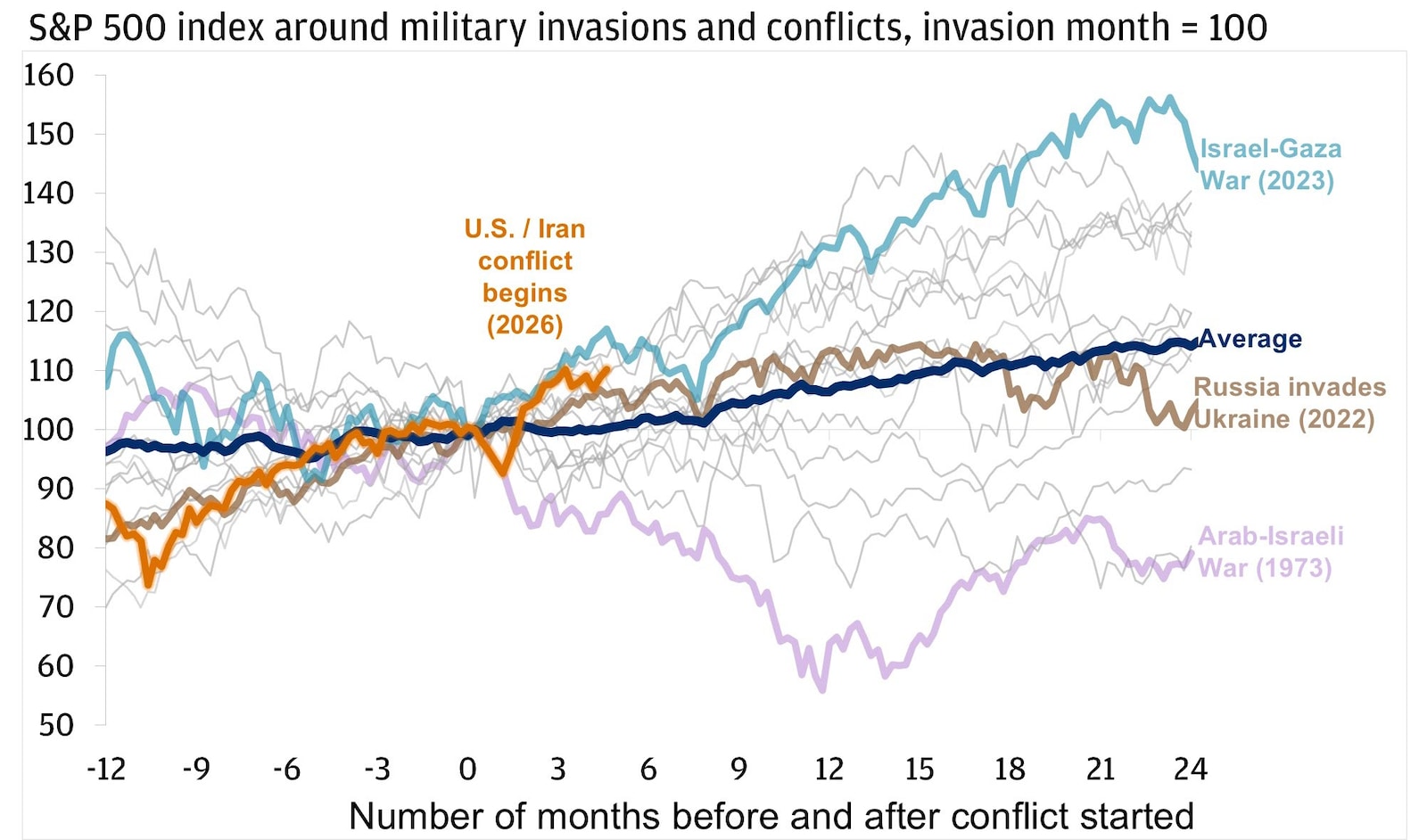
Investors have seen that trend play out in recent months. While conflict flare-ups have created volatility, the S&P 500 has rallied nearly 12% since the start of the Middle East conflict and almost 21% since March lows.
Interested in working with an advisor?
Work 1:1 with our advisors to help build a personalized financial strategy that’s built around you.
Is AI starting to deliver?
One of the biggest drivers of the market's rebound since the March 2026 lows has been the technology sector, which has rallied more than 40%. That rally may suggest growing investor confidence in one of the market's most important themes: AI, which is fueling one of the largest corporate investment cycles in decades.
Current estimates suggest the five largest hyperscalers will spend nearly $800 billion in 2026 and more than $1 trillion in 2027 to build the infrastructure needed to support AI. Those investments span everything from semiconductors and data centers to cloud infrastructure and computing power.
Given the scale of spending, many investors are increasingly asking: When does the payoff finally arrive?
One way to think about the AI buildout is as a three-stage process. First comes the investment itself. Companies spend heavily on chips, cloud infrastructure and data centers. Next comes demand for those services. One measure of that demand is backlog, or future business that has already been contracted but not yet delivered. Finally, that demand must translate into actual revenue growth. We believe the evidence is encouraging so far.
Backlog for the major hyperscalers increased more than 150% year over year in the second quarter, suggesting demand for AI-related services continues to accelerate even faster than capital spending, which grew 94%. At the same time, cloud revenue increased 51%.
Accelerating blacklog and revenue growth supports hyperscaler capex intentions
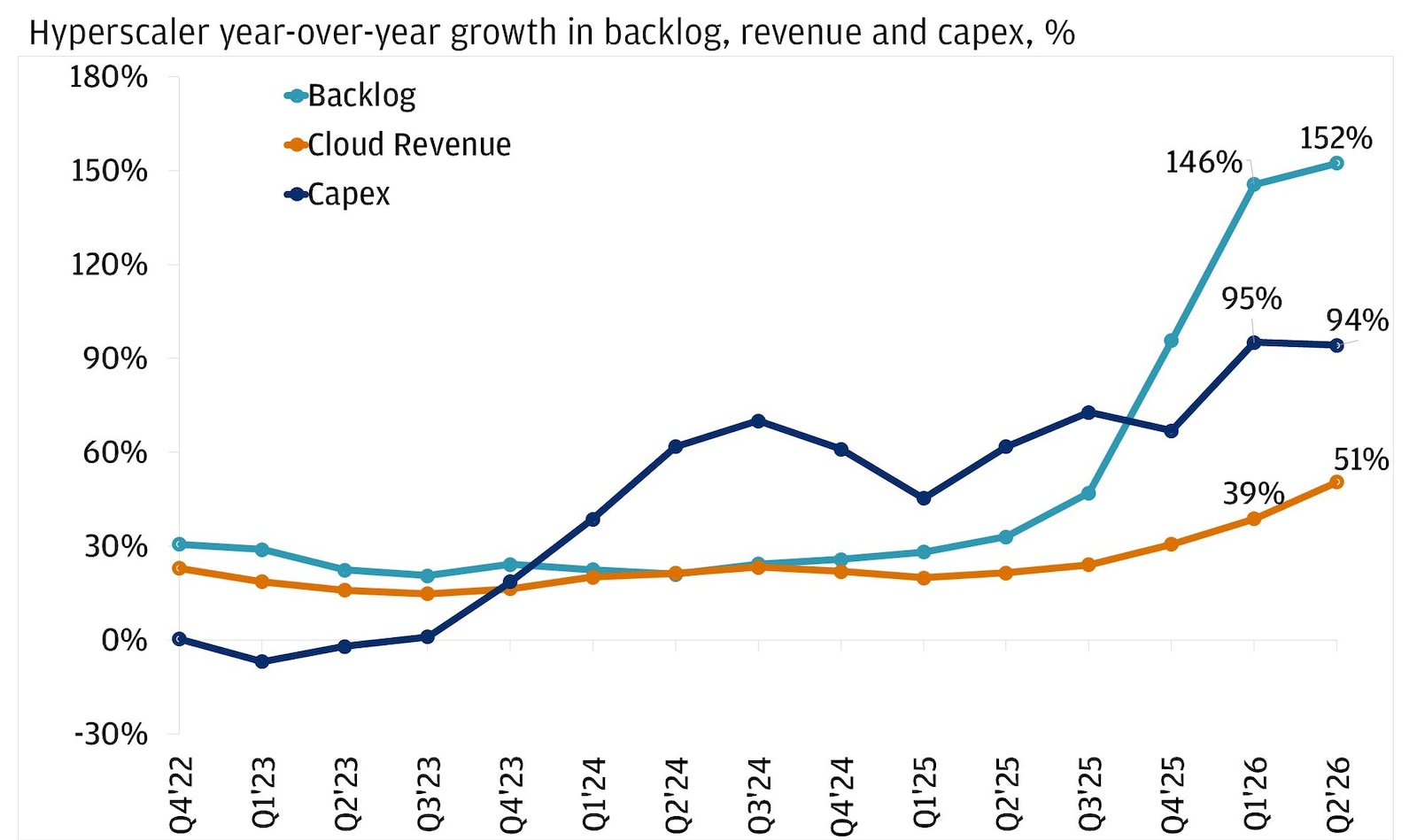
Together, those numbers can tell an important story. Demand is growing faster than spending, which can help support the case that AI infrastructure is being built to meet real customer demand rather than speculative future demand. If spending was surging while anticipated demand remained weak, concerns about overspending could be justified. Instead, customers appear to be lining up for AI-related infrastructure and cloud services, while revenue growth is beginning to accelerate alongside that anticipated demand.
That doesn't mean investors have stopped asking tough questions. Semiconductor stocks – some of the biggest beneficiaries of the AI boom – experienced a sharp correction earlier this summer as investors reassessed the timing and magnitude of future returns.
Still, we continue to believe AI remains one of the strongest growth stories in the market today, supported by rising investment, expanding adoption and strong indicators of future demand.
Is there a broader story behind market gains?
A popular discussion among investors today is market concentration. When a relatively small group of companies becomes such a large part of the market, it can create the impression that the broader market is struggling to keep up.
The concentration story is real. As of early August, the Magnificent 7 – a group of the largest S&P 500 companies by market capitalization – accounted for roughly 32% of the S&P 500's market cap, up from around 10% in 2016. Their scale, profitability and leadership have helped drive a significant and increasing share of the index’s performance over the past several years.
Rather than focusing solely on market concentration, we think it makes sense to focus on earnings. Over time, earnings growth tends to be one of the most important drivers of stock market returns.
As of writing, over 90% of S&P 500 companies have released their second-quarter earnings, reporting remarkable numbers across the board. Approximately 85% of S&P 500 companies have exceeded their earnings expectations, a result that is broadly distributed across sectors – not just the Magnificent 7 companies or even the technology sector.
% of S&P 500 companies beating earnings are above average
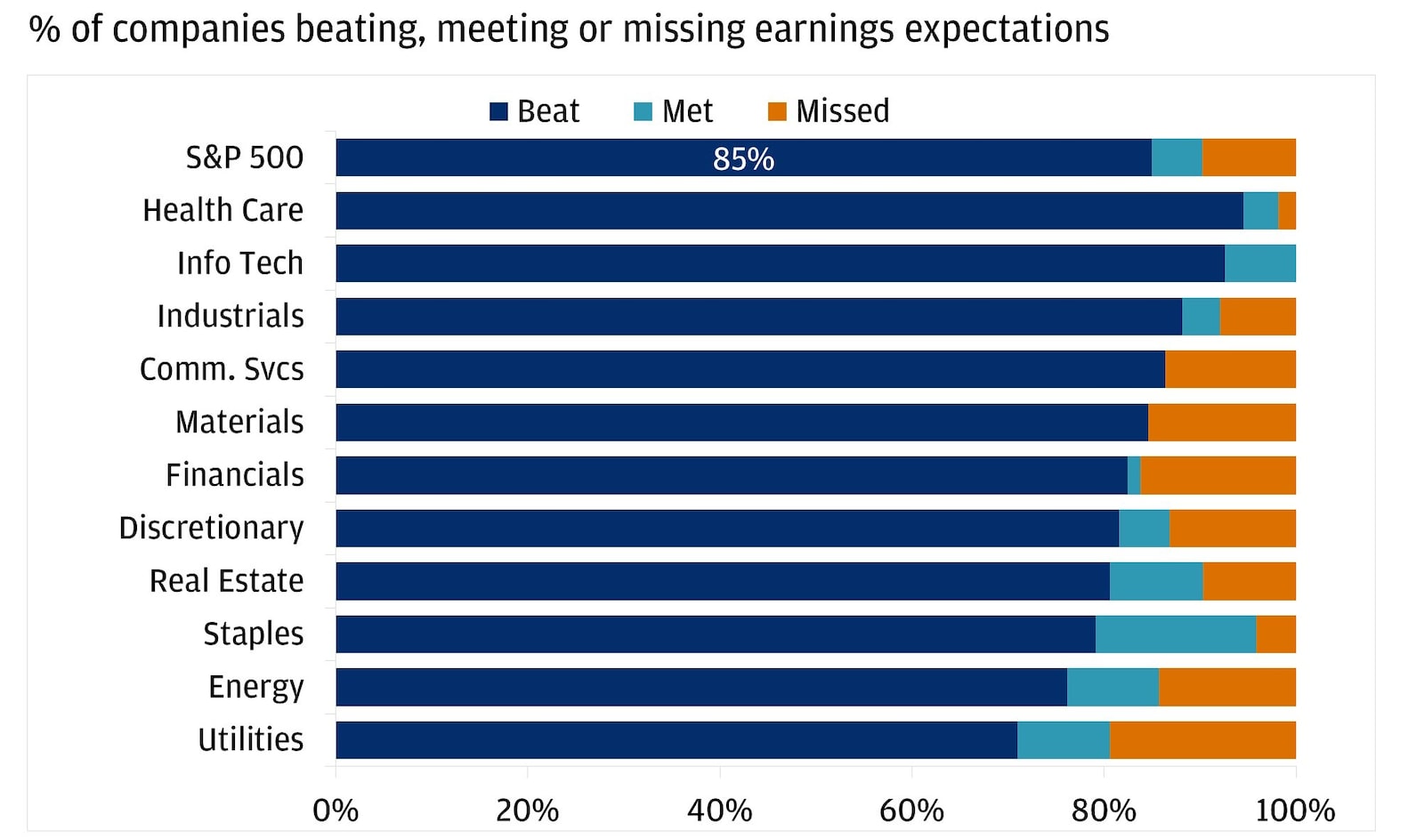
While market concentration remains elevated, corporate earnings growth appears broadly distributed across sectors, suggesting a wider range of companies are participating in the current expansion.
Even more encouraging, median earnings growth for the typical S&P 500 company accelerated to roughly 14% in the first half of 2026, compared with a long-term average of 8.4%. That can be a positive signal because it suggests the earnings story extends well beyond a small handful of mega-cap technology companies.
In many ways, that can reflect some of the themes discussed earlier. While AI investment may be led by hyperscalers and semiconductor companies, the effects are increasingly spreading through the broader economy. Utilities are helping meet rising power demand from data centers, industrial companies are supplying equipment and infrastructure, and software firms continue integrating AI capabilities into their products and services.
The Magnificent 7 may still be leading the story, but they don't appear to be the only companies benefiting from it.
For investors, that's an important distinction. Concentration may remain elevated, but the earnings picture under the surface appears considerably broader than headlines may suggest.
The bottom line
Markets and investors have spent much of 2026 digesting three themes: higher yields, the buildout of AI and market concentration.
In the near term, rates and geopolitics may remain sources of volatility, but beneath that daily noise, investors should continue focusing on the areas that tend to matter most over time: earnings growth and innovation.
So far, the evidence is encouraging. AI investment continues to be supported by strong demand, corporate earnings are growing at an above-average pace and participation appears broader than the headlines may suggest.
The headlines will likely keep changing, but the broader themes driving them may not. As long-term investors, understanding those themes may prove more valuable than trying to predict the market's next move.
Invest your way
Not working with us yet? Find a J.P. Morgan Advisor or explore ways to invest online.