Here’s how the value of the US dollar is calculated – and why it matters

Editorial staff, J.P. Morgan Wealth Management
- The value of the U.S. dollar reflects how strong the currency is relative to other currencies and is shaped by economic conditions, policy decisions and global demand.
- Measures such as exchange rates and the Broad Dollar Index are commonly used to track changes in the dollar’s value over time.
- Movements in the dollar’s value affect inflation, trade, investment returns and everyday costs for consumers.

Have you ever wondered what makes the U.S. dollar (USD) rise or fall in value? Several important factors affect the value of the dollar, among them U.S. policy decisions and the state of the overall economy. So when there’s uncertainty around global trade or interest rates, investors may turn to safe-haven assets like gold, which can increase in price while the dollar falls.
In January 2026, the dollar fell to its lowest level in four years amid geopolitical uncertainty. It was the largest weekly depreciation since President Donald Trump’s tariffs were announced on “Liberation Day” back in April 2025. At the same time, the price of gold hit another all-time high.
The dollar’s value can play a central role in global trade, investing and everyday life, so when this happens, there may be renewed attention to how the dollar’s value is calculated and why it matters.
What does the ‘value' of the US dollar really mean?
When people talk about the value of the dollar, they’re usually referring to its purchasing power relative to other currencies or goods. Unlike stocks, which have a single quoted price, the dollar’s value depends on what it’s being compared against.
It can help to think about the dollar’s value in relation to exchange rates. For example, if one U.S. dollar can buy more euros today than it could last year, then the dollar has strengthened against the euro. If it can buy fewer euros, then the dollar has weakened.
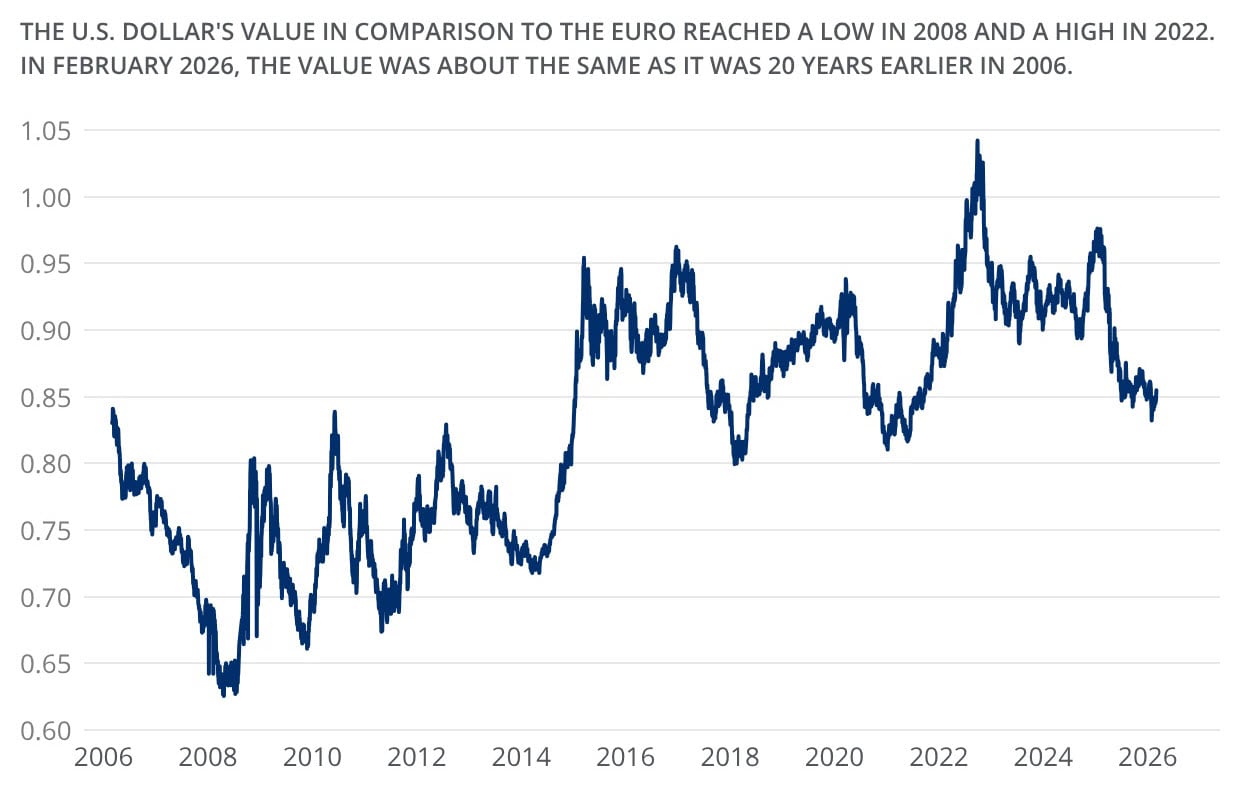
To put this into perspective, on February 27, 2025, $1 could buy about 0.95 euros, according to European Central Bank data. Fast forward to February 27, 2026, and $1 could buy only about 0.85 euros – a roughly 10.7% decrease in the value of the dollar against the euro in just one year.
Get up to $1,000
When you open a J.P. Morgan Self-Directed Investing account, you get a trading experience that puts you in control and up to $1,000 in cash bonus.
How is the US dollar’s value calculated?
There is no single official formula used to calculate the dollar’s value. Instead, economists and market participants rely on several indicators derived from foreign exchange markets, where the dollar’s strength is determined relative to other currencies rather than set by the U.S. government or Federal Reserve (Fed).
The most widely cited measure is the Broad Dollar Index. The index tracks the dollar’s value against the currencies of 26 economies for which bilateral trade accounts for 0.5% or more of total U.S. bilateral trade. When the index rises, it indicates the dollar is strengthening relative to that basket of currencies.
Key factors that can influence the US dollar’s value
Several interconnected forces can influence whether the dollar strengthens or weakens over time.
Interest rates and Fed policy
Interest rates can be one of the most important drivers of currency values. When U.S. interest rates rise relative to those in other countries, dollar-denominated assets can become more attractive to global investors. This increased demand can push the dollar higher. At the same time, the Fed’s monetary policy decisions may influence financial conditions, borrowing costs and capital flows, all of which can affect the dollar’s value.
Inflation and economic growth
Lower inflation and steady economic growth can support a stronger currency, while higher inflation can erode purchasing power and weaken confidence in a currency over time. During periods of high inflation, a strong dollar can help ease inflationary pressures by lowering import prices and, in some cases, tightening financial conditions that temper demand.
Trade balances
The U.S. trade balance reflects the difference between exports and imports. A strong dollar can result in a trade deficit. In such a scenario, foreign-made goods tend to become cheaper for Americans to import, while American-made goods tend to become more expensive for foreign buyers; this can result in higher imports and lower exports. Large trade deficits can put downward pressure on the dollar if more dollars flow overseas to pay for imports.
Global demand for US assets
The dollar can benefit from strong global demand for U.S. Treasury securities, stocks and other financial assets. For example, U.S. Treasury bonds are widely viewed as a safer investment by many financial institutions and central banks around the world, as these bonds are backed by the U.S. government and the U.S. dollar is the world’s dominant reserve currency. The demand this view creates allows the United States to borrow money at lower interest rates and thus can strengthen the U.S. dollar.
Geopolitical events and market sentiment
Geopolitical uncertainty, regional conflicts and even widespread shifts in risk appetite can also influence the dollar’s value. Investors may seek the dollar as a safe haven during global crises, which was the case at the onset of the COVID-19 pandemic. Additionally, shifts in U.S. monetary or fiscal policy – by the Fed or the Treasury, respectively – may also weigh on the value of the dollar.
US dollar highs and lows
The value of the U.S. dollar has experienced significant ups and downs over time. Let’s look at the past 20 years, from 2006 to 2026. The dollar was worth about 0.84 euros in 2006, before dropping below 0.65 in 2008 during the global financial crisis.
For about six years, the dollar’s value bounced between 0.65 and 0.85 euros. The dollar climbed to over 0.95 euros in 2015, maintaining that strength until 2018 when it pulled back. In 2020, during the COVID-19 pandemic, investors sought safety and liquidity amid widespread market stress, driving the dollar’s value higher.
Since then, shifts in monetary policy, interest rate differentials and global risk sentiment have continued to drive fluctuations in the dollar’s value. At the start of 2026, the dollar’s value pulled back again, closer to what it was worth back in 2006.
USD/EUR 2006 to 2026
Why the dollar’s value matters for investors
Changes in the dollar’s value have real implications for investors and households alike. Let’s consider some of them.
Inflation, interest rates and asset prices
The dollar’s value can influence inflation by affecting the cost of imported goods, along with how monetary policy decisions translate to people’s wallets. At the same time, changes in interest rates can also affect spending, investment and financial conditions, which in turn can change U.S. asset prices and impact overall economic activity.
Travel, shopping and investing
Changes in the value of the U.S. dollar can have practical effects on travel, everyday spending and investment outcomes. When the dollar is strong, for example, Americans traveling abroad may find their money goes further because foreign currencies cost less in dollar terms. When it comes to shopping, imported goods can also become cheaper for U.S. consumers.
For investors, movements in the value of the dollar can influence returns on international securities. This is because changes in exchange rates affect how income and asset values denominated in foreign currencies translate when converted back into dollars for tax and investment reporting purposes.
The bottom line
The value of the U.S. dollar can be shaped by exchange rates, economic conditions and global demand for U.S. assets. Factors such as interest rates, inflation, trade balances and geopolitical events can play a role in determining whether the dollar strengthens or weakens. Because the U.S. dollar is the world’s dominant reserve currency, changes in its value can ripple through global markets and impact everyday costs for consumers.
Frequently asked questions about the US dollar
The Broad Dollar Index is a measure of the dollar’s value against a basket of 26 major foreign currencies for which bilateral trade accounts for 0.5% or more of total U.S. bilateral trade. The index is commonly used to track whether the dollar is strengthening or weakening over time.
The value of the U.S. dollar changes based on the forces of supply and demand in foreign exchange markets. Ultimately, the value of the dollar can be impacted by economic conditions both in the United States and abroad. Interest rate shifts, inflation, economic growth and geopolitical events can all influence investor demand for dollars.
Changes in the dollar’s value can affect investment returns, especially for assets with international exposure. A stronger dollar can reduce returns on foreign investments when converted back into dollars, while a weaker dollar can boost returns. Currency movements may also influence inflation, interest rates and asset prices more broadly.
Invest your way
Not working with us yet? Find a J.P. Morgan Advisor or explore ways to invest online.