The 10-year Treasury yield hit a 19-year high in September – Why is it so important?

Editorial staff, J.P. Morgan Wealth Management
- The 10-year Treasury yield plays a central role in the economy, influencing mortgage rates, borrowing costs and the behavior of financial markets.
- Movements in the yield reflect shifting expectations around inflation, economic growth and interest rate policy, not just bond market activity.
- For investors, the 10-year yield is best used as a reference, offering insight on market conditions and risk, rather than signaling whether to buy or sell.

If it feels like the 10-year Treasury yield has become a fixture in financial headlines, there’s a reason for that. As investors navigate lingering inflation concerns, shifting market expectations around Federal Reserve policy and questions about economic growth, moves in the 10-year Treasury yield are closely watched, as it can impact mortgage rates, stock prices and broader financial conditions.
At its core, the 10-year Treasury yield reflects the annualized return an investor earns by holding a 10-year U.S. Treasury note to maturity, based on its current market price. The yield helps shape long-term borrowing costs across the economy, offers insight into how investors view inflation and growth, and even serves as a reference point for market risk.
The 10-year Treasury yield can act as a window into a broader economic outlook. Here’s what you need to know about the yield, what it signals about the economy, how it affects financial markets and why it can be a useful tool for investors trying to make sense of an uncertain economic environment.
What is the 10-year Treasury yield?
Very simply, the 10-year Treasury yield is the annualized return an investor earns by holding a 10-year U.S. Treasury note to maturity, based on its current market price. These notes, which are issued by the U.S. Department of the Treasury, are widely viewed as one of the safest instruments in which to invest money because they are backed by the “full faith and credit of the U.S. government."
Also important for investors to understand is how the 10-year Treasury yield typically behaves. Treasury prices and yields move in opposite directions. When investors rush to purchase Treasuries, prices rise and yields fall. When investors move money elsewhere, Treasury prices drop and yields rise. The 10-year yield reflects how investors feel about inflation, economic growth and where interest rates may be headed over the long term. That’s why it’s often treated as a barometer for broader economic expectations, not just a return on government debt.
The influence of the 10-year Treasury yield shows up in very real ways. For example, long-term borrowing costs across the economy – especially mortgage rates – tend to follow the 10-year yield. When the yield rises, 30-year fixed mortgage rates also typically climb, making the cost to borrow money to buy a home more expensive. When the yield falls, borrowing may become more affordable, which can help boost the housing market and consumer spending.
That’s why the yield on the 10-year Treasury note can be important to people who may never buy a bond – they may still feel the impact when they take out a loan or refinance their mortgage.
Get up to $1,000
When you open a J.P. Morgan Self-Directed Investing account, you get a trading experience that puts you in control and up to $1,000 in cash bonus.
10-year Treasury yield, January 1, 2000-September 23, 2026
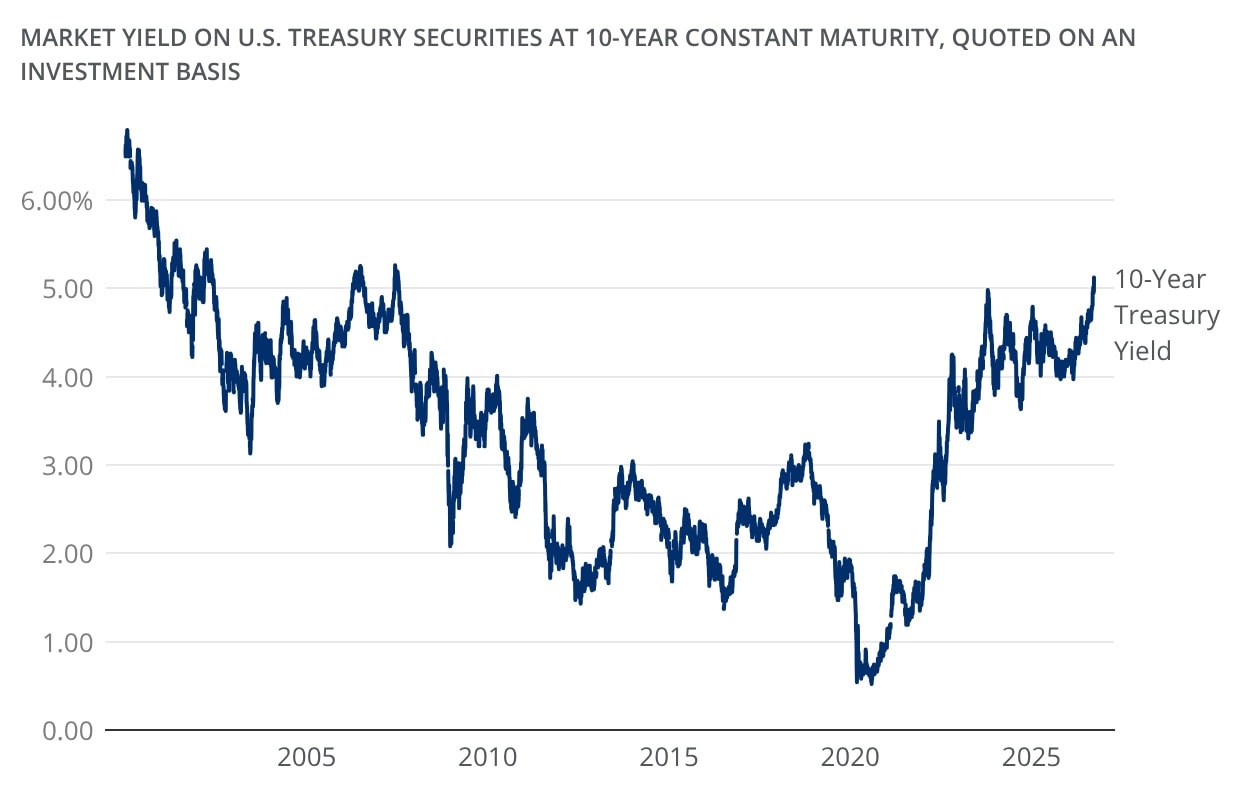
When you look at the period of January 2000 to September 23, 2026, it’s easy to see how the 10-year yield reacted to major economic disruptions. After the dot-com bubble burst in the early 2000s and during the 2008 financial crisis, one reason yields fell could be that investors sought out safer assets over those that are seen as riskier, such as equities.
The same pattern reappeared in 2020. As the COVID-19 pandemic disrupted the global economy, investors sought safety, pushing the 10-year Treasury yield to historic lows. In contrast, persistent inflation and correspondingly aggressive rate hikes by the Federal Reserve in 2022 and 2023 caused existing bonds to lose market value as investors tried to sell their old bonds with lower yields for newer bonds paying higher yields. And then in 2025, when the Fed began cutting rates, 10-year Treasury yields increased – and that was unusual since history suggests that the yield typically falls after a Fed rate cut.
In 2026, after the Fed hiked rates in September to combat stubborn inflation, the 10-year Treasury yield continued to climb, hitting a high of 5.116% on September 23, a rate not seen since 2007.
What does the 10-year Treasury yield tell investors about the economy?
The 10-year yield is a gauge of the economic outlook and investor confidence. Rising yields generally suggest optimism about growth or concern about inflation. Falling yields tend to signal caution, slower growth expectations or rising recession risk, and a move toward safer investment options.
The yield also plays a key role in discussions about the yield curve, or the relationship between short-term and long-term interest rates. When short-term rates rise above long-term rates, the result is what’s known as an inverted yield curve.
The yield curve can become inverted when investors grow concerned about slowing economic growth, prompting them to buy long-term Treasuries to lock in current rates before they decline. That demand pushes long-term yields below short-term yields.
These inversions have preceded the past eight recessions in the United States, along with many global downturns, making them a closely watched indicator for potential economic challenges ahead. However, the method isn’t foolproof; there have been two “false positives” that did not lead to a U.S. recession, in 1966 and again in 1998. Nonetheless, this relationship helps explain why investors watch the 10-year yield so closely.
What is the 10-year Treasury yield’s impact on financial markets?
The reach of the 10-year yield extends well beyond bonds, and changes in Treasury yields can ripple through multiple parts of the financial system. In stock markets, higher yields can pressure valuations by increasing borrowing costs and reducing the present value of future earnings. Growth-oriented stocks are often the most sensitive, since much of their value depends on profits expected years down the road.
Bond markets feel the effects directly. When yields rise, existing bond prices fall, which can weigh on bond fund performance. Other asset classes, including real estate, commodities and currencies, can also be affected as investors adjust their expectations for risk and return.
This interconnectedness is why the 10-year yield often becomes a focal point during periods of market stress or transition.
What drives changes in the 10-year Treasury yield?
Several forces influence where the 10-year yield moves. Expectations around Fed policy are a major factor, for example. If investors believe interest rates will stay higher for longer, yields tend to rise. If rate cuts are expected, yields typically fall.
Inflation expectations matter just as much, though. Investors demand higher yields when they believe inflation will erode the purchasing power of future interest payments. And during periods of financial uncertainty, investors often seek the relative safety of U.S. Treasuries, pushing yields lower.
All in all, the Fed’s monetary policy (and commentary), the current administration’s economic policy, government borrowing needs and foreign demand are all key factors in influencing Treasury rates.
How can investors use the 10-year Treasury yield to manage their portfolio?
For most investors, the 10-year yield is best used as a reference point rather than a trading signal. It can help frame decisions around asset allocation, interest rate risk and diversification. The 10-year yield doesn’t tell investors what to do, but it helps explain why markets behave the way they do and can be an indicator of what is currently happening in the economy or expectations of what’s to come.
When Treasury yields are on the rise, bond values typically decrease, which can cause investors to reassess bond duration. Rising yields can also pull money away from equity exposure, potentially leading to lower stock valuations. Falling yields may signal increasing expectations of lower economic growth. Treasuries themselves can play different roles depending on the environment, offering stability during uncertainty or income when yields are higher.
The bottom line
The 10-year Treasury yield matters because it reflects economic expectations, the behavior of financial markets and everyday borrowing costs. It shows how investors perceive inflation, growth and risk over the long term. Although the yield represents just one part of the broader economic landscape, understanding it can help contextualize market fluctuations and perhaps help you make smarter financial choices.
Frequently asked questions about the 10-year Treasury yield
When the 10-year Treasury yield goes up, investors are generally demanding higher returns to hold long-term government debt. This often reflects expectations for higher inflation or stronger economic growth. Higher yields tend to increase borrowing costs across the economy, including mortgage rates and business loans.
The yield moves because it responds to constantly changing expectations about inflation, growth, interest rates and global risk. New economic data, policy signals or geopolitical events can quickly shift investor sentiment, leading to rapid changes in Treasury prices and yields.
Invest your way
Not working with us yet? Find a J.P. Morgan Advisor or explore ways to invest online.