How interest rates can impact lending strategies

Executive Director, Growth & Strategy, J.P. Morgan Wealth Management

Interest rates are one of the most important concepts in understanding how the global economy works. There’s a reason why the Federal Reserve deciding to raise or lower interest rates by just a fraction of a percentage point can send the stock market tanking or soaring. Interest rates define the cost of borrowing, and therefore, the cost of money. If it’s too expensive to take out a loan for a new business, get a mortgage to buy a home, make the payments on a new car or charge a vacation to your credit card, then you probably won’t do any of those things. If interest rates are low, money is cheap, and it’s easier to borrow, spend and invest.
Interest rates are largely determined by the market and heavily influenced by central banks. Central banks around the world, like the Federal Reserve, stimulate or restrict the global economy by raising or lowering interest rates. When the economy struggles, they lower borrowing costs to encourage more spending and investment. Once the economy is strong enough to stand on its own, they raise interest rates to slow borrowing and spending and ensure the economy doesn’t overheat. Inflation is the economy’s heat gauge. It’s a constant balancing act, deploying different financial operations to influence interest rates and keep the economy running smoothly with relatively stable prices.
These interest rate changes aren’t always operating in unison across countries, and those imbalances can influence international trade, currency exchange rates and investment opportunities. With some economies growing faster than others and some in recession at any given time, there will often be a wide range in borrowing costs across countries. These differences affect trade, making it more expensive to do business in places with high interest rates, or impact currency values, as investors look to put their money in currencies with high-paying bonds or savings accounts. Interest rates drive financial decisions and business strategies on a global scale.
What’s the difference between short-term and long-term interest rates?
If you’re going to borrow money, the lender will likely ask how long you plan to use the funds before paying the money back. The cash you need on hand at any time to manage your personal or business expenses is called liquidity.
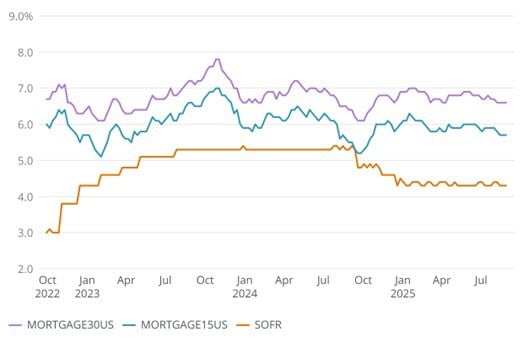
Think of your liquidity needs within a time horizon of a year or less – such as seasonal financing, working capital or emergency expenses – as short-term. These short-term borrowing needs can be addressed using a portfolio line of credit or margin loan, which provides access to cash using your investment portfolio as collateral. These lending strategies are traditionally charged a variable base rate that is set by the market rate plus a spread set by the lender. The Secured Overnight Finance Rate (SOFR) is the most frequently used variable base rate and may change on a daily basis, as it’s primarily influenced by central bank policy.
On the other hand, liquidity needs for a time horizon beyond one year – such as home purchases, business expansion or education – are generally deemed long-term. These longer-term borrowing needs can be addressed using term loans or home lending products like a mortgage. These lending strategies are traditionally charged a fixed rate, which is set by the market rate plus a spread set by a lender. The fixed base rate largely depends on how long you plan to borrow and the confluence of future expectations, risk premiums and supply-and-demand. In practice, this means that long-term rates don’t always move in conjunction with short-term rates.
Interested in working with an advisor?
Work 1:1 with our advisors to help build a personalized financial strategy that’s built around you.
How do interest rates impact borrowing costs?
Put simply, lower rates equate to lower borrowing costs and more cash available for you to save, invest and pursue other interests. Clients borrowing on variable-rate lending options will likely experience more rate changes, regardless of loan size. Consider the following example using a $100,000 loan:
How interest rate percentages affect cost
Consider the following example using a $100,000 loan: One percentage point of higher interest on the loan would require the borrower to pay $1,000 more per year to the lender or vice versa. In other words, for every percentage point interest rates rise, borrowers would pay an additional $1,000 per year; conversely, they would pay $1,000 less on the loan per year for each percentage point decrease.
A three-year view of SOFR, 15-year mortgage rates and 30-year mortgage rates
How do interest rates impact different lending options?
Borrowing money is all about getting cash (liquidity) when you need it, and interest rates influence how expensive it will be to pay the money back. As borrowing gets more expensive, it’s crucial to ensure the amount of debt responsibly fits within your overall financial plan. There are endless reasons why you might need extra liquidity, but taking on a ton of high-interest credit card debt to go on a shopping spree may not be as responsible as borrowing to invest in your business or education.
How interest rates impact portfolio lines of credit
Investors often borrow against their investment portfolios to raise cash rather than sell investments, which would require them to pay taxes on any profits. Using a portfolio line of credit, which is from a bank, or margin loan from a broker/dealer could address short-term borrowing needs while maintaining a carefully crafted portfolio. When borrowing against investment portfolios, it’s important to consider investment returns exclusive of borrowing costs.
But when interest rates climb, it may make it more challenging to pay back the line of credit. Investors should carefully watch portfolio value swings to ensure they don’t have to pay back some of the loan early in a margin call.
How interest rates impact business loans
Business leaders understand that even the best companies need extra liquidity. Whether you’re taking out a loan to fund an expansion project or borrowing on a line of credit to cover payroll while you wait for customer checks to arrive, the cost of borrowing can significantly impact your operational costs. Fixed-rate loans can provide a little more cost predictability for businesses, but variable-rate loans may be helpful in falling interest rate environments.
How interest rates impact student loans
Borrowing to pay for your education can be one of the most important investments of your life, but paying off those loans will depend on your professional income and loan interest rates. Federal student loan interest rates are typically set annually by the government, while private student loan lenders may have higher fixed or variable interest rates, depending on your creditworthiness. New borrowers should make sure their career earning potential can cover their intended debt.
How interest rates impact credit cards
Borrowing on a credit card can be one of the most expensive ways to extend your liquidity. These no-collateral, on-demand loans charge very high interest rates (which are directly impacted by interest rates set by the Fed) that can compound the borrower’s debt quickly. If you don’t pay off the entire statement balance each month, the credit card provider will charge interest on your balance, which can easily add up.
How interest rates impact auto loans
Auto loan rates fluctuate significantly and can change a lot depending on your credit score and borrowing history. Like credit card rates, auto loan rates are directly impacted by interest rates set by the Fed. Cars are depreciating assets, meaning you will never be able to sell them for more than you paid. So, it’s important to make sure you can handle the monthly payments, because selling it in a pinch won’t help much with the debt.
How should I manage my loans in a changing rate environment?
Paying attention to trends in interest rates can help borrowers make life-changing decisions, especially around long-term borrowing for things like mortgages, student loans or businesses. For instance, when paying back a $100,000 loan over 20 years, reducing the interest rate from 6% to 5% would save over $13,500 in total interest costs. So, as interest rates rise, borrowers may want to consider locking in their cheaper monthly payments with a fixed-rate loan. When interest rates fall, it may make sense to explore a variable-rate option or refinance an existing fixed-rate loan to a lower interest rate with cheaper monthly payments.
If you’re looking for a new long-term lending solution, you should consider how rate movements might impact your borrowing costs. If you’re specifically thinking about financing a new home and are unsure about the rate environment, you should talk with a home lending advisor about the preapproval and rate lock process.
The bottom line
Fluctuations in interest rates can impact your borrowing costs and should be weighed when considering finding an appropriate lending strategy. Regardless of duration – be it short-term or long-term – a J.P. Morgan advisor can help you evaluate your financial goals and how a lending solution may be able to complement your investment strategy.
Invest your way
Not working with us yet? Find a J.P. Morgan Advisor or explore ways to invest online.