One economy, two markets, one message

Executive Director, Global Investment Strategist, J.P. Morgan Private Bank

Global bond markets have repriced sharply higher in recent months, pushing borrowing costs to levels that would typically challenge risk assets. Yet equities have remained remarkably resilient. It comes down to the power of economic growth that the bond and stock markets are interpreting in very different ways. The divergence highlights a defining feature of the investor psyche: Bond investors are increasingly focused on inflation, deficits and a new normal in interest rates, while equity investors remain fixated on corporate earnings and the next wave of artificial intelligence (AI) innovation.
Rate vol is back
Higher bond yields have become the norm over the last few months, but volatility in the bond market is a relatively new development. Convention suggests that the margin of the move is more significant than the level of yields themselves. If the move is gradual, investors can digest and reprice risk assets accordingly. When yields jump more than their average, it can jolt the system.
But even as Treasury yields have risen this summer, the bond sell-off has largely been orderly. And the ripple effect across other asset classes has been relatively muted. For example, a 14-basis-point move in the 10-year Treasury yield in just one trading session was met with a less than 1% drop in the S&P 500. It marked the biggest jump in yields since Liberation Day, when President Donald Trump announced tariffs on a variety of trade partners, and risk assets – although weaker – did not crumble.
Over the summer, the Treasuries market was largely driven by hawkish monetary policy, AI investment-driven economic growth and corporate issuance, but recent rate volatility was spurred by several other factors:
- Business activity rose to 5-year highs: The S&P Global US Composite Purchasing Managers’ Index (PMI) rose to 58.4 versus an expected reading of 55.3. Although investors are not as sensitive to this data metric as they are to others, it does measure new orders, production, employment, supplier deliveries and inventories. In the context of an economy that is already demonstrating resilience and growth, the significantly higher print reinforced the narrative of more growth and therefore higher yields.
- Oil marches higher: Oil prices continue to rise. The spread between Brent and WTI has returned to levels seen when the conflict in Iran first began. That shows that even if oil prices continue to trade in a range, the geopolitical risk premium remains. Meanwhile, pressure in refined products like diesel and gasoline continues to build. Given the increased correlation with bonds, the moves in the energy market are contributing to the rise in yields.
- Pricing in more interest rate hikes: In the face of stronger growth and higher energy prices, investors are now pricing in nearly four interest rate hikes, with another as soon as the October FOMC meeting.
- A very weak 5-year Treasury auction: After an upside PMI surprise, and front-end rates already having risen sharply in recent weeks, demand for 5-year Treasury supply disappointed. The bid-to-cover ratio, which measures investor demand for new government debt issuance, fell to 2.21. That is the lowest since December 2018. The lack of appetite pushed the 5-year Treasury yield up by nearly 17 basis points to its highest level since 2007.
Ready to take the next step in investing?
We offer $0 commission online trades, intuitive investing tools and a range of advisor services, so you can take control of your financial future.
A global phenomenon
In the United States, real yields have moved higher as resilient economic growth and sticky inflation raise expectations for a higher interest rate environment. And whereas the United States has a growing deficit, fiscal policy plays a much larger role in Europe.
While the tolerance for a larger national debt burden in the United States is showing up in term premium, investors are also demanding greater compensation in countries with weaker fiscal trajectories. France has become a focal point of those concerns.
The difference in yields between French 10-year OATs and German Bunds, which are viewed as the safest assets in Europe, widened to levels last seen during the eurozone debt crisis 14 years ago. The move in the spread serves as a key measure of waning investor confidence in French public finances. By comparison, countries previously associated with irresponsible finances like Italy, Spain and Greece are being treated by investors as safer investments. In other words, the risk premium in their relative debt offerings are lower.
Risk premium in French government debt at 2012 levels
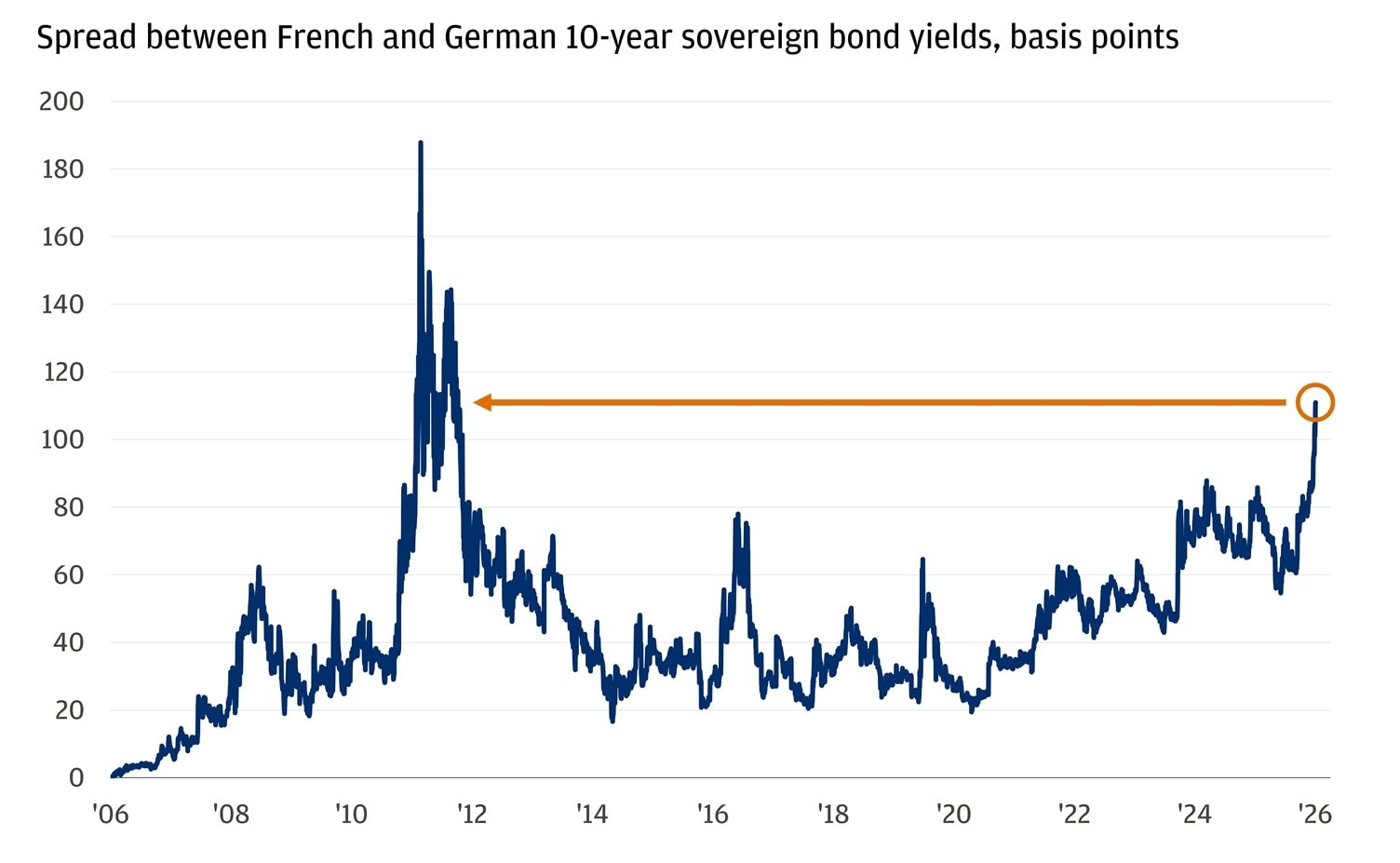
The widening spread reflects a broader theme beginning to emerge across global bond markets: Governments are issuing large amounts of debt at the same time central banks are no longer acting as major buyers. Years of pandemic support, industrial policy initiatives, defense spending and persistent fiscal deficits have left bond markets needing to absorb significantly more supply. Investors are responding by demanding higher term premiums and higher real yields. And that is becoming a feature of a structurally higher interest rate environment.
The stocks’ readthrough
Historically, this environment would have posed a significant challenge for equities. Higher yields increase borrowing costs, reduce the present value of future cash flows and raise the hurdle rate for investment. In prior cycles, a move of this magnitude in global bond markets would likely have weighed heavily on stock valuations. That’s not at play to the same extent this time around.
Both economic growth and corporate earnings have consistently exceeded expectations. This is largely driven by the AI buildout but accompanied by breadth across industries and sectors. As a result, volatility in the equity market has not matched the volatility in the bond market.
Volatility in stocks isn’t mirroring pickup in bond volatility
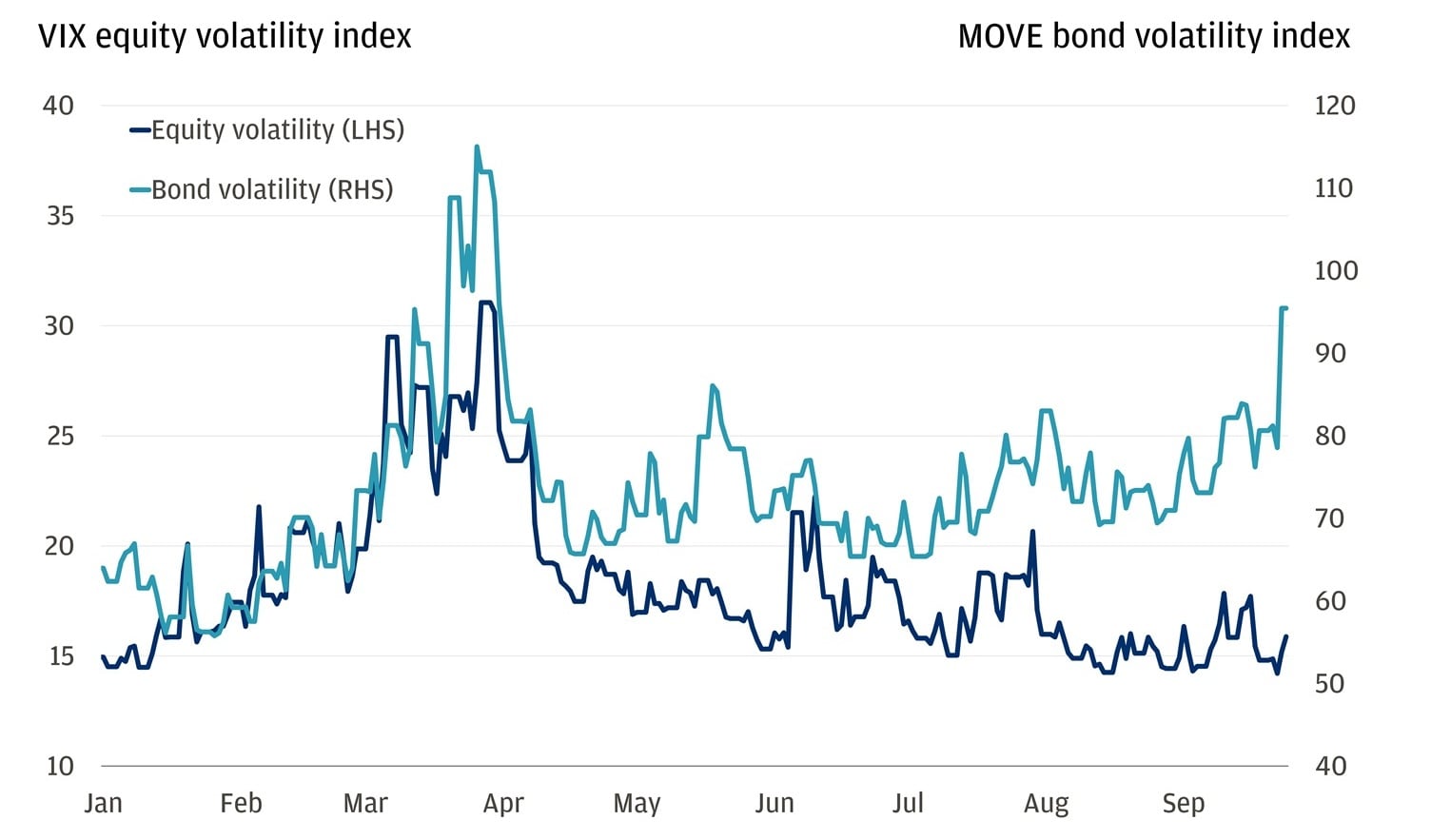
For now, that means the tolerance for rising yields is higher than history would suggest because growth trajectory is so promising. Whereas bond markets are warning about the consequences of higher deficits and increased debt supply, it’s also taking its cue from economic growth. That’s something the equity markets are also pricing in: an economy that continues to expand and a technological revolution that’s powering it.
All market and economic data as of 09/24/2026 are sourced from Bloomberg Finance L.P. and FactSet unless otherwise stated.