3 key contrasts shaping market momentum

J.P. Morgan Wealth Management

Global stocks fell this week with uncertainty over AI, economic data and tariffs
U.S. equities declined -2.9%, European equities dropped -2.2% and Japanese equities were down -1.8% as investors wrestled with conflicting artificial intelligence (AI) sentiments, mixed economic signals and geopolitical uncertainty. The flight from risk hit tech and AI-linked stocks hardest, spreading across sectors and dragging bitcoin below $87,000 for the first time since April, as it nears its longest weekly losing streak since July 2024. In this climate of uncertainty, three key dichotomies stood out.
AI skepticism dominated headlines, but Nvidia and Google delivered results that show the sector’s momentum is real
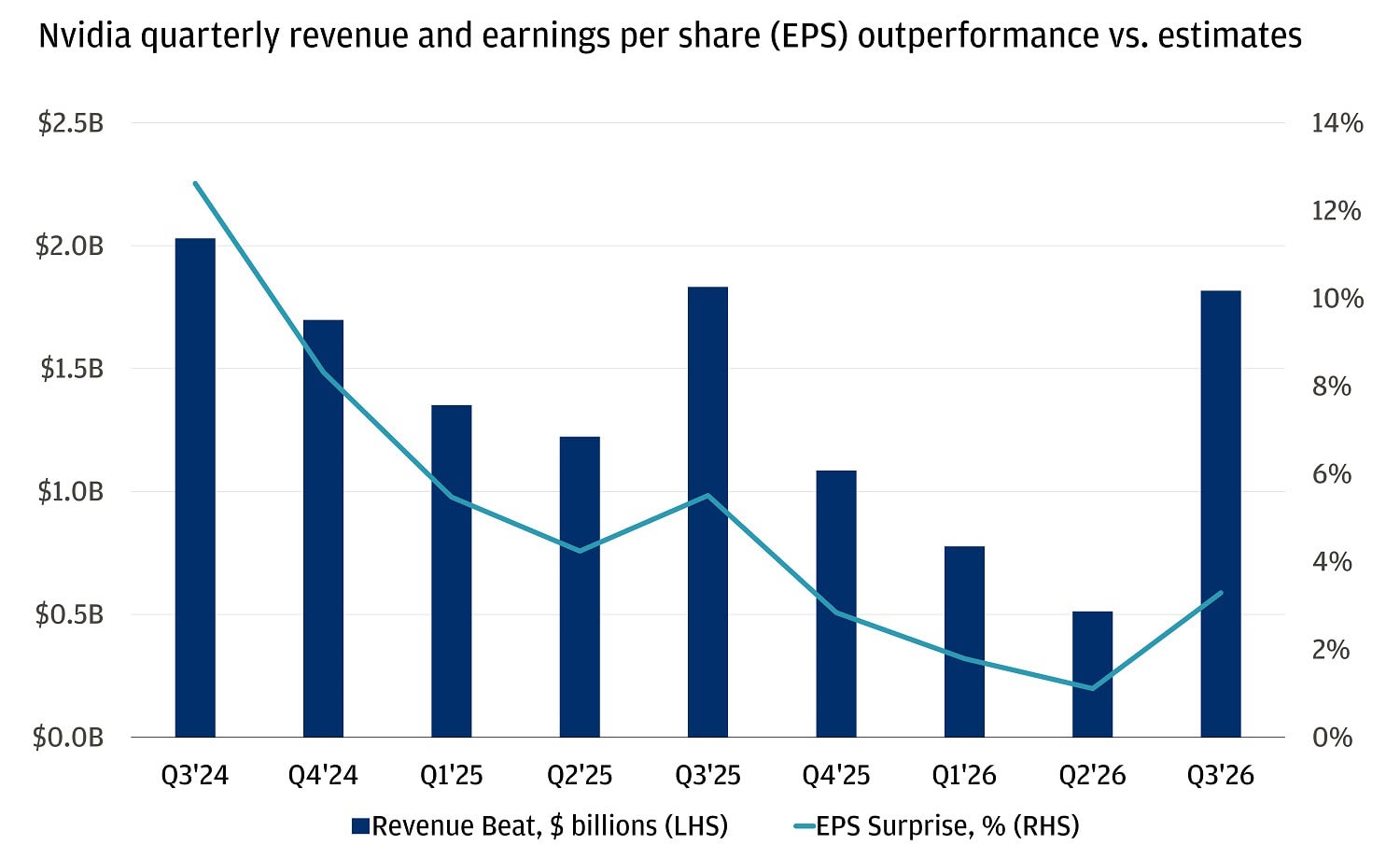
Nvidia’s revenue soared 62% year-over-year to $57 billion, with data center sales up 66%. The company’s ability to consistently beat Wall Street’s expectations highlights relentless demand for AI infrastructure, and its chief financial officer (CFO) pointed to fast-growing, profitable AI startups as evidence of a healthy ecosystem.
Beating expectations is business as usual for Nvidia
Meanwhile, Google proved that legacy tech giants can compete on innovation, launching Gemini 3 – the new leading large language model – which surpassed OpenAI’s GPT-5 in model intelligence. Despite these wins, questions lingered, and both the AI sector and broader market struggled to hold gains. Investors are still grappling with concerns about whether rapid AI growth is sustainable and profitable.
Our read: Despite persistent skepticism, the fundamentals behind AI infrastructure and innovation remain strong. Nvidia and Google’s results reinforce the sector’s staying power, but investors should remain mindful of ongoing questions about profitability and sustainability as the market continues to evolve.
Ready to take the next step in investing?
We offer $0 commission online trades, intuitive investing tools and a range of advisor services, so you can take control of your financial future.
The labor market is holding up, but cracks are emerging in consumer spending
Roughly 119,000 new jobs were added in September – more than double what analysts predicted. The unemployment rate ticked up to 4.4%, mostly because labor participation rose above expectations. Wage growth was modest, which may help keep inflation in check. However, revisions to previous months’ data revealed that job gains were weaker than initially reported.
At the same time, U.S. retail giants sent mixed signals about the American consumer. Walmart delivered strong results, with last quarter’s profits and earnings per share beating expectations, and e-commerce sales jumping 28% over the past year – helping to ease concerns that consumers are pulling back. In contrast, Home Depot’s earnings showed flat sales, with U.S. comparable sales up just 0.1% and customer transactions down 1.4%, as shoppers hesitated to take on big projects amid falling home prices and job worries. Target also missed sales expectations; consumers cut back on discretionary spending, prompting the retailer to lower its full-year profit outlook and plan increased investment in its stores. Despite these mixed signals, the holiday season is projected to see record consumer spending, surpassing $1 trillion.
Our read: The labor market’s resilience is encouraging, but the divergence in retail results suggests consumers are becoming more selective, especially with discretionary purchases. Investors should watch for shifts in spending patterns as the holiday season approaches since these could signal broader changes in economic momentum.
Tariffs are making their mark – imports are down and the trade deficit is shrinking, but the gap with China is widening
Shutdown-delayed numbers revealed that in August, the U.S. trade deficit narrowed by almost 24%. Exports to the rest of the world stayed relatively flat, but increased costs from tariffs led to a sharp drop in imports. A steep decline in gold imports from Switzerland, driven by a massive increase in tariffs, was a notable factor. However, the deficit with China widened, even before a trade deal lowered tariffs on China at the end of October.
Our read: Tariffs are reshaping trade flows, delivering the intended effect of reducing imports and narrowing the overall deficit. Overall, supply chain reconfiguration presents an opportunity for investors to capitalize on.
What does this all mean for investors?
These developments highlight the complex and rapidly changing landscape investors have faced this year, with technology, consumer trends and policy decisions all playing a role in shaping market sentiment.
As we enter 2026, investors should prepare for a market shaped by three key forces: artificial intelligence, global fragmentation and persistent inflation. Here's a teaser:
- AI is driving real growth, but disciplined investing is crucial to avoid speculative risks.
- Shifting global dynamics are changing supply chains and energy security, making resilience and risk management more important than ever.
- Inflation remains elevated and unpredictable, so intentional planning is essential to protect your purchasing power.
Check out our full 2026 Outlook: Promise and pressure for deeper insights and actionable ideas to help you navigate the year ahead.
All market and economic data as of 11/21/25 are sourced from Bloomberg Finance L.P. and FactSet unless otherwise stated.
You're invited to subscribe to our newsletters
We'll send you the latest market news, investing insights and more when you subscribe to our newsletters.