Why AI might strain the economy before it booms

By Kriti Gupta
It’s not uncommon to hear that artificial intelligence (AI) will one day take over jobs, from recent graduates to Nobel laureates. It’s undoubtedly one of the most revolutionary advances in technology the world has ever seen. One of the biggest fears? That the innovation moves so quickly that catching up becomes harder, unprofitable or simply impossible – eliminating jobs across the country at scale. But for all the focus on an overnight jobs shock, a gradual AI-related disruption is more likely, with a productivity payoff on the other side. Here’s why.
The doomsday scenario
There is no magic number of how many jobs will be at risk when AI technology has its breakthrough moment. Estimates range from 14% to 30% for displacement with as many as 80% of Americans being impacted in some way.
When asking an AI large language model (LLM) about the impact of its technology on the future of jobs, it yielded the following numbers: 3%-6% of the 163 million-person U.S. workforce will face displacement in the next one to three years with another 10%-15% over the next decade.
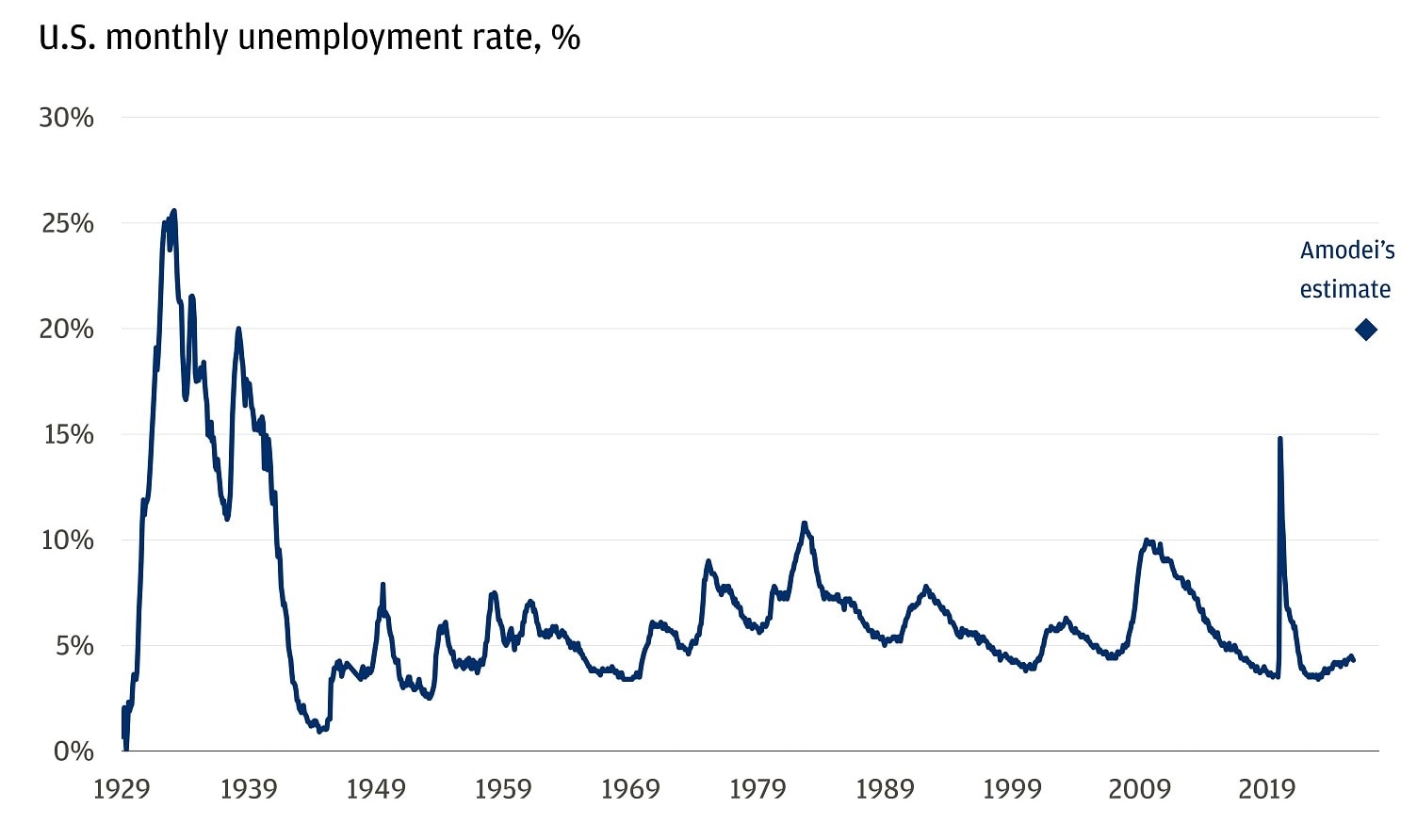
Dario Amodei, the CEO of Anthropic, one of the world’s largest AI companies, says 50% of entry-level white-collar jobs will be disrupted within five years. He points to the potential of a technological breakthrough that could lead to a spike in unemployment as high as 20%. For context, that is an unemployment rate that supersedes the Great Financial Crisis in 2009 and nears the peak of the Great Depression in 1933.
The doomsday scenario would rival the Great Depression
Ready to take the next step in investing?
We offer $0 commission online trades, intuitive investing tools and a range of advisor services, so you can take control of your financial future.
The result would make things cheaper to produce, but fewer people could afford to buy them. Imagine a society where gross domestic product (GDP) grows at double digits while large segments of the population are economically obsolete. It’s a recipe for instability.
What’s worse? Amodei and others think it can happen almost overnight. This could be reminiscent of the initial spike in unemployment during the COVID-19 pandemic.
Previous eras of mass unemployment (and recession) have been driven by demand. When people lose their jobs, they expect to find another job in the future. The uncertainty is when, not if, a new job would be on the table. But displacement from the AI revolution means the unemployment rate, in theory, could spike and plateau there. That is until a more substantial part of the workforce is reskilled and hired for jobs that AI cannot do.
The economic fallout from labor market disruption is bittersweet. Mass unemployment means a drop in consumption and wages, which would translate to a drop in U.S. GDP. But then the economy would reaccelerate to new heights thanks to AI-driven productivity gains.
It’s not abnormal to see that happen in an economic cycle. In periods after a recession, GDP traditionally rebounds before employment catches up. But that takes time. And reskilling a workforce or even identifying the gaps in the technology that require new jobs is not a quick endeavor. Whereas the AI-induced growth would come, at least according to Amodei, at a rate 10 times the historical norm.
There isn’t a clear economic roadmap on how to navigate this hypothetical, and almost unimaginable, scenario.
The world we actually live in
There are many reasons to be wary of the doomsday scenario. It’s both an incredible moment in human and technological history and a potentially terrifying outcome for a large chunk of the labor force. Not to mention the economists who are racing to model out the impact.
But it won’t happen all at once. There may be a singular moment when the technology breaks through, but there’s unlikely to be a singular moment when the layoffs become omnipresent. That requires a speedy pace of adoption, a breadth of applications, standardized regulations to encourage corporations to take on the new technology without legal ramifications, energy capacity and an infrastructure buildout.
It’s also important to remember that the net effect of the doomsday scenario is first deflationary, given the effect on jobs and consumption. The American economy is currently running hot. And the diffusion of AI is likely to take place slowly. Whereas it could quickly affect jobs in financial services, law and tech, applying AI to areas like education and health services will take more time, funding and regulation. The doomsday scenario also assumes the government would not intervene as this was playing out.
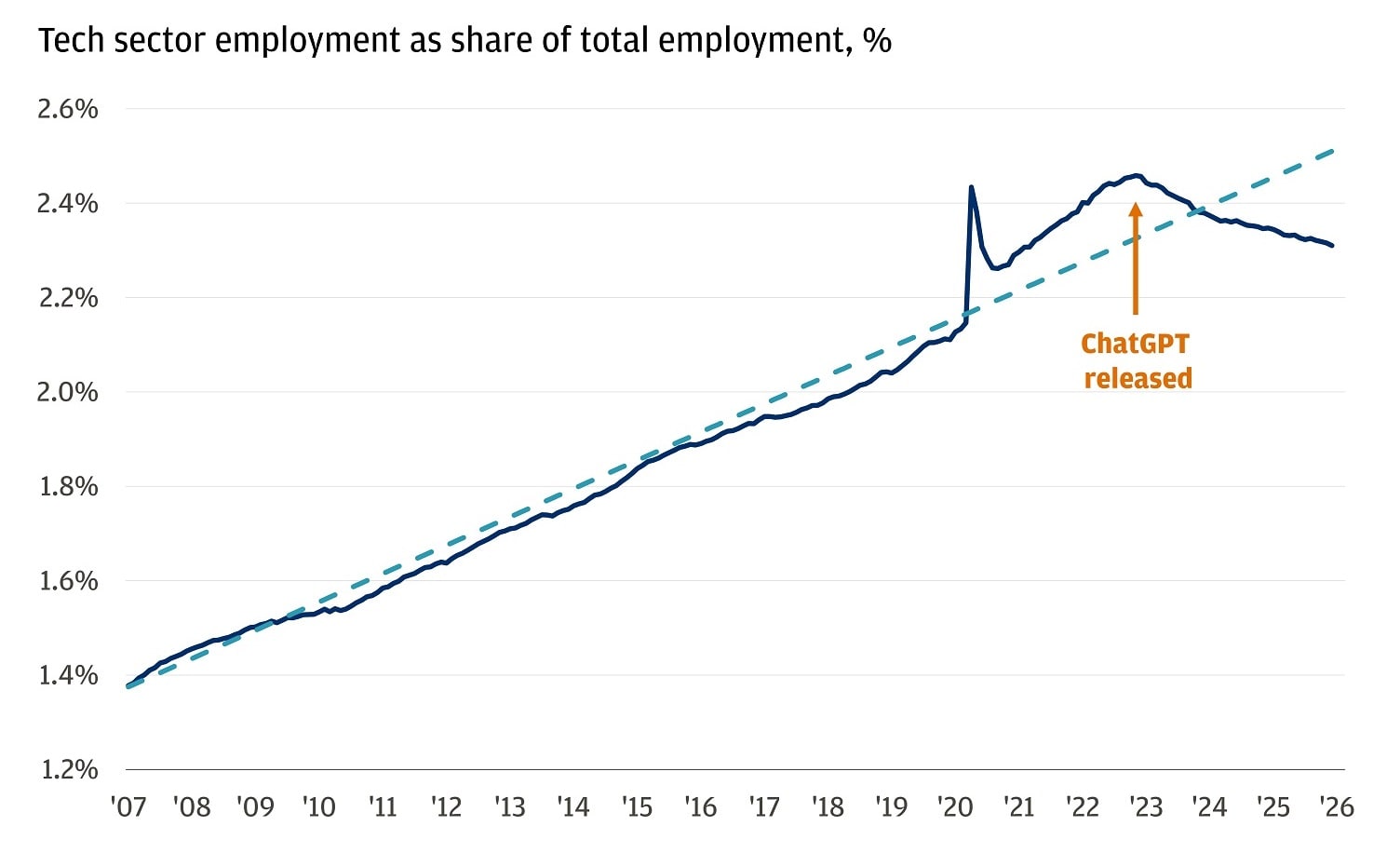
What data pushes back against the doomsday scenario? The first signal would show up in unemployment data. Jobs in technology would be the first frontier. Employment in this sector is trending lower but isn’t falling at a pace that would suggest widespread displacement is around the corner.
Tech sector employment may have already peaked
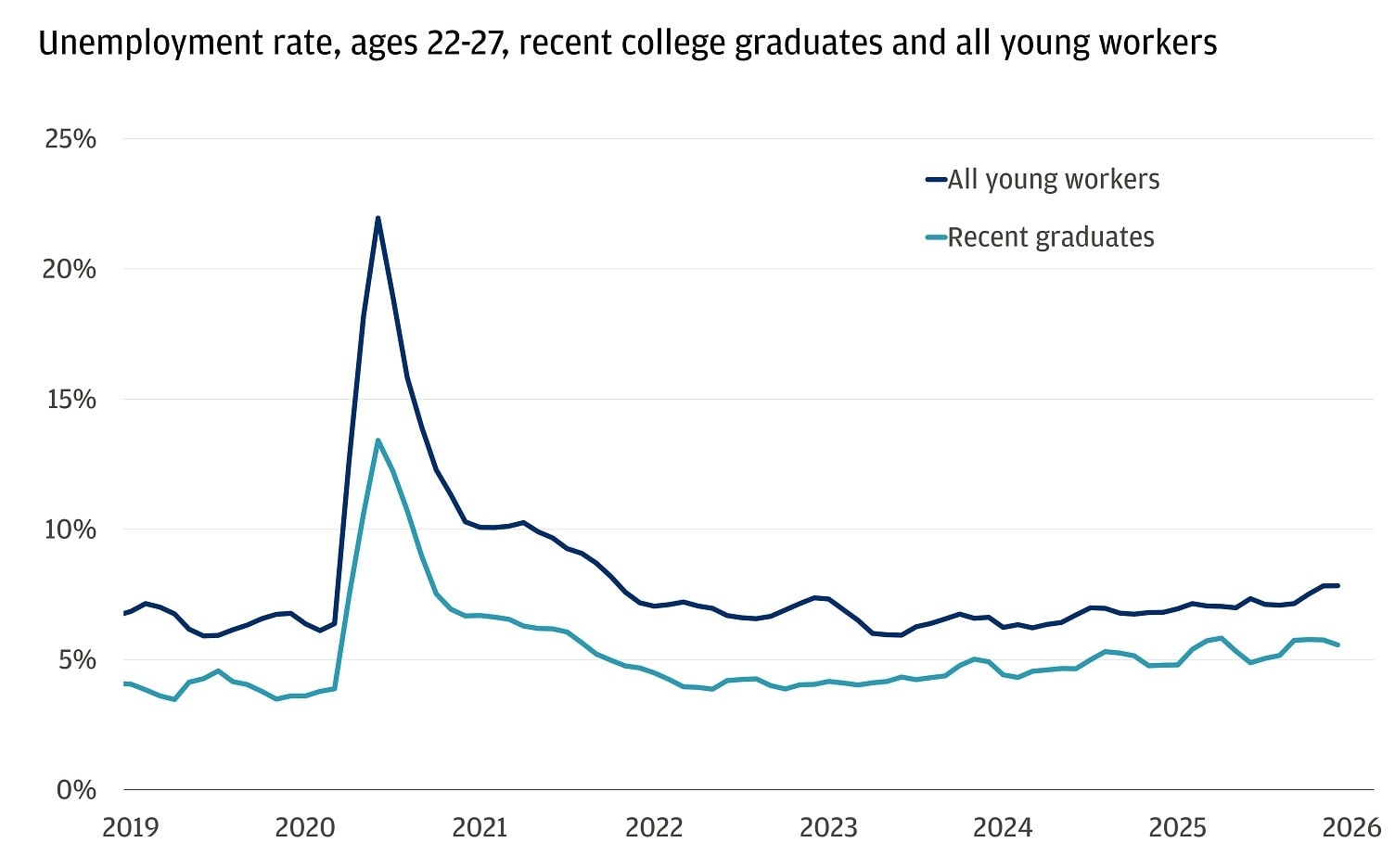
The Anthropic founder also pointed to entry-level college graduates in white-collar jobs. Anecdotally, AI is being used in many of those jobs in a “trust but verify” capacity. It has yet to meaningfully move the unemployment rate in that cohort. When it does, it’ll show up in the data below. We’re not there yet.
AI displacement hasn’t shown up in youth unemployment
Does this play out in two years? Maybe. But the impact may not be as concentrated as AI advocates would suggest. Will it be disruptive? Absolutely. The market is already pricing the potential in waves. And there’s a clear desire to build out the infrastructure to support AI while also encouraging gradual adoption within preexisting roles. The productivity jump, driven by AI adoption, is likely to happen gradually with the peak landing toward the end of the decade rather than in the near-term. In the meantime, the worry of mass unemployment mirroring America’s worst economic crises feels like a stretch.
All market and economic data as of 02/20/2026 are sourced from Bloomberg Finance L.P. and FactSet unless otherwise stated.
You're invited to subscribe to our newsletters
We'll send you the latest market news, investing insights and more when you subscribe to our newsletters.