Software shock: AI’s broken logic

By Kriti Gupta
Artificial intelligence (AI) was always going to be disruptive, but few expected that the consequences would come so quickly for the software sector. Unlike the DeepSeek episode, when investors questioned the need to spend so much money to develop large language models (LLMs), now the market is pricing in the potential impact that agentic AI will have on existing software businesses. And it’s taking everyone with it … including some of the hyperscalers spending the most on AI infrastructure.
Over the last few weeks, Anthropic has released several new models and features that have once again shaken up the AI landscape. The latest breakthrough allows a user to interact with their computer using natural language to generate code and achieve real outcomes: from data aggregation and analysis to formatting to expense tracking – domains that traditional software-as-a-service firms dominate.
Therefore, one day, software companies could become obsolete. Cue the repricing. Investors are taking the disruption seriously. The S&P 500 software index has fallen into a bear market. The selling pressure has been intense. With a current relative strength index of 18, an indicator used to evaluate oversold levels, it is the most oversold since 1990. Historically, anything below 30 incentivizes inflows. But few are buying.
The software market action is extreme relative to history
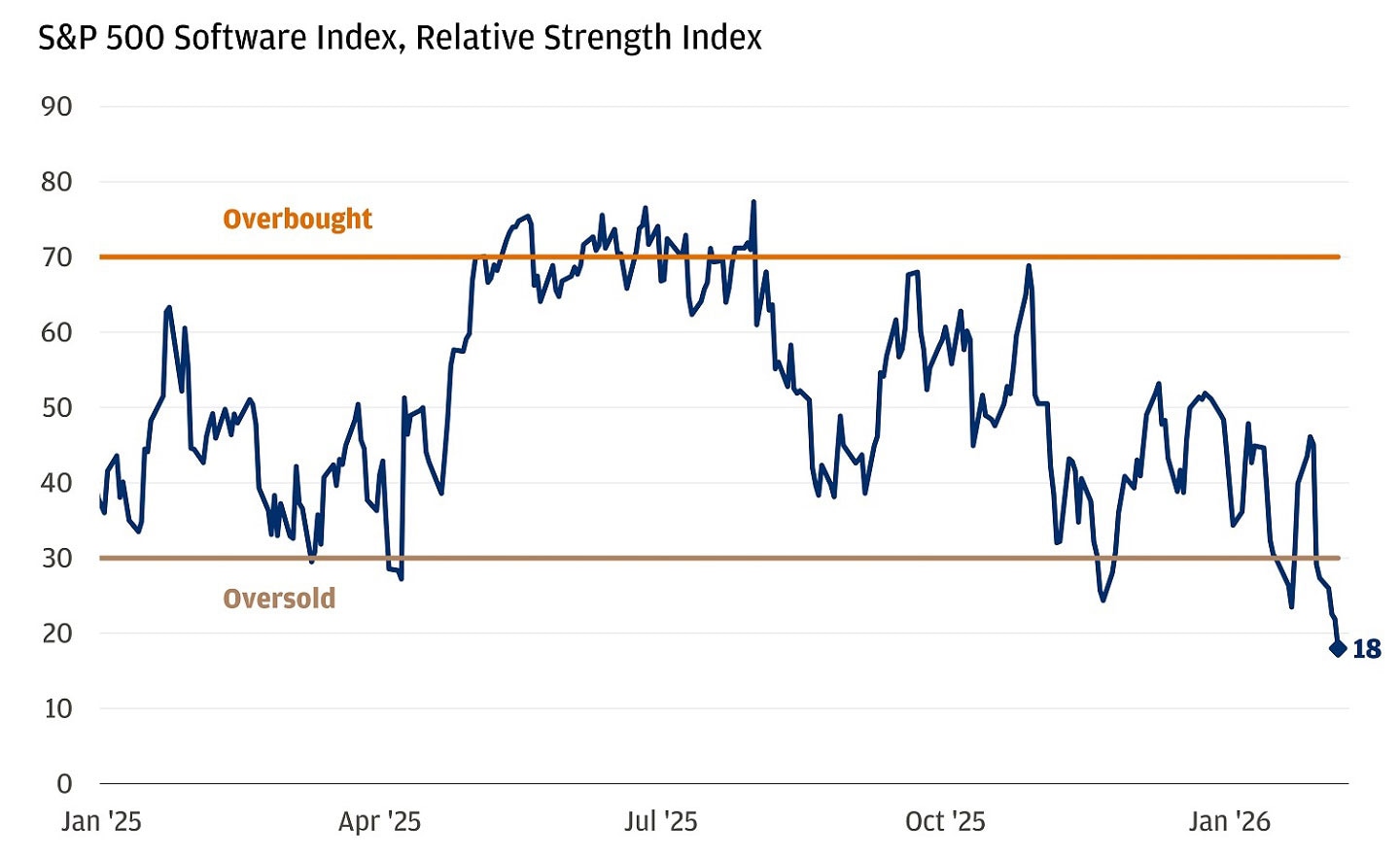
To underscore the point, the iShares Expanded Tech-Software Sector ETF (IGV) is trading over 20% below its 200-day moving average, the widest spread since the tail end of the dotcom crash.
But if the view is that new AI companies are going to disrupt the entire software industry, why are stocks that should benefit from the disruption – like the hyperscalers that invested early in AI technology, chipmakers fulfilling demand from the infrastructure build and even the materials needed for the process – also down? And therein lies the broken logic. The market is selling indiscriminately.
Ready to take the next step in investing?
We offer $0 commission online trades, intuitive investing tools and a range of advisor services, so you can take control of your financial future.
Now add on the insatiable hunger for compute emanating from the very businesses that it could destroy. Capital expenditure forecasts, as one example, from the likes of Meta, Amazon, Alphabet and Microsoft were scorned by investors.
This type of broad-based selling in technology has never been riskier for portfolios. Tech’s heavy presence in the S&P 500 and its top companies – most of whom have significant revenues tied to the AI theme – matters, because it means a large part of the index is highly correlated with each other. In fact, after testing thousands of possible combinations of the top 10 stocks in today’s S&P 500 by taking random samples of 10 from the 500, the actual top 10 in the index yielded a pairwise correlation in the 99th percentile. That means if the technology and AI narrative falters, a large portion of the S&P 500 could experience a simultaneous drawdown – something like the price action of this week. It stands in stark contrast to previous periods of concentration, when leadership was more diversified across sectors.
On the other hand, perhaps there’s no rhyme or reason to the sell-off at all. Take a look at the sector’s enterprise value (EV) to sales ratio. It’s near levels seen in November of 2022, when the world was bracing for recession and reacting to an aggressive rate-hiking cycle. This valuation collapse could signal a structurally lower growth rate and terminal value for software companies due to AI disruption. But for that view to hold water, either the hyperscalers or the private AI model companies will need to invest in the physical inputs like semiconductors, electricity, cooling systems, networking solutions and grid interconnection that actually make AI work. However, if you believe that Claude Code is just another DeepSeek moment, current software valuations are worth a look in finding an entry point.
Software company valuations are plummeting
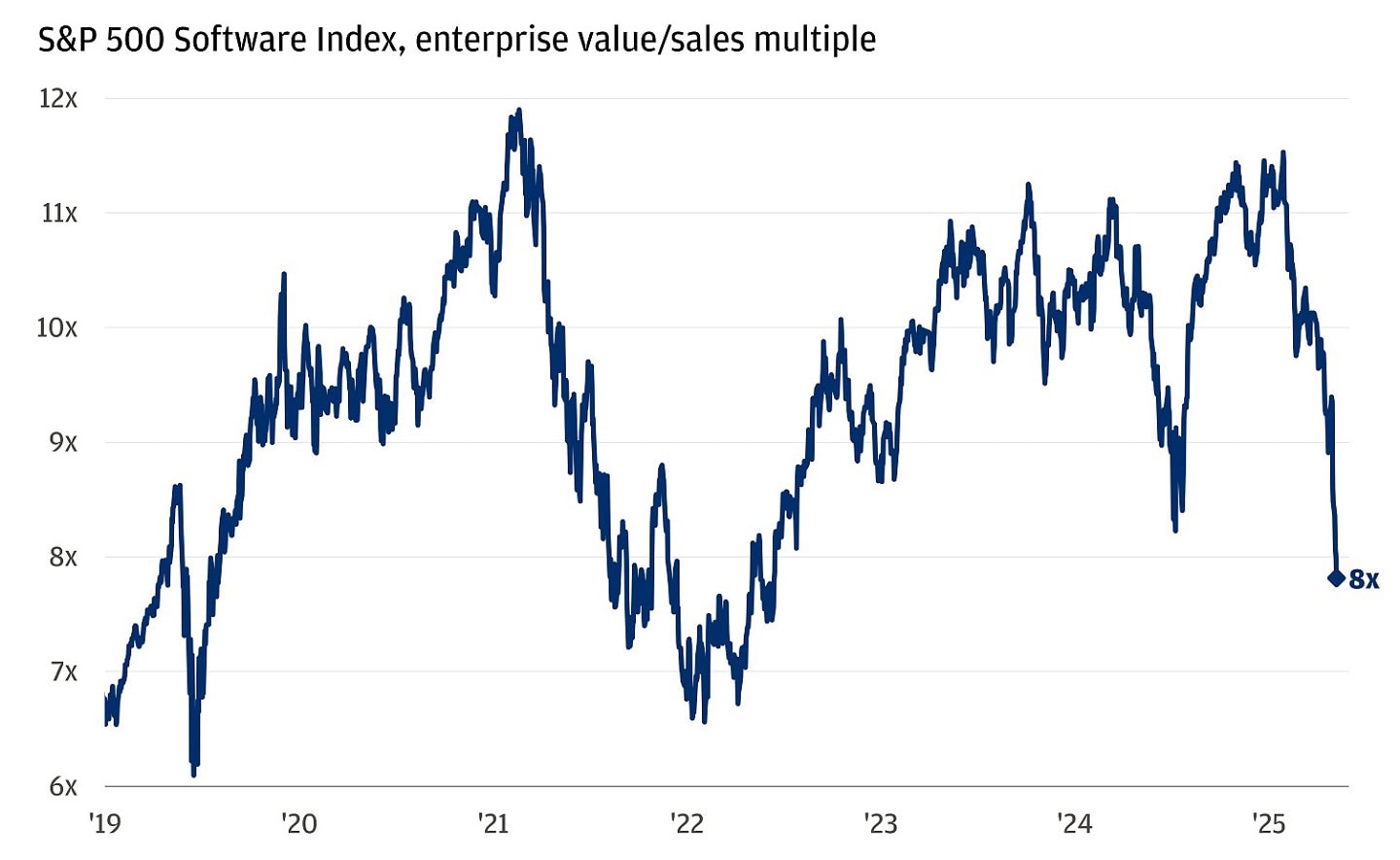
The macro thesis of AI stands. It’s going to change the productivity landscape and the companies that lean into it will be rewarded in the long run. But more bouts of volatility are likely as the technology itself continues to leapfrog previous generations and portfolios remain so skewed to tech.
The good news? Corporate users of AI are already seeing the positive impact in their margins. AI adopters in the S&P 500 have posted margin expansion that outpaces both the index as a whole and the individual companies not using AI by two to three percentage points. Disruption can have painful consequences, but the revenue opportunity and productivity gains will be worth it.
AI is driving margin expansion for its adopters
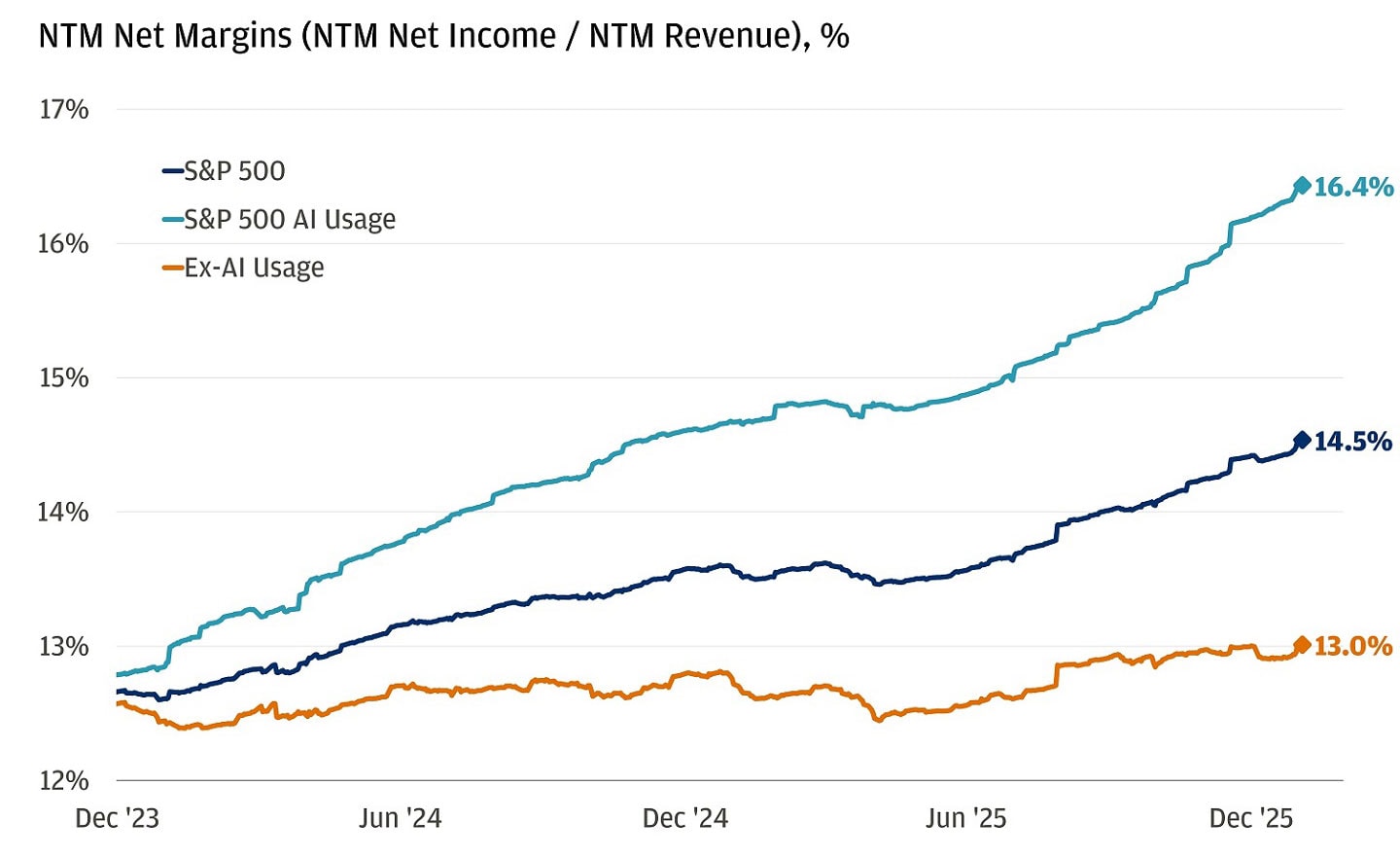
Keep the focus on the large-cap leaders who are likely to see a strong return on their AI investments as well as the chipmakers and commodity-related players in the AI supply chain. They’ve been swept up in the software sell-off for now, but they are most likely to benefit in the long term.
All market and economic data as of 02/06/2026 are sourced from Bloomberg Finance L.P. and FactSet unless otherwise stated.
You're invited to subscribe to our newsletters
We'll send you the latest market news, investing insights and more when you subscribe to our newsletters.