Oil prices in 2026: How are WTI crude and Brent crude performing so far this year? Why does it matter for investors?

Editorial Staff, J.P. Morgan Wealth Management
- Oil prices have spiked in 2026: WTI crude is up about 68% and Brent crude is up about 84% from the start of the year through the end of September.
- For investors, oil prices matter because they can feed into headline inflation – and that can influence bond yields, rate expectations and overall risk appetite.
- Oil swings can change what’s leading in the stock market: When prices rise, the energy sector can benefit, while oil-sensitive industries can face cost pressures and volatility can increase.

Oil prices so far in 2026 have risen sharply. West Texas Intermediate, or WTI crude (the U.S. benchmark), and Brent crude (the global benchmark) have moved higher this year as markets have weighed a familiar push and pull: concerns about supply versus questions about demand.
On the supply side, oil has been especially sensitive to the ongoing conflict involving Iran and related disruption risks – from shipping and trade flows to sanctions and broader regional instability as energy facilities were targeted – which can quickly change how investors think about near-term supply. Decisions by OPEC+, comprising the Organization of the Petroleum Exporting Countries and its nonmember allies, have also mattered, since even small changes in expected production can shift the balance between a well-supplied market and a tighter one.
On the demand side, the story has been about how fast the world economy is growing and whether higher interest rates are making it harder and more expensive to borrow. Those factors influence expectations for how much oil the world will use.
And while crude oil isn’t the same thing as gas at the pump, higher oil prices can contribute to higher gasoline and diesel costs over time, which can squeeze household budgets and affect spending.
“Oil doesn’t just affect what you pay at the pump; it can shape inflation and interest rates, which is why it often shows up in stock and bond markets at the same time,” J.P. Morgan Wealth Management Global Investment Strategist Mohammad Maaz Rehan said. “For most investors, the goal isn’t to trade every oil headline; it’s to stay diversified, understand where energy costs can pressure parts of your portfolio, and make sure your plan can hold up if inflation stays higher for longer.”
Oil prices in 2026 so far – a quick snapshot
Oil has had a big year so far. From early-January lows to early-April highs, both benchmarks increased sharply – then pulled back in early summer before climbing again into September. Both WTI and Brent crude have had several months this year where prices averaged over $100 per barrel.
Oil prices have climbed higher so far this year
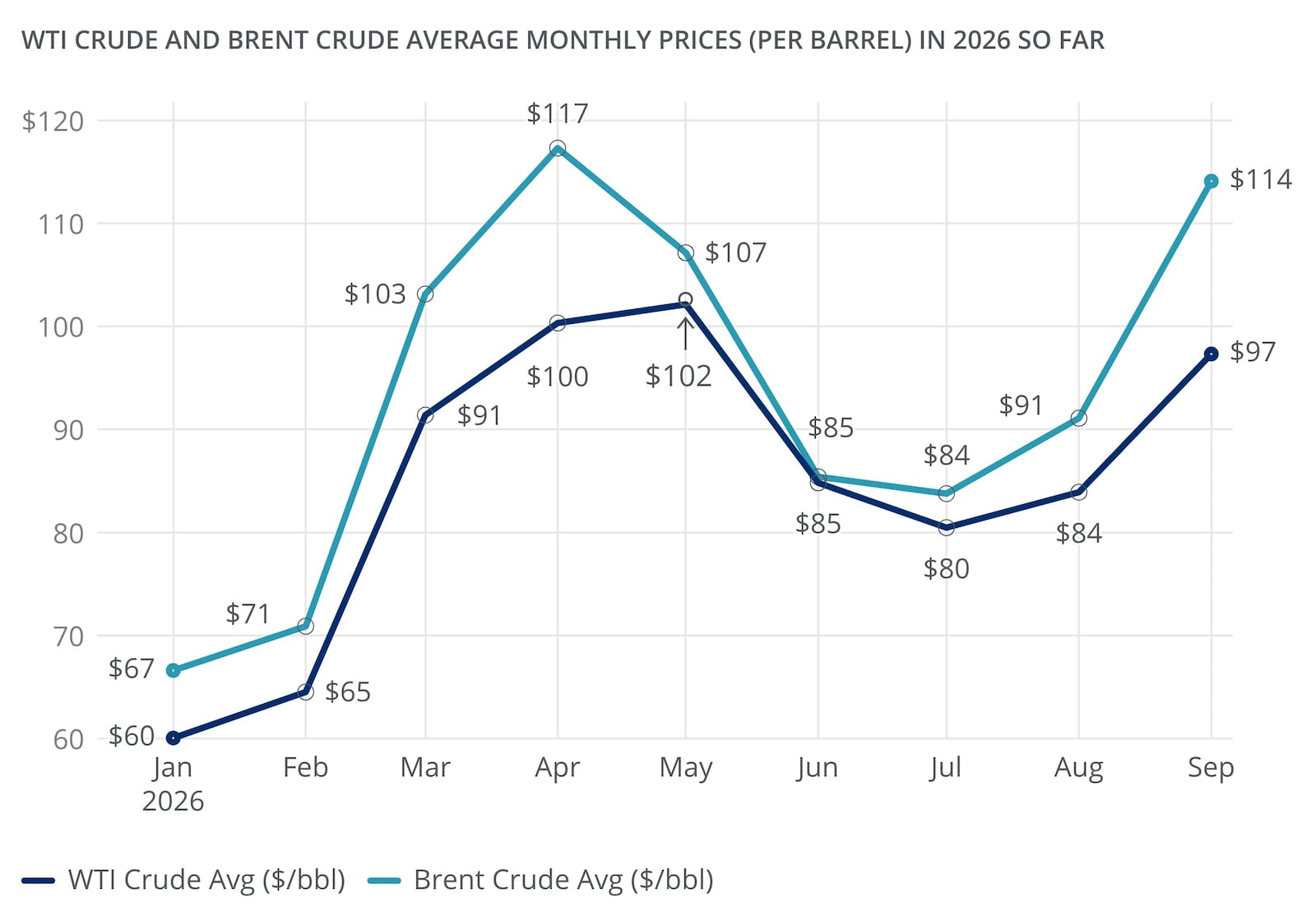
While monthly averages smooth out day-to-day noise and make the broader trend easier to see, the table below captures the year-to-date (YTD) changes along with the highs and lows for each benchmark. According to daily prices between January and September, WTI ranged from about $56 to $115 per barrel, while Brent ranged from about $61 to $138 per barrel.
WTI crude and Brent crude oil prices in 2026
| Benchmark | WTI crude | Brent crude |
|---|---|---|
| Start of year | $57.21 | $61.98 |
| End of September | $96.16 | $113.96 |
| $ change in 2026 | $38.95 | $51.98 |
| % change in 2026 | 68.08% | 83.87% |
| YTD high | $114.58 | $138.21 |
| YTD low | $56.01 | $61.08 |
What moved oil prices in 2026
Geopolitics and supply risk (Iran and key shipping routes)
Oil’s biggest moves in 2026 were shaped by the ongoing conflict with Iran and the risk of disruptions in critical Middle East shipping lanes – particularly the Strait of Hormuz, a chokepoint for a large portion of the world’s oil and liquefied natural gas (LNG) trade – because even the threat of interrupted flows can push prices higher quickly.
OPEC+ policy
OPEC+ influenced prices in 2026 less through target announcements and more through what the market believed would actually reach buyers. The group signaled a path of modest monthly increases in output targets (an adjustment of about 188,000 barrels per day) through the summer, but real-world disruptions tied to the ongoing conflict with Iran meant production and exports were often well below quota.
US supply and inventories
U.S. crude production trends and weekly inventory data can move prices as well, as they’re a frequent reality check on whether the market is tightening or loosening. When inventories draw down unexpectedly, that can support prices; when inventories build up, it can signal softer demand or rising supply.
Global demand expectations, the US dollar and borrowing costs
Oil demand rises and falls with the global economic growth outlook, so signs of slower activity can cool prices after rallies. In early summer, softer global oil demand – especially tied to China and Europe – played a role as prices eased from earlier highs. A stronger dollar and higher borrowing costs have also weighed on demand expectations.
Interested in working with an advisor?
Work 1:1 with our advisors to help build a personalized financial strategy that’s built around you.
Why oil matters for investors
Energy is a direct input into everyday costs – including fuel, shipping and manufacturing – so when oil prices rise sharply, it can push headline inflation higher. That matters because markets don’t look at inflation in isolation; they translate it into expectations for interest rates and bond yields, which influence borrowing costs and valuations across the larger economy.
In 2026, for example, headline Consumer Price Index (CPI) inflation (measured year over year) rose from 2.4% in January to 3.4% in August. Investors have also seen a meaningful rise in longer-term yields this year, with the 10-year Treasury yield rising from 4.19% at the start of 2026 to 5.29% by the end of September. When oil is moving quickly, markets often reassess where inflation and rates could go next – and that can ripple across stocks, bonds and credit.
Higher oil prices can affect the market in different ways. When crude rises, energy producers and oil field services firms may benefit, because revenues can improve with higher prices. At the same time, higher fuel costs can squeeze margins for industries like airlines, transportation, chemicals and parts of the consumer discretionary sector.
The key nuance for investors is that the impact often isn’t uniform: Companies with stronger pricing power may be able to pass some costs through to consumers, while others may absorb them. Some firms also hedge fuel or commodity exposure.
Big moves in oil prices can increase market volatility, especially when driven by geopolitical risk or tied to global supply concerns. That’s in part because oil can impact both sides of the macro equation at once: It not only can add to inflation concerns but also can lead to uncertainty around economic growth. When that happens, oil spikes can temporarily change how different assets move together, including stocks and bonds.
Oil is global but priced in U.S. dollars, so changes can affect regions differently. Oil-importing economies can face more inflation pressure when prices rise, while oil-exporting economies may benefit from stronger energy revenues. Currency moves can also amplify those differences, since a stronger dollar can make oil more expensive for non-U.S. buyers as well as influence demand at the margin.
How to think about oil – without trying to trade it
Most investors don’t need to predict short-term oil moves to manage oil-related risk. Instead, a more practical approach is to treat oil prices as a useful signal for inflation, rates and certain parts of the market, without letting headlines drive big portfolio changes.
Start by checking sector concentration: You may be more exposed to energy, or to oil-sensitive industries, than you realize. Next, consider pressure-testing your financial plan, especially if you’re near or in retirement. If energy costs were to stay elevated for a stretch, would that change your spending assumptions or your need for short-term liquidity? Finally, it can be helpful to focus on diversification and discipline. Oil headlines can be dramatic, but portfolios often do best when changes are measured and aligned to a long-term plan rather than short-term forecasts.
For investors who want to understand where oil exposure can show up, common high-level exposures include energy sector funds, broad commodity funds and inflation-linked bonds. If you are unsure about your portfolio’s exposure to oil, consider speaking with a qualified financial professional.
The bottom line: What to watch for in the rest of 2026
Several signals are likely to matter most for where WTI and Brent crude prices go next – and how markets respond to those changes.
First, watch OPEC+ meetings and compliance. Announcements can move prices, but follow-through matters more, especially if actual exports don’t match what’s been signaled. Second, keep an eye on inventory trends and demand signals. Inventory drawdowns or buildups can act as a near-term reality check on whether the market is tightening or loosening, while demand indicators help clarify whether prices are moving on stronger consumption or on supply fears. Third, geopolitical developments and shipping constraints remain central – particularly any shifts that affect the reliability of flows through major routes.
It can also be worth paying attention to refining constraints and product-market stress – not as a separate gas prices story, but because tightness in refined products can sometimes feed back into crude demand and pricing. It helps to remember that oil doesn’t trade in a vacuum: Inflation data and rate expectations can influence overall risk appetite, and that can either reinforce or dampen price moves.
Here’s a checklist of things to track as oil prices move:
- Inflation implications: Is energy pushing headline inflation up or down in recent data?
- Rate and yield implications: Are bond yields and rate expectations reacting to inflation pressure?
- Likely sector leadership: Are energy-related areas leading, or are oil-sensitive industries showing signs of margin pressure?
Oil prices through the end of 2026 are likely to hinge on the balance between supply risk (geopolitics, shipping, OPEC+) and demand (growth, inventories), with inflation and rates shaping how markets digest each move.
Invest your way
Not working with us yet? Find a J.P. Morgan Advisor or explore ways to invest online.