How has the Nasdaq performed so far in 2026?

Editorial Staff, J.P. Morgan Wealth Management
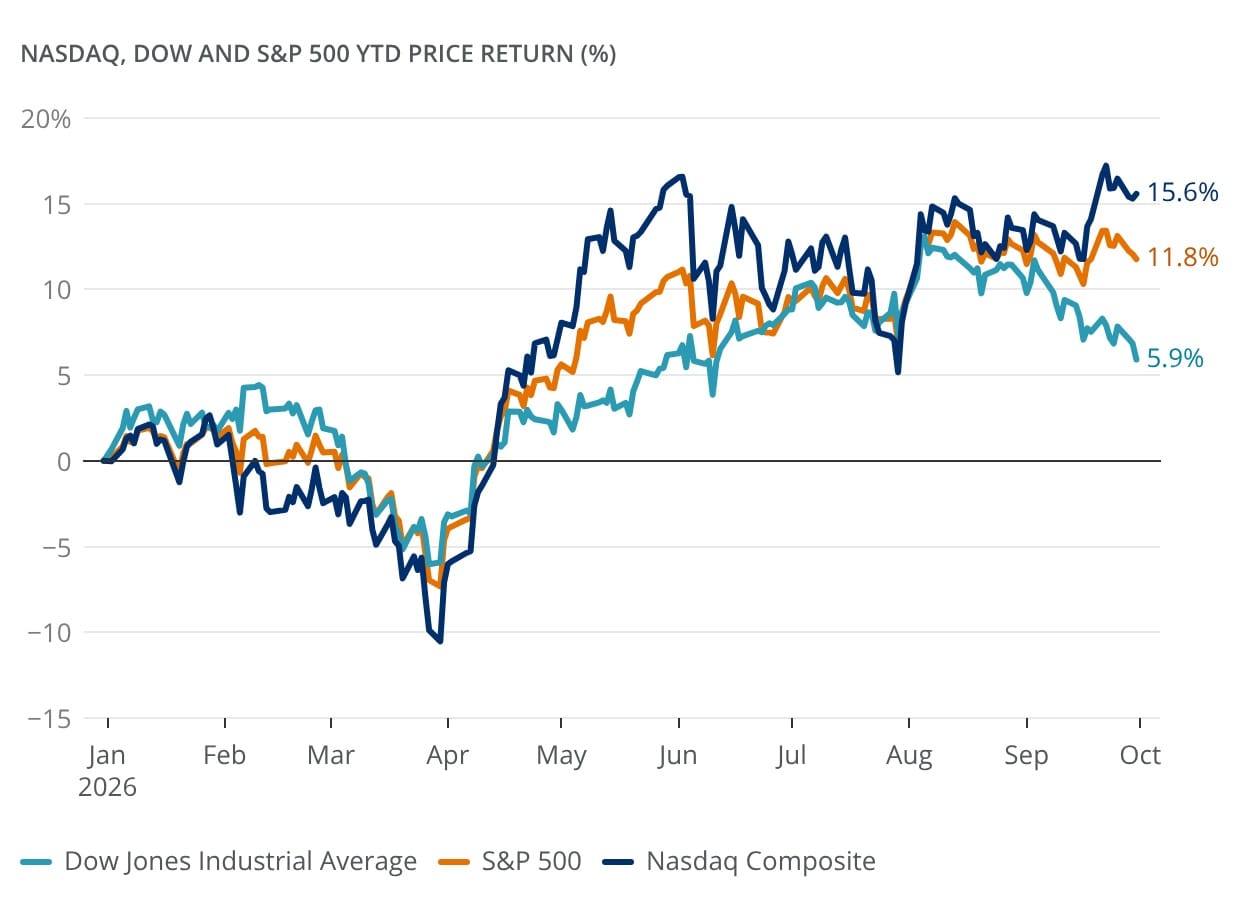
- The Nasdaq Composite Index has hit several record highs in 2026, including a record close of 27,599 on October 6. Looking at the index for the year as of close on September 30, the Nasdaq is up 15.6%, outpacing both the S&P 500 and the Dow.
- The Nasdaq tracks thousands of stocks listed on the Nasdaq exchange and is market-cap weighted, meaning the largest companies can drive a big share of its day-to-day moves.
- The index includes many tech and growth-oriented companies, meaning it tends to be more sensitive to shifts in investor sentiment, earnings expectations and changes to interest rate outlooks.
- Artificial intelligence (AI) and semiconductor momentum, earnings strength and geopolitical-related energy volatility have been major themes shaping stock market performance in 2026.

The Nasdaq Composite Index is up 15.6% year to date in 2026 (as of close on September 30), outpacing both the S&P 500’s 11.8% gain and the Dow Jones Industrial Average’s 5.9% rise. Those headline numbers tell a simple story that tech-heavy companies have led markets higher, but they don’t explain why the Nasdaq can surge or slide faster than other benchmarks.
That difference matters because some 401(k)s, individual retirement accounts (IRAs) and brokerage portfolios may have meaningful exposure to Nasdaq-listed companies. When the Nasdaq is driving market returns, it may boost portfolio performance, but it may also increase the ups and downs you experience along the way.
This article will break down how the Nasdaq has performed so far in 2026, how that compares to other major indexes and what factors have been driving that performance.
Nasdaq snapshot: 2026 year-to-date returns and key milestones
Year-to-date (YTD) return is a simple way to describe performance from the start of the year through the latest close. In other words, it answers: How much has the index risen or fallen since the end of last year?
So far in 2026, as of close on September 30, the Nasdaq Composite was up 15.6% year-to-date, which is ahead of both the S&P 500 and Dow. This gap in performance may be a useful clue about market leadership. In years when growth- and tech-leaning stocks are doing more of the heavy lifting, the Nasdaq often pulls away from the broader, more diversified benchmarks.
For context, 2025 was also a strong year for major U.S. indexes, with all three hitting new record highs and ending the year positive: The Nasdaq gained roughly 20%, the S&P 500 rose more than 16% and the Dow jumped nearly 13%.
In 2026, the market’s pace has been somewhat slower than last year’s. Looking at an apples-to-apples comparison, returns as of close on September 30, 2025, were slightly higher than they are through the same point in 2026. For that same period last year, the Dow was up 9.1%, the Nasdaq Composite was up 17.3%, and the S&P 500 was up 13.7%.
The Nasdaq has outpaced both the S&P 500 and Dow in 2026
It can also help to know the difference between price return and total return. Price return reflects only the change in the index level (prices moving up or down). Total return goes a step further by including dividends, assuming they’re reinvested. Over long periods, reinvested dividends may meaningfully add to your returns through compounding. While dividends generally play a smaller role in the Nasdaq Composite than in some other benchmarks, total return is still a more complete way to think about long-term performance.
For context, the S&P 500 has posted an average annual total return of nearly 16% over the 10-year period of 2016 to 2025.
What’s driving Nasdaq returns in 2026 so far?
No single storyline explains every move in the Nasdaq Composite. But in 2026, a few themes have mattered more than usual because they directly affect Nasdaq’s heavyweights. In a market-cap-weighted index, leadership at the top can move the whole benchmark.
A big part of the 2026 story has been the market’s focus on the AI buildout – and whether large companies will keep ramping up spending on data centers, chips, networking and power. Mega-cap chipmakers and large platform companies buying the infrastructure carry outsized weight within the broader Nasdaq Composite, and that can drive the index's performance.
Geopolitics has also mattered in 2026, impacting markets mainly through energy prices and stubborn inflation. The price of oil has risen above $100 per barrel on multiple occasions, while diesel prices surged to new record highs of more than $6.50 per gallon in September. When inflation worries rise or fall with energy headlines like this, rate expectations can move quickly – often translating into bigger swings for growth-heavy parts of the market like the Nasdaq.
Get up to $1,000
When you open a J.P. Morgan Self-Directed Investing account, you get a trading experience that puts you in control and up to $1,000 in cash bonus.
Breadth and concentration: The context behind the headline returns
When you see an index like the Nasdaq sharply up for the year, it helps to look beyond the headline number. Market breadth (sometimes called participation) asks how many stocks are rising, not just whether the index level is higher. Strong breadth may suggest a rally is being shared across more companies, while weak breadth may mean the index is being pulled up by a smaller group of names.
That’s where concentration comes in. Because the Nasdaq is market-cap weighted, its largest companies carry the most influence. The index is heavily top-weighted, and halfway through 2026, the top 10 holdings – including companies like Nvidia, Microsoft and Apple – accounted for roughly 53.3% of the index. In other words, even if hundreds of stocks are flat, a strong (or weak) move in a small group of mega-cap names can meaningfully shape the index’s year-to-date return.
Sector mix plays into this, too. Technology currently represents 65.22% of the index’s weight, followed by consumer discretionary at 15.41% and much smaller weights across areas like financials (2.77%) and energy (0.60%). That kind of sector concentration is one reason the Nasdaq can move differently than more diversified benchmarks and helps explain why its returns can look strong even when market leadership is narrow.
Two questions investors may want to ask when thinking about breadth and concentration:
- Are more stocks and sectors participating in the move higher, or is it still a narrow rally?
- Are gains still being driven mostly by mega-cap tech, or is leadership broadening beyond the biggest names?
What investors can watch for through the end of 2026
With just a few months left in 2026, the key question is what will drive the next leg of performance in the Nasdaq – and whether leadership is broadening or narrowing. Because the Nasdaq is market-cap weighted and tech-leaning, shifts in a relatively small set of large companies (and the themes tied to them) can still have an outsized impact.
One factor to watch is the durability of the AI and data-center spending cycle. Headlines and updates around capital expenditure plans, demand for advanced chips, and the pace of buildouts can all influence expectations for growth, especially among the largest Nasdaq companies. Closely related to that are companies' earnings and guidance: Markets may react less to whether companies beat expectations and more to what they signal about margins, spending and demand into year-end.
Finally, keep an eye on macro and geopolitics, particularly energy-driven inflation concerns and interest-rate expectations. Moves in oil and fuel prices, along with central bank messaging, can shift interest rate outlooks quickly. Growth-oriented indexes like the Nasdaq can be especially sensitive to changes in that backdrop. On top of that, consider market breadth: If fewer stocks are participating in gains, index-level moves may be more dependent on a concentrated group of mega-cap leaders.
The bottom line
The Nasdaq Composite has outpaced other major U.S. indexes and hit several new record highs so far in 2026, reflecting how much today’s market performance can be shaped by a relatively small group of large, growth-oriented companies.
Understanding how the mix, concentration and breadth of the Nasdaq can influence its returns helps put the year’s performance in context. Looking ahead, the biggest swing factors are likely to be the trajectory of AI-related investment, the tone of earnings and guidance, and macro developments that affect inflation and interest-rate expectations.
Invest your way
Not working with us yet? Find a J.P. Morgan Advisor or explore ways to invest online.