Nasdaq vs. Dow: Key differences every investor should know

Editorial staff, J.P. Morgan Wealth Management
- The Nasdaq Composite is a market-cap-weighted index of thousands of Nasdaq-listed stocks.
- The Nasdaq exchange is a global electronic marketplace for trading stocks.
- The Dow Jones Industrial Average is a price-weighted index of 30 blue-chip U.S. companies that, unlike Nasdaq-listed stocks, trade on both the New York Stock Exchange and the Nasdaq exchange.
- Monitoring both the Nasdaq Composite and the Dow can help investors understand the market’s general risk appetite, sector rotation and how growth and stability interact across the market.

Financial media outlets often mention major market indexes like the Nasdaq and the Dow Jones Industrial Average (Dow for short) together when recapping the events of the trading day. Both indexes are widely followed, but they play different roles in terms of how investors build portfolios. Knowing how the indexes are calculated, the types of stocks they contain and how they have typically behaved over time is important for investors deciding how to allocate their portfolios and manage risk.
What is the Nasdaq?
The Nasdaq is both an exchange and an index. When measured by market capitalization (or “market cap,” which refers to the total value of a company’s outstanding shares), the Nasdaq exchange is the second-largest stock exchange in the world, behind the New York Stock Exchange (NYSE). Then there’s the Nasdaq Composite, which is an index comprising thousands of stocks that are listed on the Nasdaq exchange.
Designed to modernize trading and increase transparency, the Nasdaq was launched as the world’s first electronic stock exchange in 1971. Since then, it has grown into a hub for leading technology and growth companies such as Apple, Microsoft, Amazon and Nvidia.
The index’s value above 22,000 (as of March 10, 2026) reflects the growth in aggregate market cap of its components. In other words, the Nasdaq is a market-cap-weighted index where larger companies have greater influence on daily price movements than they would in a price-weighted index like the Dow Jones Industrial Average.
Although its history is far shorter than that of the Dow, the Nasdaq has witnessed several celebrated runs to record highs. Foremost among them have been the surge above 1,000 during the runup to the dot-com bubble in the late 1990s, the sharp rebound over 10,000 in late 2020 following the COVID-19 crash, and the run through 20,000 during the rally driven by artificial intelligence (AI) in 2025.
Get up to $1,000
When you open a J.P. Morgan Self-Directed Investing account, you get a trading experience that puts you in control and up to $1,000 in cash bonus.
What is the Dow Jones Industrial Average?
Unlike the Nasdaq, the Dow Jones Industrial Average tracks just 30 stocks that trade on both the NYSE and the Nasdaq exchange. The Dow, which includes popular companies like Coca-Cola, Johnson & Johnson and Boeing, is price-weighted; this means companies with higher share prices have a bigger impact on the index, regardless of their overall size.
Owned and managed by S&P Dow Jones Indices LLC, the Dow was first created in 1896 by Charles Dow and Edward Jones to represent the health of the U.S. industrial economy. Over the years, the index has evolved from its focus solely on industrial stocks and now includes companies across a variety of sectors.
The Dow is often seen as a proxy for large, well-established U.S.-based companies. For investors, the index can be a valuable tool for understanding how mature, large-cap companies are performing over time – and therefore may offer insights into broad market leadership and economic stability.
It goes without saying the Dow has had a storied 130-year history – from the bull market of the "roaring twenties" that saw the average explode over 500% through milestones at the 200 and 300 levels ahead of the Great Depression. There were also five widely celebrated 10,000-point milestones the index achieved ahead of its break above 50,000 on February 6, 2026.
How the Nasdaq and the Dow are calculated
The Nasdaq Composite is market cap-weighted, so larger companies have a greater impact on index performance. To maintain consistency over time by offsetting the effects of corporate actions such as stock splits and spinoffs, the total market capitalization is divided by an index divisor.
In contrast, the Dow is a price-weighted index, so companies with higher share prices – not market caps – exert greater influence on index performance. Like the Nasdaq, the total of the Dow’s 30 stock prices is also divided by a divisor to keep the index comparable over time.
Key differences between the Nasdaq and the Dow
Nasdaq vs. the Dow
Nasdaq | The Dow |
|---|---|
Market representation | |
Tracks more than 3,000 stocks listed on the Nasdaq exchange; stocks span a wide range of company sizes and industries, with a notable concentration of technology and growth-oriented companies | Tracks 30 large, well-established U.S.-based companies that trade on both the New York Stock Exchange and the Nasdaq, offering a snapshot of blue-chip corporate America |
Sector focus | |
Consists of stocks from all 11 market sectors; technology stocks carry the most weight | Includes companies from nine sectors, but with limited representation because only 30 companies are represented |
Potential investor implications | |
Often associated with growth, innovation and higher risk appetite; movements may reflect confidence in technology and emerging industries | Commonly viewed as a proxy for economic stability; periods when the Dow is a market leader often reflect less risk appetite as investors move toward established companies |
How it’s calculated | |
Market-cap-weighted – larger companies have greater influence on index performance; adjusted by an index divisor to account for stock splits and corporate actions | Price-weighted – higher-priced stocks have more influence regardless of company size; uses a divisor to account for stock splits and corporate actions |
Market representation
The Nasdaq and the Dow represent different portions of the U.S. stock market. The Nasdaq Composite tracks more than 3,000 stocks, including many beyond the tech companies for which it’s known. In addition to such “Big Tech” behemoths as Apple and Nvidia, other notable names like Walmart and Starbucks are also included in the Nasdaq Composite.
The Dow, however, consists of just 30 companies. Made up of household names like Microsoft, Johnson & Johnson, Boeing, Coca-Cola and Chevron, the Dow offers a snapshot of blue-chip corporate America, emphasizing earnings stability and economic leadership over higher growth.
Sector focus
To the casual market observer, it might come as a surprise that the Nasdaq Composite includes stocks from all 11 recognized market sectors: basic materials, consumer discretionary, consumer staples, energy, financials, health care, industrials, real estate, technology, telecommunications and utilities.
In terms of concentration, however, technology is the Nasdaq’s largest sector by far, with a weighting of over 60%.
Nasdaq Sector Breakdown
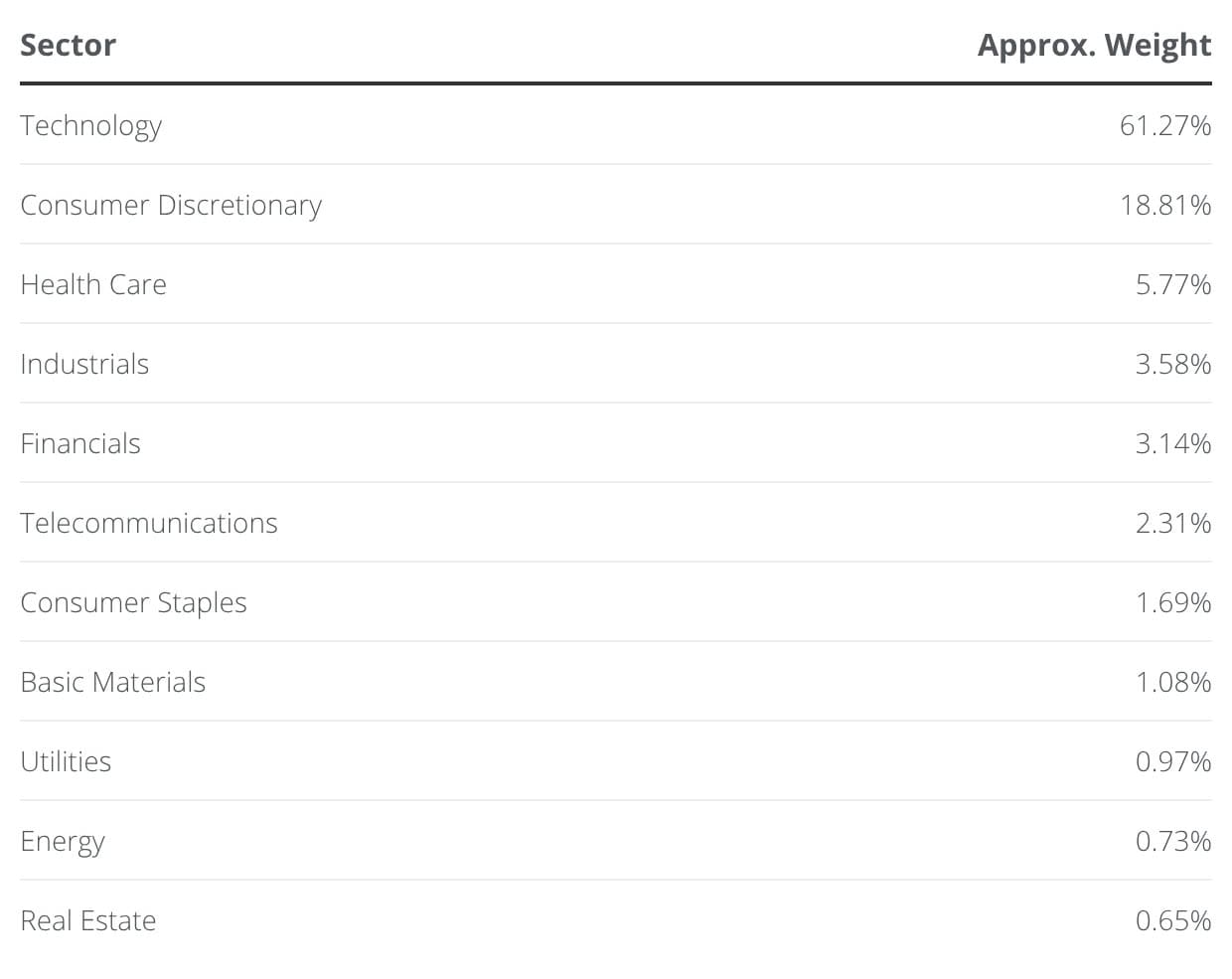
The Dow also includes stocks from multiple sectors. Beyond the focus on industrials implied by its name, this widely followed benchmark of blue-chip stocks comprises companies from nine sectors, where exposure is spread more evenly across top-weighted sectors than in the Nasdaq.
Dow Sector Breakdown
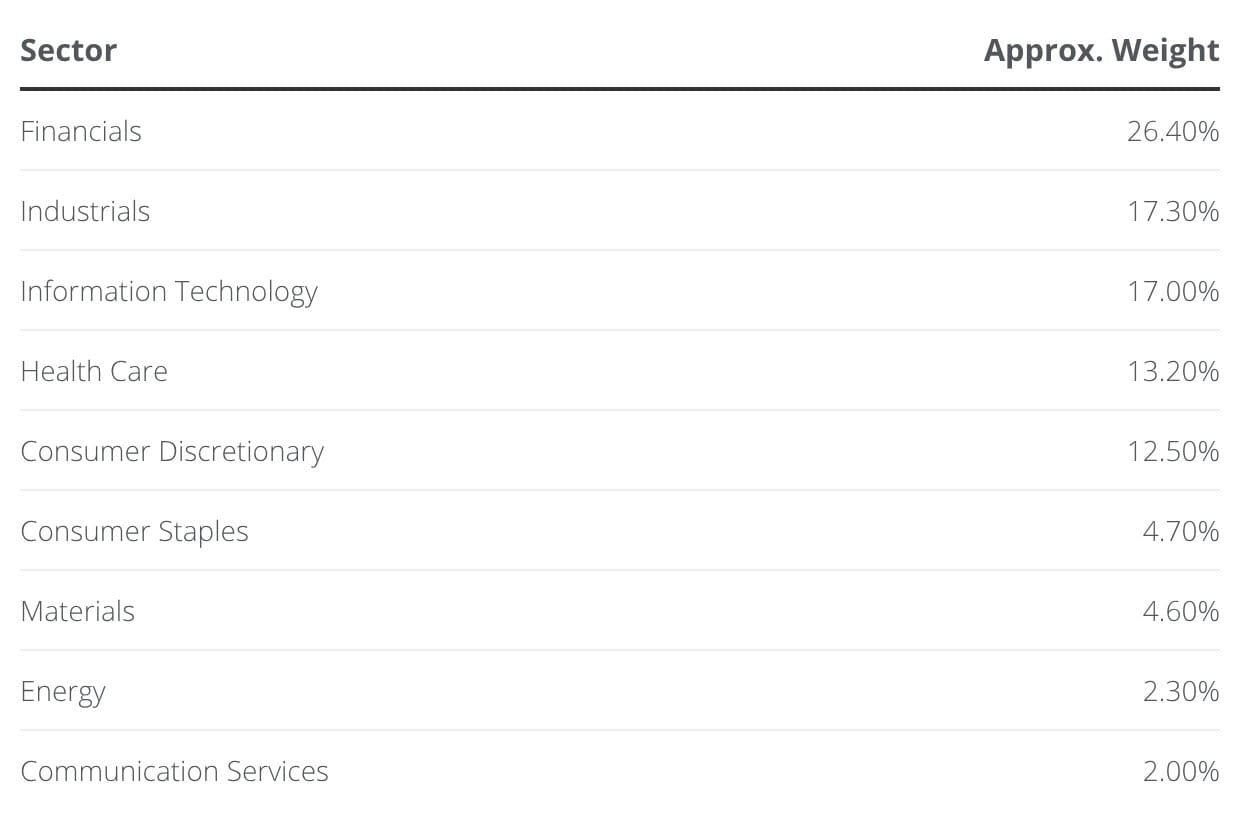
After financials, the Dow’s next-highest concentrations are in industrial and information technology companies. (As of February 27, 2026, each of these sectors accounted for approximately 17% of the total index.) With regard to tech firms, these tend to be mature, diversified entities such as IBM, which can make the index feel more defensive during periods of market volatility.
Potential investor implications
For investors, the Nasdaq and the Dow are useful as contextual benchmarks; they’re not direct investment vehicles like stocks, exchange-traded funds (ETFs) or mutual funds. With that in mind, understanding what each index emphasizes can help investors interpret market trends, assess sector leadership and determine how different types of exposure might fit into a diversified, long-term investment strategy.
Strength in the Nasdaq may reflect greater risk appetite among market participants, along with confidence in growth-oriented companies and innovation-led economic cycles, while stability in the Dow may point to investor preference for stable earnings and consistent cash flows.
Historical performance of the Nasdaq and the Dow
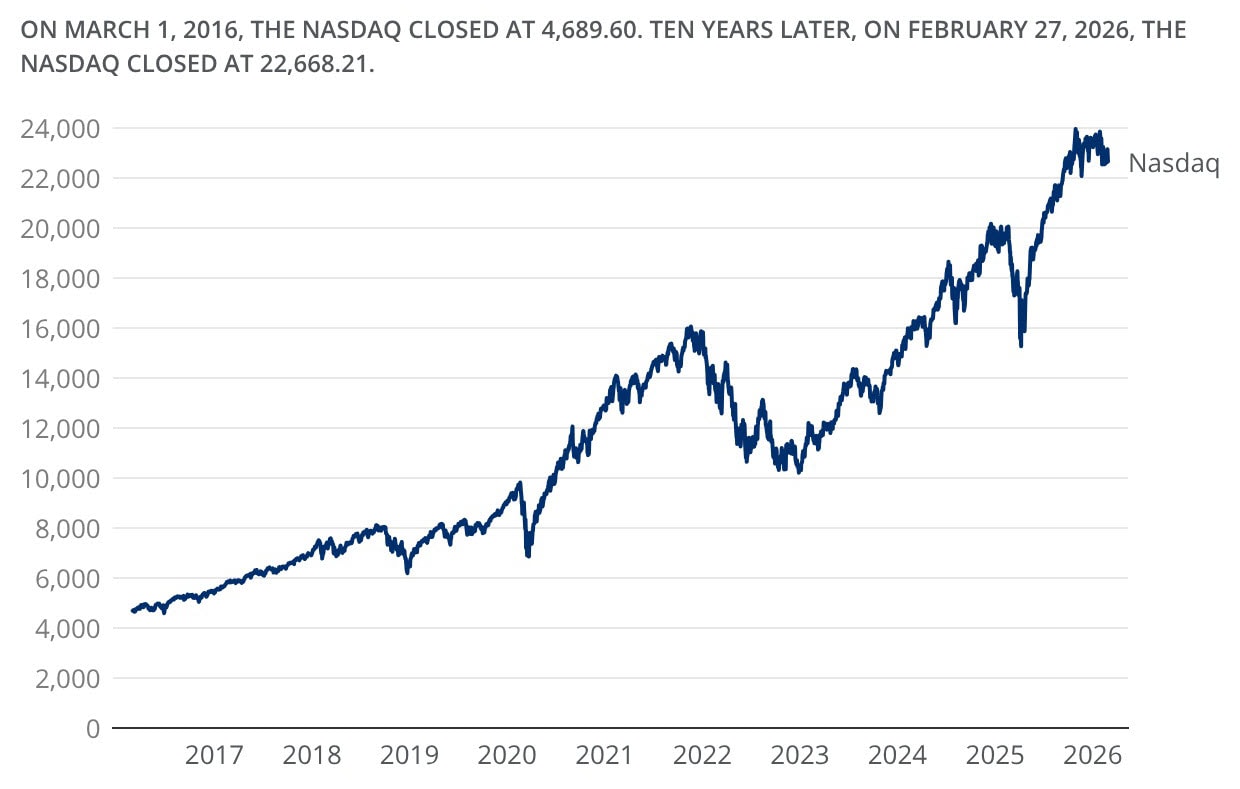
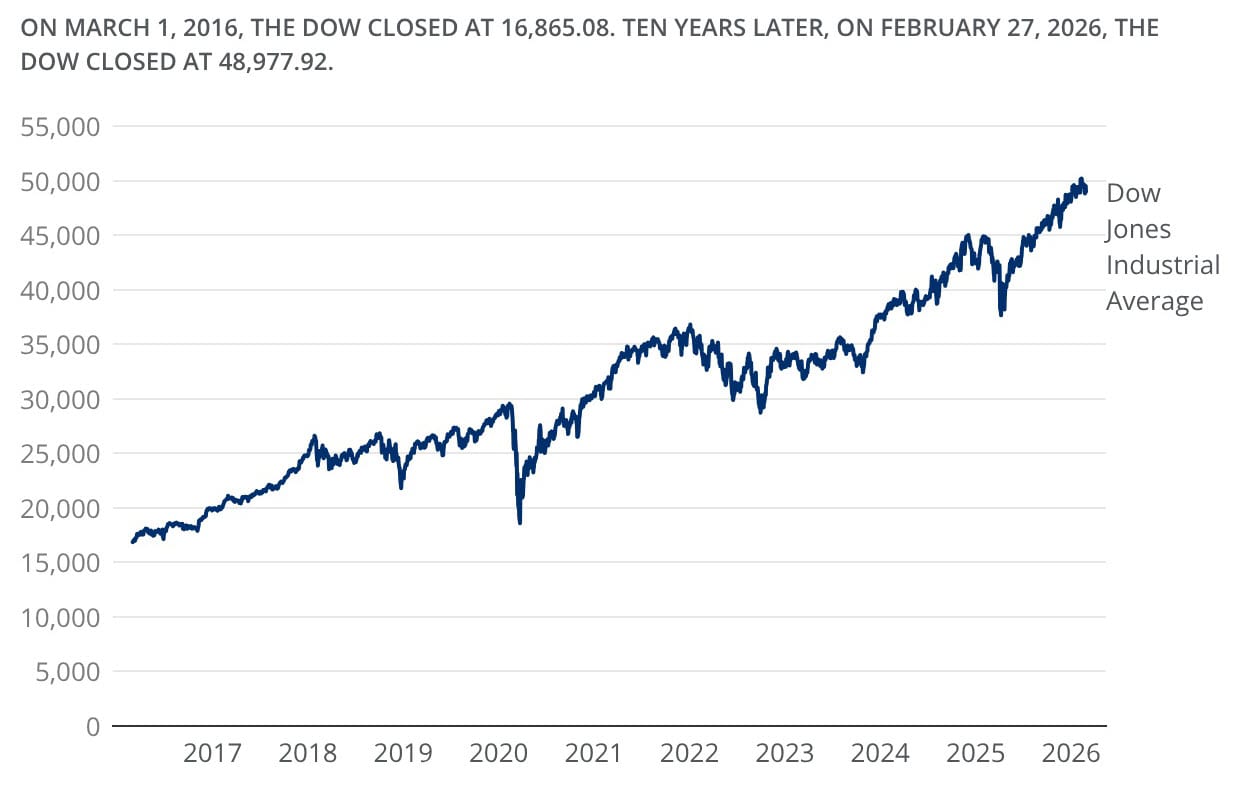
From 2016 to 2026, the Nasdaq Composite and the Dow have followed similar trends in nominal price terms. However, over that same 10-year period, the Nasdaq has seen a roughly 380% gain, while the Dow has seen a 190% gain.
Over time, the Nasdaq Composite has outperformed the Dow during periods of rapid innovation, amid strong growth in technology stocks. For the Dow, outperformance of the Nasdaq has come during more defensive or value-driven cycles, when investors may favor the stability and more predictable income of mature businesses.
Nasdaq Peformance 2016-2026
Dow performance 2016-2026
What investors can watch for with the Nasdaq and the Dow
Whether it be the work-from-home movement that helped drive the strong rebound of the tech-heavy Nasdaq in the wake of the COVID-19 decline or the AI-driven cycle that has caused the Nasdaq to outperform the Dow since the tariff-induced market lows of early 2025, there’s always a narrative at work during bull and bear market cycles.
When money starts rotating from riskier, more growth-oriented stocks to more established blue-chip names active investors ought to be extra “tuned in” to economic data and developing market trends. Market rotation is often a healthy, cyclical market process, but it can also signal a meaningful decline in risk tolerance if accompanied by deteriorating fundamental and technical conditions.
The bottom line
The Nasdaq and the Dow represent different segments of the U.S. stock market. With thousands of domestic and international stocks across all 11 industry sectors – and a strong tilt toward technology and growth – the Nasdaq is a useful barometer of innovation and risk appetite. Tracking 30 large, established U.S.-based companies across a less-concentrated sector basket, the Dow often reflects the health of blue-chip corporate America. Together, these indexes help investors interpret market leadership, shifts in sentiment and how different parts of the economy are performing.
Frequently asked questions about the Nasdaq and the Dow
The Nasdaq typically moves more than the Dow because of its heavy concentration in growth-oriented companies, which can be more volatile than the established companies that make up the Dow.
Yes, a company can be part of both the Nasdaq and the Dow. The Dow Jones Industrial Average is a stock market index, not a stock exchange. Examples of companies that are listed on the Nasdaq and are also members of the Dow include Apple, Microsoft and Walmart.
Determining if the Nasdaq or the Dow is more important depends on investors’ goals and risk tolerance. The Nasdaq is composed of leading technology and growth companies which often reflect trends in growth and innovation, while blue-chip companies with stable earnings make up the Dow.
Invest your way
Not working with us yet? Find a J.P. Morgan Advisor or explore ways to invest online.