U.S. adds 228K jobs in March amidst market volatility: How investors should read the numbers
- The U.S. economy added a robust 228,000 jobs in March, beating forecasts of 140,000.
- The unemployment rate ticked up slightly to 4.2% in March from 4.1% in February. Meanwhile, average hourly earnings grew by a firm 0.3% month-over-month, as expected.
- The March jobs report underscores the resilience of the labor market through March. This supports our strategists’ expectation for the Federal Reserve to keep interest rates on hold in the near term as it evaluates how the economy responds to the expected meaningful increase in tariff rates.
- While our strategists expect U.S. economic growth to decelerate, they do not yet see a recession as the base case. For investors, building a resilient, diversified portfolio remains vital during times of heightened market volatility.

The U.S. economy added a robust 228,000 jobs in March, above consensus expectations of 140,000, according to the Bureau of Labor Statistics (BLS).
However, there were net downward revisions of 48,000 to the prior two months. Job gains were revised down by 34,000 to 117,000 in February and down by 14,000 to 111,000 in January. This lowers the three-month average payroll growth to 152,000 from 200,000 in February.
U.S. nonfarm payroll employment
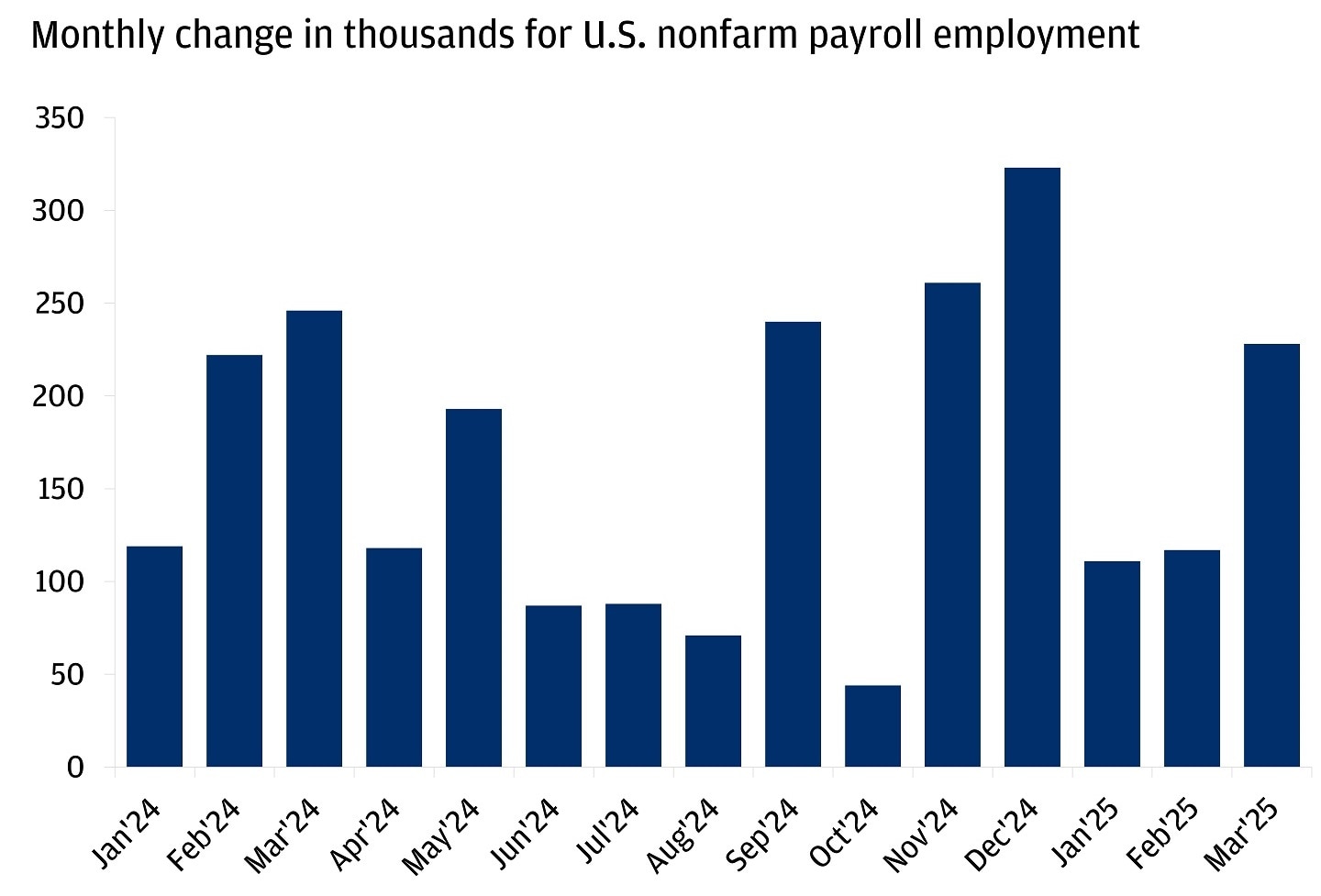
Overall, March’s employment report reaffirms that the labor market remains healthy ahead of potential widespread U.S. tariff increases. If President Donald Trump’s tariff announcement on April 3 is fully implemented, our strategists would expect economic growth to eventually soften, which could weaken the labor market. While the baseline 10% tariff rates are likely to go into effect on April 5, there remains room for negotiations before the higher ‘reciprocal’ tariffs go into effect on April 9.
What does February 2025's job report mean for investors?
For investors, the latest report indicates that the labor market remains on solid footing.
Vinny Amaru, a Global Investment Strategist for J.P. Morgan Wealth Management, says, “Friday’s report shows that the U.S. labor market remained steady in March, but all eyes are on the upcoming employment reports to see how the labor market responds to a significant rise in tariffs. To the extent that they are implemented as announced, we see meaningful downside risks to employment growth in the coming quarters.”
While our strategists expect economic growth to decelerate, they do not yet see a recession as the base case.
Work with an advisor
Our advisors can provide ongoing financial advice on how your portfolio can adapt to the changes in the market, your life and your goals.
How could the Federal Reserve react to February 2025's jobs report?
This report keeps our strategists’ views intact: The Fed is likely to keep interest rates unchanged in the near term as it assesses the health of the U.S. economy within the backdrop of heightened tariff policy uncertainty. Our strategists’ view continues to be that the Fed will lower interest rates throughout the course of the year and could accelerate the pace of interest rate cuts if growth were to weaken meaningfully.
Before the upcoming Federal Open Market Committee meeting on May 6 to 7, the employment report on May 2 will provide a sense of how the labor market is responding to the recent tariff announcements. The Fed will also pay close attention to the next Consumer Price Index (CPI) release on April 10. CPI is a key inflation measure that the Fed will use to monitor inflation’s progress toward its 2% goal and will then be able to assess how higher tariff rates are impacting goods prices.
Industries that gained and lost jobs in March 2025
Job gains were concentrated in the health care, transportation and warehousing, and leisure and hospitality sectors. Employment rebounded in the retail sector, as workers returned from a strike.
Government employment also rose. Within government employment, there was further decline in federal government jobs, which fell by a more modest 4,000 after declining by 11,000 in February. This likely reflects recent measures from the Department of Government Efficiency to reduce the size of the federal civilian workforce.
Elsewhere, jobs gains were little changed, including in mining, quarrying, oil and gas extraction, among other industries.
Unemployment rate and labor force participation ticked up slightly in March 2025
The household survey, which measures the unemployment rate, also pointed to a steady labor market. The unemployment rate rose slightly to 4.2% in March from 4.1% in February. It’s been roughly in the 4% range for the past several months, which shows the labor market remains on solid footing.
The labor force participation rate, which indicates the percentage of working-age individuals who are employed or actively seeking work, was also little changed. It edged up to 62.5% in March from 62.4% in February, consistent with the range seen in the past few years. However, the participation rate for prime-age workers (ages 25 to 54) fell to the lowest level in more than a year.
Wage growth remains steady
Average hourly earnings increased by 0.3% month-over-month (MoM). This reading met expectations and was in line with the twelve month average of 0.3% MoM. The year-over-year change in average hourly earnings was 3.8%, down from 4% in February, but still roughly in the range of where wages have been growing for the past year. The latest data shows that wages continue to grow at a healthy pace that should support consumer spending.
As always, consult with a J.P. Morgan advisor to understand how this data could impact your portfolio.
Explore ways to invest
Take control of your finances with $0 commission online trades, intuitive investing tools and a range of advisor services.