US unemployment ticks slightly higher, economy adds 151K jobs in February
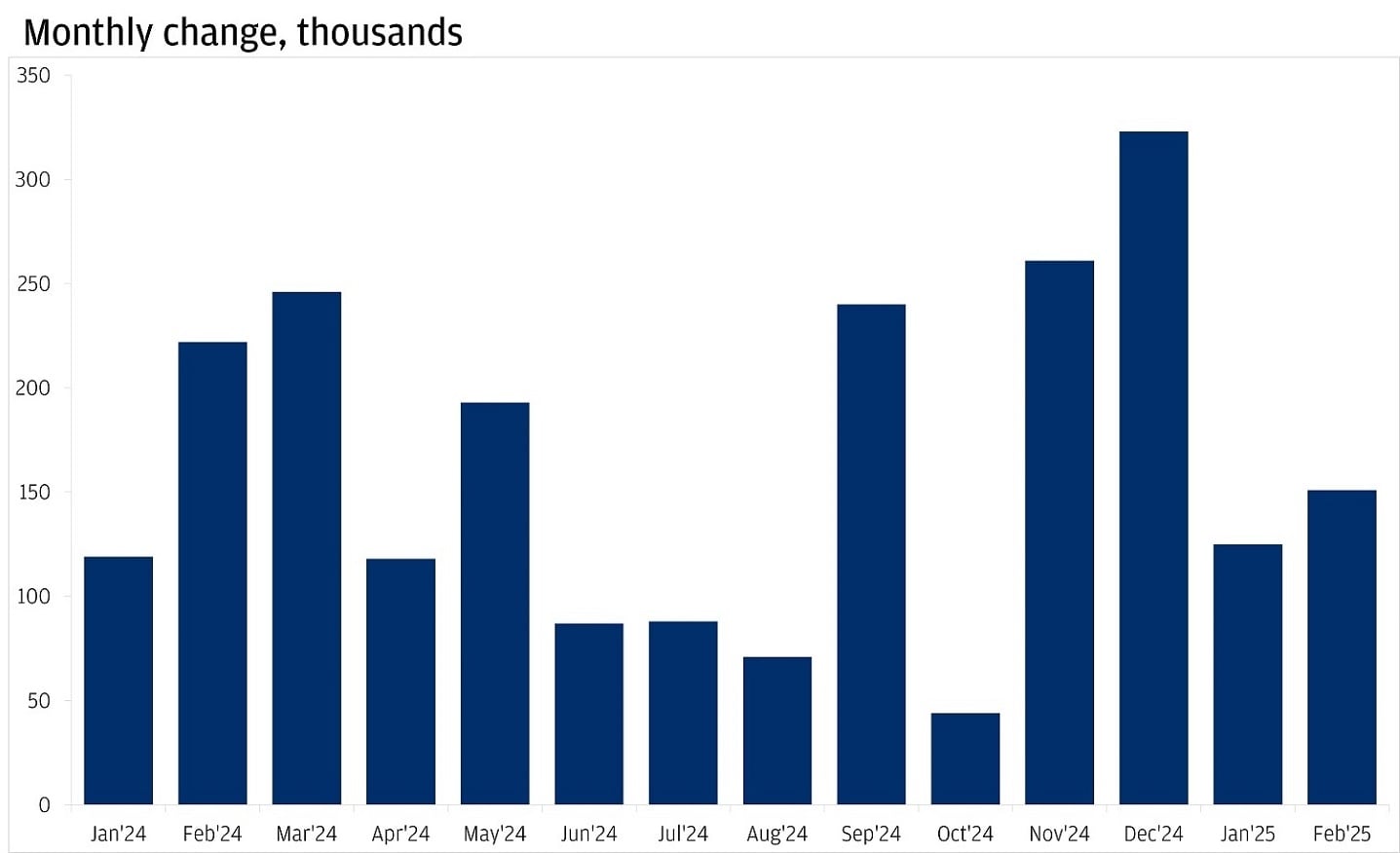
- The U.S. economy added 151,000 jobs in February, slightly below consensus expectations of 160,000 but in line with the 12-month average of 168,000. This confirms that the labor market is roughly balanced.
- The unemployment rate ticked up to 4.1% in February from 4% in January. Meanwhile, average hourly earnings increased by 0.3% month-over-month, as anticipated.
- This report keeps our strategists’ views intact: The Federal Reserve is likely to remain on hold in the near term as it assesses the strength of the U.S. economy within the backdrop of heightened fiscal policy uncertainty. Our strategists’ view also remains that the Fed will lower interest rates throughout the course of the year.

The U.S. economy added 151,000 jobs in February, slightly below consensus expectations of 160,000 but in line with the 12-month average of 168,000, according to the Bureau of Labor Statistics (BLS). This confirms that the labor market is roughly balanced.
Job gains for the prior two months were revised downward, lowering the three-month average payroll growth to 200,000 from 236,000 in January.
U.S. nonfarm payroll employment
Unemployment rate ticked up and labor force participation slightly dropped
The household survey, which measures the unemployment rate, also showed some moderating of the labor market. The unemployment rate ticked up to 4.1% in February from 4% in January.
The labor force participation rate, which indicates the percentage of working-age individuals who are employed or actively seeking work, fell from 62.6% in January to 62.4% in February. The participation rate remains within the range seen in the past few years.
How will the Federal Reserve react to February 2025's jobs report?
This report keeps our strategists’ views intact: The Fed is likely to hold off on further decreases in interest rates in the near-term as it assesses the strength of the U.S. economy within the backdrop of heightened fiscal policy uncertainty. Our strategists’ view also remains that the Fed will lower interest rates throughout the course of the year.
Before the upcoming Federal Open Market Committee meeting on March 18–19, the Fed will play close attention to the next Consumer Price Index (CPI) release on March 12. CPI is a key inflation measure, which the Fed will use to monitor inflation’s progress towards its 2% goal.
What does February 2025's job report mean for investors?
For investors, building a resilient, diversified portfolio remains vital. Our strategists still expect equity upside, supported by strong corporate earnings growth.
Work with an advisor
Our advisors can provide ongoing financial advice on how your portfolio can adapt to the changes in the market, your life and your goals.
In fixed income, our strategists see potential in go-anywhere, actively managed fixed income strategies to take advantage of global opportunities. They continue to favor core bonds as a method to add diversification and a potential buffer against continued market volatility.
A deeper look: Industries that gained and lost jobs
Job gains were concentrated in the health care, finance and construction sectors. Notably, government employment (which includes state, local and federal) also added 11,000 jobs. However, there was a decline of 10,000 federal government jobs.
Further declines in federal government employment could show up in March’s employment data, reflecting recent additional measures from the Department of Government Efficiency to reduce the size of the federal civilian workforce.
Other areas of the economy that saw job losses include the leisure and hospitality and retail trade industries.
Average hourly earnings rose
Average hourly earnings increased by 0.3% month-over-month (MoM). This reading met expectations and was in line with the twelve month average of 0.3% MoM. The year-over-year change in average hourly earnings was 4%, roughly in the range of where wages have been growing for the past year. The latest data shows that wages are growing at a healthy pace that should continue to support consumer spending.
As always, consult with a J.P. Morgan advisor to understand how this data could impact your portfolio.
Explore ways to invest
Take control of your finances with $0 commission online trades, intuitive investing tools and a range of advisor services.