July Jobs report highlights US job growth has slowed significantly; markets react negatively
- Job growth slowed in July with only 73,000 new jobs added relative to expectations for 104,000 gains. The prior two months were also revised meaningfully lower, which indicates the labor market is losing momentum.
- The unemployment rate ticked up slightly to 4.1%, while wage growth remained firm at 3.9% year-over-year. The health care and social assistance sectors remains bright spots for job growth.
- In response, U.S. Treasury yields across the curve moved lower, with the 2-year yield falling by over 20 basis points. Our strategists expect the Federal Reserve (Fed) to be in a position to cut interest rates in the fall.

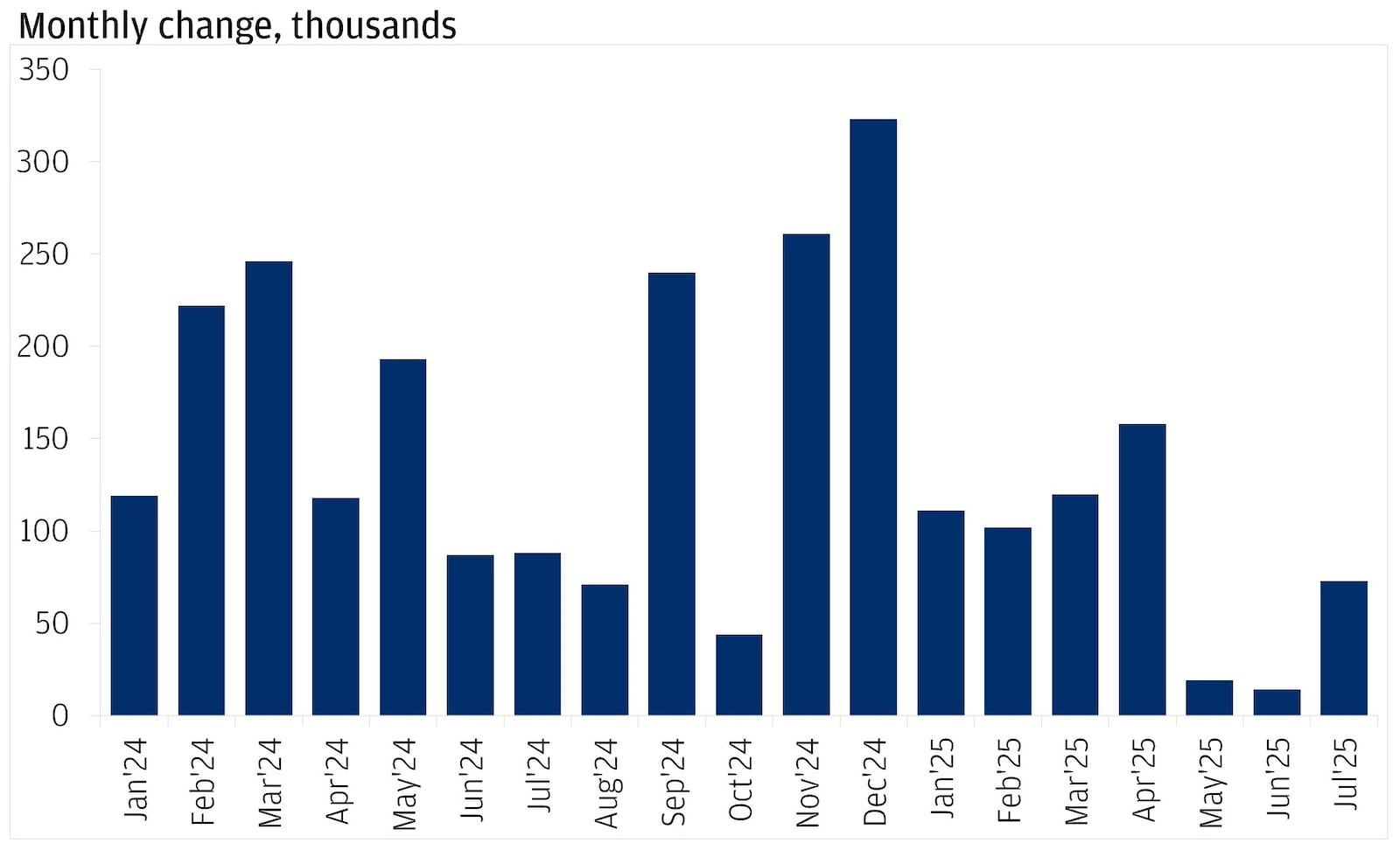
The July 2025 Employment Situation release from the Bureau of Labor Statistics showed that the U.S. labor market has lost momentum after peaking in December 2024.
How did employment data look in the July jobs report?
Nonfarm payrolls rose by only 73,000, far below expectations of 104,000 jobs added.
U.S. nonfarm payroll employment
The unemployment rate ticked up slightly to 4.2%, but it has stayed in a narrow range of 4% to 4.2% since May 2024.
May and June’s job totals were also revised sharply lower, cutting a combined 258,000 jobs from earlier estimates. These revisions suggest that hiring during the spring was not as robust as initially believed, which tempers optimism regarding the labor market's resilience amidst policy and macroeconomic challenges.
How did markets react to the July jobs report?
Immediate market reactions to the report were mostly negative. Stock futures slipped as weaker job growth raised concerns about the economy’s momentum.
Bond yields also fell sharply, with the 2‑year Treasury yield dropping about 0.23 basis points to 3.7% as traders priced in a higher chance of a Fed rate cut. By the end of trading hours on Friday, Dow Jones Industrial Average, Nasdaq and S&P 500 had all dropped sharply.
Work with an advisor
Our advisors can provide ongoing financial advice on how your portfolio can adapt to the changes in the market, your life and your goals.
Elevated policy uncertainty seems to be cooling the labor market
In his briefing on July 30, Fed Chairman Jerome Powell noted that there is a downside risk to the labor market that could influence the Fed’s position on a possible future rate cut. The unemployment rate has remained mostly steady because the supply of workers has declined along with a slowdown in hiring demand. But if that equilibrium breaks, it could prompt a change in the central bank’s stance to act, rather than remain on hold.
Trade tensions are also likely playing a role in the hiring slowdown. Higher tariffs on imports from China, Canada and Mexico have raised business costs and made companies more cautious about expanding their workforce. Industries sensitive to global input costs – such as manufacturing, transportation and trade – showed little change in employment. The “bright spots” in this month’s jobs report were health care and social assistance, which continued to add jobs steadily. This resilience reflects ongoing demand for medical services and support roles, even as the broader economy cools.
How did our strategists view the July jobs report?
Looking ahead, our strategists anticipate that the U.S. economy will continue to slow down, but they do not expect it to enter a recession. Consequently, they foresee the Federal Reserve being able to reduce interest rates by around 100 basis points over the next year. While cash yields are likely to decrease, they do not expect long-term bond yields to decline as significantly.
Despite the softer growth outlook for the U.S., our strategists remain optimistic about further gains in the broad U.S. equity market. This optimism is driven by key sectors in the S&P 500, such as financials, which are expected to benefit from deregulation, and the tech and utilities sectors, which are well-positioned to capitalize on advancements in artificial intelligence.
Given the ongoing uncertainty surrounding trade policy, maintaining a well-diversified portfolio across various sectors and regions continues to be one of the most effective strategies for protecting investors against market volatility.
The bottom line
July’s jobs report confirms a labor market losing steam, with earlier gains revised down sharply. While the unemployment rate remains low, the weaker job growth makes it more likely the Fed will be in a position to cut interest rates in the coming months.
Elevated trade tensions remain a key headwind and investors should consult with a J.P. Morgan advisor to help them navigate these uncertain waters.
Explore ways to invest
Take control of your finances with $0 commission online trades, intuitive investing tools and a range of advisor services.