US adds 139,000 jobs in May, showing gradually moderating labor market

Editorial staff, J.P. Morgan Wealth Management
- The U.S. economy added 139,000 jobs in May, slightly above consensus expectations of 126,000, though negative revisions of 95,000 jobs over the past two months tempers optimism.
- The unemployment rate remained unchanged at 4.2%, with the number of unemployed people holding steady at 7.2 million.
- Job gains were concentrated in health care, social assistance and leisure and hospitality, while federal government employment continued to decline, shedding 22,000 positions in May.
- Average hourly earnings for private nonfarm payrolls rose by 0.4% in May, with a 3.9% increase over the past year, indicating moderate wage growth.
- The labor market is showing signs of waning momentum, but our strategists do not expect the latest data to shift the Federal Reserve from its ‘on-hold’ approach in June.

Total nonfarm payroll employment increased by 139,000 in May, according to the latest data from the Bureau of Labor Statistics. This is short of the 177,000 job gains reported in April (which was subsequently revised to 147,000), but the unemployment rate remained unchanged at 4.2 percent.
U.S. nonfarm payroll employment
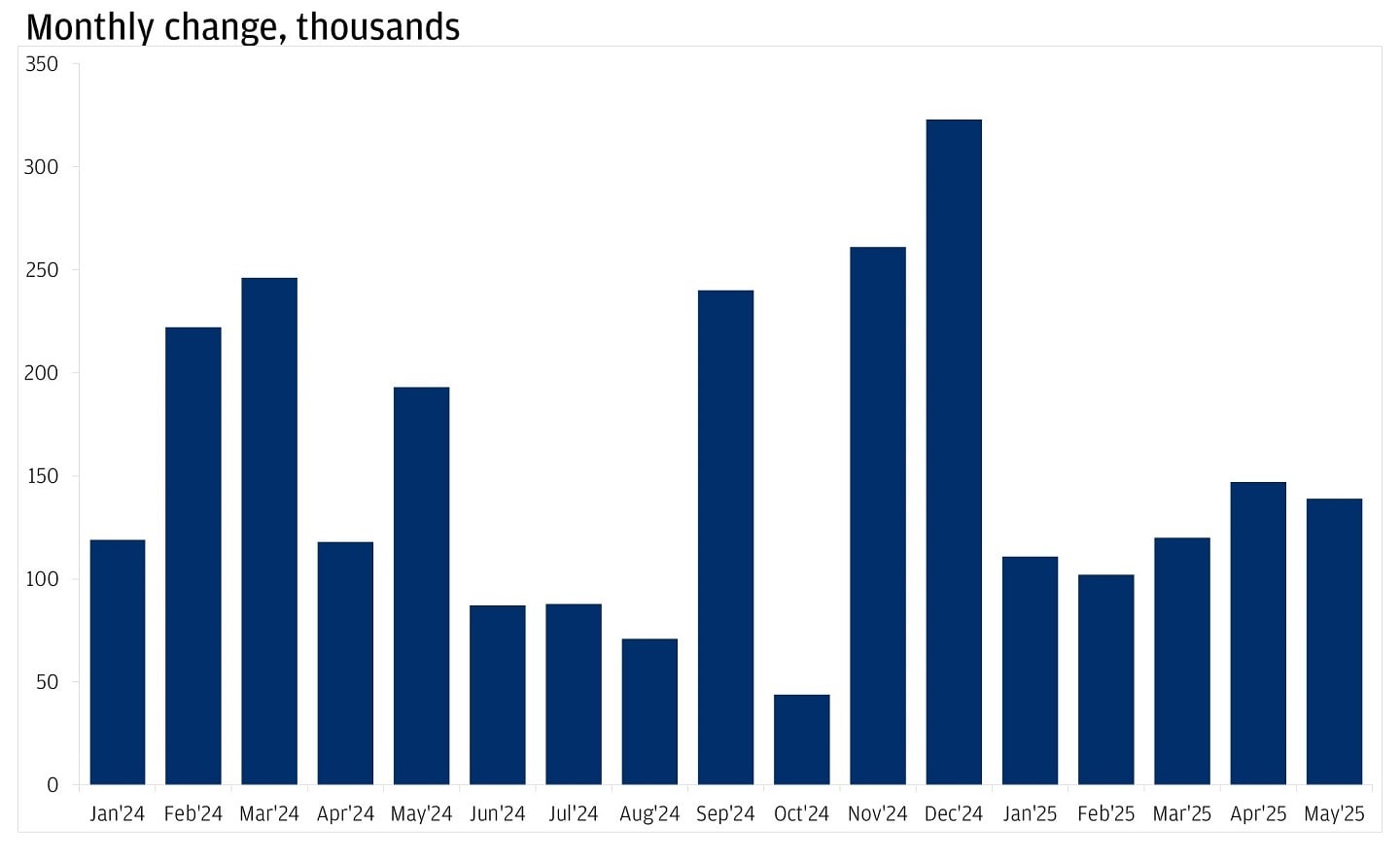
The level of job growth in May fits a developing trend over much of the past year: It was steady but unspectacular, neither an argument for exceptionally strong growth nor an argument for recession.
Sectors that gained and lost jobs in May
Job gains were concentrated in health care, social assistance and leisure and hospitality, which are sectors that have driven much of the job gains over the past few quarters.
While job creation in the private sector remains positive, federal government employment continued its retreat in May, shedding another 22,000 positions. Since January, the federal workforce has contracted by 59,000 jobs. Despite weakness at the Federal level, state and local governments added 21,000 jobs during the month, keeping the overall level of government employment mostly constant.
The number of unemployed people in the U.S. held steady at 7.2 million, and the unemployment rate has now hovered in the narrow range between 4.0 and 4.2 percent for a full year. But not all signs point to strength: The employment to population ratio declined by 0.3 percentage points to 59.7 percent, and the labor force participation rate slipped 0.2 points to 62.4 percent.
These numbers suggest that some Americans are either leaving the labor market or struggling to re-enter it, even as job openings remain available in specific sectors.
Work with an advisor
Our advisors can provide ongoing financial advice on how your portfolio can adapt to the changes in the market, your life and your goals.
Wage growth continues
Wages continued to move higher in May. Average hourly earnings for all employees on private nonfarm payrolls rose by 15 cents in May, or 0.4 percent, reaching $36.24. Over the past 12 months, earnings have grown by 3.9 percent. That level is still above inflation, and should help support household spending, but it also suggests that as the labor market strength has cooled, employee bargaining power has also moderated.
What could May’s jobs report mean for markets and the economy?
May’s report showed that overall, the economy continues to add jobs but those jobs remain concentrated in a few sectors. Small declines in both retail trade and manufacturing could show the beginning signs that tariff impacts are weighing on employment growth.
To that point, Vinny Amaru, a Global Investment Strategist for J.P. Morgan Wealth Management, believes we’re looking at “a labor market that remains healthy but ‘in limbo’ as businesses and consumers alike try to sort through recent trade discussions.”
Interestingly, a cooling trend in temporary help services is an area worth watching. This sector shed the most jobs outside of government in May. Because temp hiring is often used by firms to manage uncertainty without making long-term commitments, it suggests employers are hesitant to ramp up growth, even if they are not yet ready to make meaningful shifts in headcount.
Furthermore, our strategists believe this data is not likely to provide any added incentive for the Federal Reserve to cut interest rates at its June meeting, though the next Consumer Price Index (CPI) release on June 11 could provide more context.
Actionable insights
If you are currently employed and concerned that the economy may cool further, now might be an ideal time to increase your emergency fund contributions. A few extra months of living expenses in cash can make a huge difference.
May’s report paints a picture of a labor market that’s steady, if unremarkable. It’s a good time for consumers and investors alike to prepare for a future that may not be dire, but certainly won’t be effortless.
As always, consult with a J.P. Morgan advisor to understand how this data could impact your portfolio.
Explore ways to invest
Take control of your finances with $0 commission online trades, intuitive investing tools and a range of advisor services.