What April’s solid jobs report means for the stock market and interest rates
- The U.S. economy added 177,000 jobs in April, beating expectations of 138,000. However, there were net downward revisions of 58,000 to the prior two months.
- The unemployment rate remained steady at 4.2%, while average hourly earnings grew by a modest 0.2% month-over-month.
- April’s jobs report underscored the labor market’s resilience in the face of trade policy uncertainties and recent market volatility. This reinforces our strategists’ view that the Federal Reserve will keep interest rates on hold in the near-term as it evaluates how recently enacted tariffs impact the health of the economy.
- Although our strategists anticipate a slowdown in U.S. economic growth, they do not see a recession as the base case this year. For investors, they reiterate that building a resilient, diversified portfolio is key during times of elevated market volatility.

The U.S. economy added 177,000 jobs in April, beating expectations of 138,000, according to the Bureau of Labor Statistics (BLS).
However, there were net downward revisions of 58,000 to the prior two months. Job gains were revised down by 43,000 to 185,000 in March and down by 15,000 to 102,000 in February. Despite the latest revisions, the April jobs number raises the three-month average payroll to 155,000 from 152,000 in March.
U.S. nonfarm payroll employment
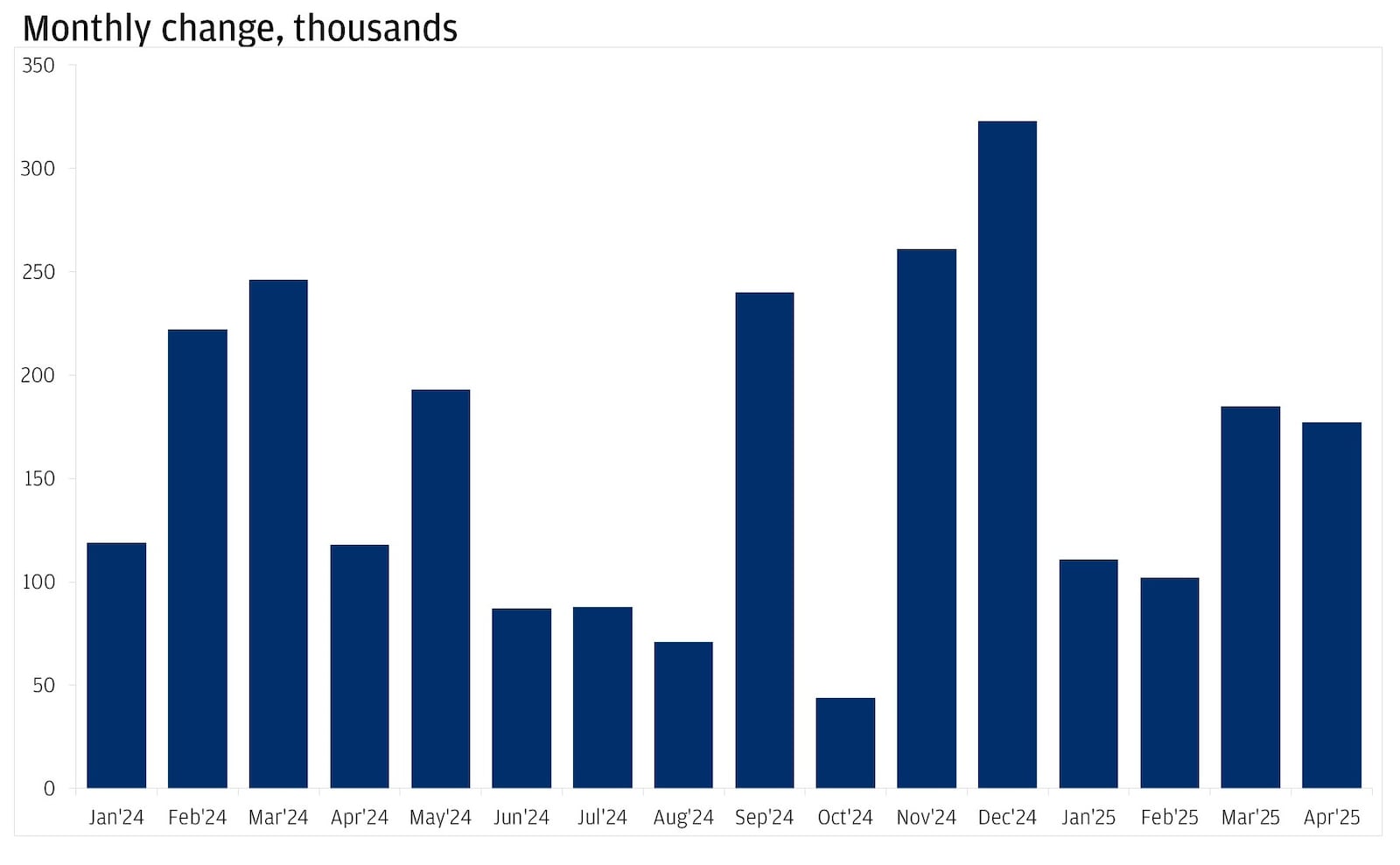
Overall, April’s jobs report underscored the labor market’s resilience in the face of trade policy uncertainties and recent market volatility. Although our strategists anticipate a slowdown in U.S. economic growth, they still do not see a recession as the base case this year.
Sectors that gained and lost jobs
Payroll gains in April were concentrated in the health care, transportation and warehousing, social assistance and financial activities sectors. Notably, transportation and warehousing jobs grew by the most since December, as some businesses likely front-loaded trade in anticipation of tariffs.
Work with an advisor
Our advisors can provide ongoing financial advice on how your portfolio can adapt to the changes in the market, your life and your goals.
Total government employment rose, boosted by state and local government employment. However, federal government jobs declined for a third consecutive month, down by 9,000. Since January, federal government employment has declined by a total of 26,000. This reflects continued measures from the Department of Government Efficiency (DOGE) to reduce the size of the federal civilian workforce.
Elsewhere, jobs gains were little changed or unchanged, including in mining, oil and gas extraction and manufacturing, among other industries.
Household survey remains steady
The household survey, measuring the unemployment rate, pointed to a stable labor market. The unemployment rate was unchanged at 4.2%. It’s been roughly in the 4% range for the past several months, which reaffirms the labor market’s solid footing.
The labor force participation rate, which indicates the percentage of working-age individuals who are employed or actively seeking work, was little changed. It ticked up slightly from 62.5% in March to 62.6% in April, consistent with the range seen in the past few years. The participation rate for prime-age workers (ages 25 to 54) increased to the highest level in the past seven months.
Average hourly earnings increased by a moderate 0.2% month-over-month (MoM), decelerating from a 0.3% MoM rise in March. The year-over-year change in average hourly earnings was unchanged at 3.8%, still roughly in the range of where wages have been growing for the past year. The latest data highlights that wages continue to grow at a healthy pace that should support near-term consumer spending.
How could the Federal Reserve (Fed) react to February 2025's jobs report?
This report reinforces our strategists’ view that the Fed will keep interest rates on hold in the near-term as it evaluates how recently enacted tariffs impact the health of the economy. Still, they expect the Fed to lower rates throughout the second half of the year.
After the upcoming Federal Open Market Committee meeting on May 6 and 7, the Fed will pay close attention to the next Consumer Price Index (CPI) release on May 13. CPI is a key inflation measure, which the Fed will use to monitor inflation’s progress towards its 2% goal.
What does February 2025's job report mean for investors?
For investors, building a resilient, diversified portfolio remains key during times of elevated market volatility.
Our strategists continue to expect slowing but positive economic growth in 2025. Going forward, investors will continue to closely monitor upcoming employment reports to examine how the labor market is reacting to recently enacted tariffs.
For investors, our strategists continue to see benefits in a globally diversified multi-asset portfolio to mitigate potential market volatility and reduce being overly exposed to any single market or event.
As always, consult with a J.P. Morgan advisor to understand how this data could impact your portfolio.
Explore ways to invest
Take control of your finances with $0 commission online trades, intuitive investing tools and a range of advisor services.