August jobs report shows stalling labor market; rate cut could be on the way
- Job growth stalled in August, with only 22,000 jobs added against expectations of 75,000.
- The unemployment rate changed marginally in August, slightly ticking up to 4.3% from 4.2% in July, further illustrating slowing labor market conditions.
- Our strategists believe this employment data could keep the Federal Reserve on a path to cut rates in September.

Summer is over and fall appears to be on the horizon for the U.S. labor market following a disappointing August employment situation release.
How did employment data look in the August jobs report?
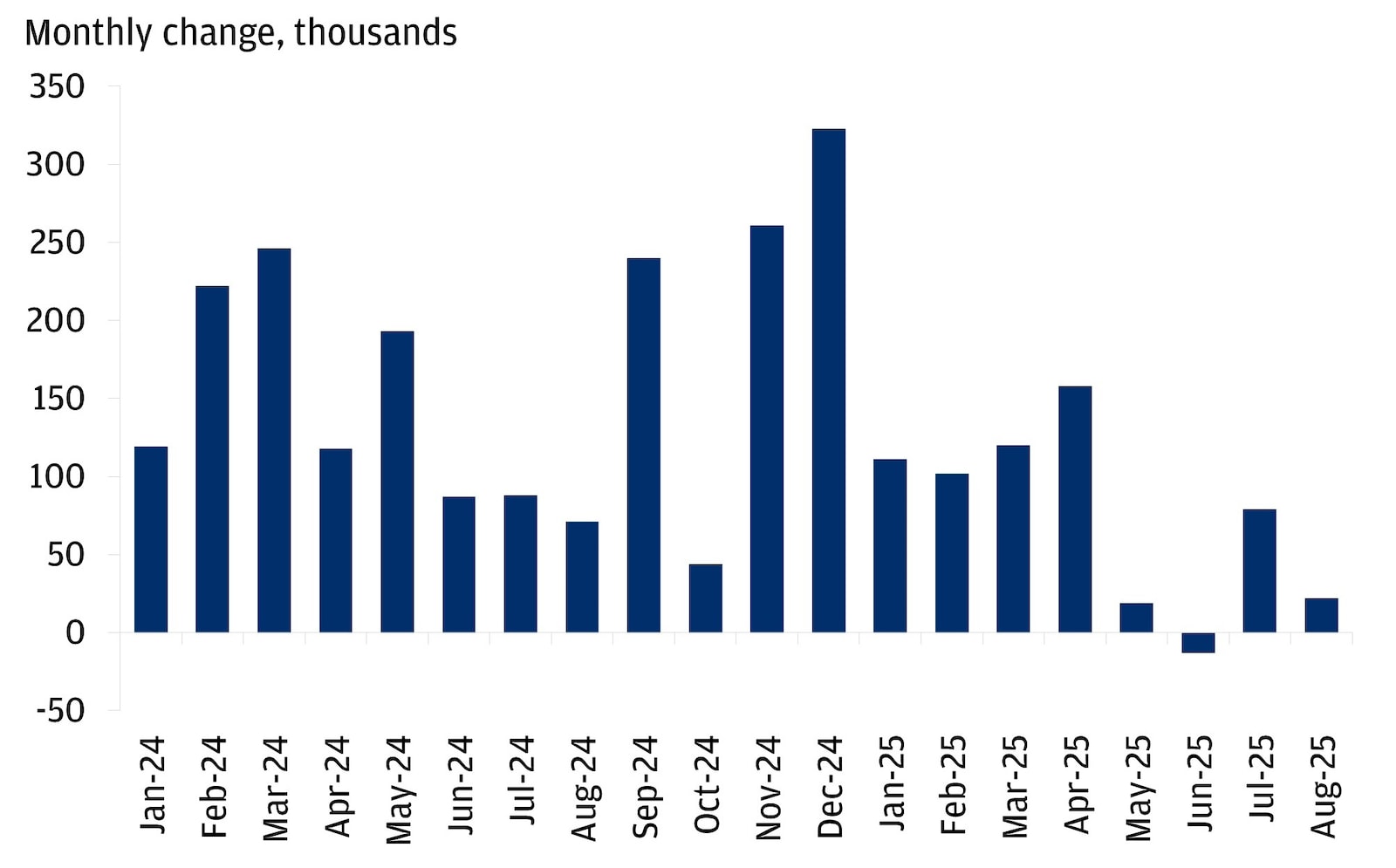
The Bureau of Labor Statistics (BLS) reported that total nonfarm payrolls “changed little” with a gain of 22,000 jobs in the month, compared to expectations of over 75,000 jobs added.
U.S. nonfarm payroll employment
The unemployment rate ticked up slightly to 4.3%, up from 4.2% in July, but in line with expectations.
Revisions showed June’s job numbers moving from a small gain to a loss of 13,000, while July’s ticked up to 79,000, leaving the prior two months a net 21,000 jobs lower than expected.
Ready to take the next step in investing?
We offer $0 commission online trades, intuitive investing tools and a range of advisor services, so you can take control of your financial future.
What sectors gained and lost jobs in August?
The story of August was the offset between the health care industry and pockets of weakness in government and goods-related industries.
August 2025 jobs breakdown by sector
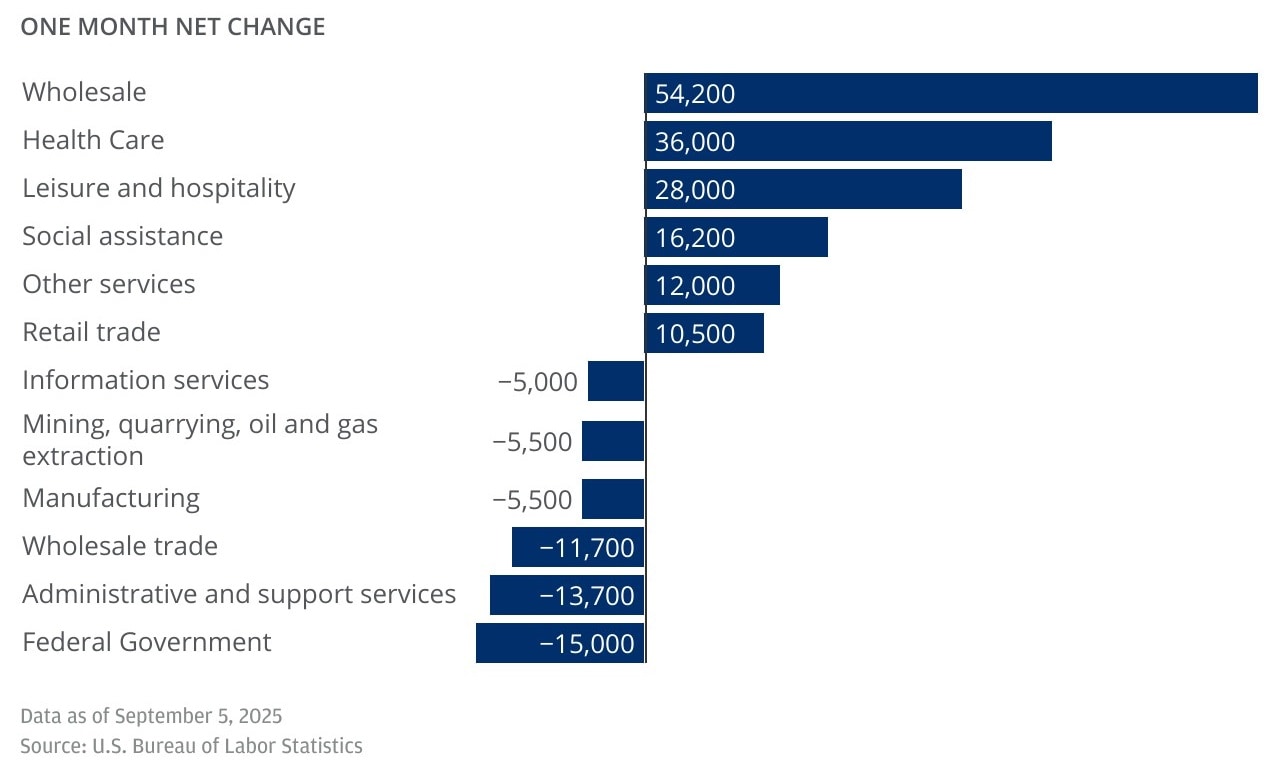
Looking across major sectors, the largest job gains came in health care, which was up 30,600 on a seasonally adjusted basis, social assistance, up 16,200, and leisure and hospitality employment, up 28,000. Within that sector, both arts and recreation, and accommodation and food services advanced. Other services rose by 12,000 and retail trade increased by about 10,500.
On the downside, federal government employment fell by 15,000, administrative and support services declined by about 13,700, manufacturing decreased by 12,000, wholesale trade dropped by 11,700, and mining, quarrying, and oil and gas extraction fell by 5,500. Information services, led by losses in motion picture and sound recording industries and telecommunications, slipped by 5,000.
How did markets react to the August jobs report?
Despite the slowing payroll numbers, markets initially reacted positively to the August jobs data in anticipation of a Federal Reserve (Fed) rate cut in September.
However, those reactions were quickly mitigated by concerns over a slowing economy. The S&P 500, for example, dropped 0.8%, while the Nasdaq Composite fell 0.7%. Additionally, the Dow Jones Industrial Average declined 0.7%.
While none of those figures are particularly alarming, it does show more tempered near-term investor optimism, as the economy shows signs of slowing.
What’s next for the Federal Reserve after the August jobs report?
Our strategists believe that the latest jobs data should keep the Fed on track to cut interest rates at its upcoming September meeting, likely by 25 basis points as hiring continues to cool. Any interest rate cut would be the Fed’s first since December 2024.
While the lower-than-expected payroll figures show that a slowdown in the economy is underway, our strategists maintain that a recession is still unlikely.
To understand how this data could affect your portfolio, consider consulting with a J.P. Morgan advisor.
You're invited to subscribe to our newsletters
We'll send you the latest market news, investing insights and more when you subscribe to our newsletters.