
4 ways market volatility can present an opportunity for investors

Editorial staff, J.P. Morgan Wealth Management
- The ups and downs in the financial markets can be nerve-racking, but understanding and embracing volatility can help you sharpen your investing strategy.
- Factors like economic developments and geopolitical events can contribute to volatility.
- Keeping sight of your long-term financial goals can help you stick to your plan in times of volatility, and you might even find attractive investment opportunities when asset prices decline.

Market volatility can feel scary, especially since it is outside of your control. But understanding volatility can help you make smarter decisions and even spot opportunities.
“Volatility is a feature, not a bug, of investing,” said AJ Oden, Global Investment Strategist for J.P. Morgan Wealth Management. “Over the past 40 years, the S&P 500 stock market index has seen average intra-year drawdowns of -14%, but the market also has a tendency to recover. Despite the pullbacks along the way, the index managed to post positive returns in over 75% of the years in that observation period.”
Bull markets come and go – but the market has historically spent more time rising than falling
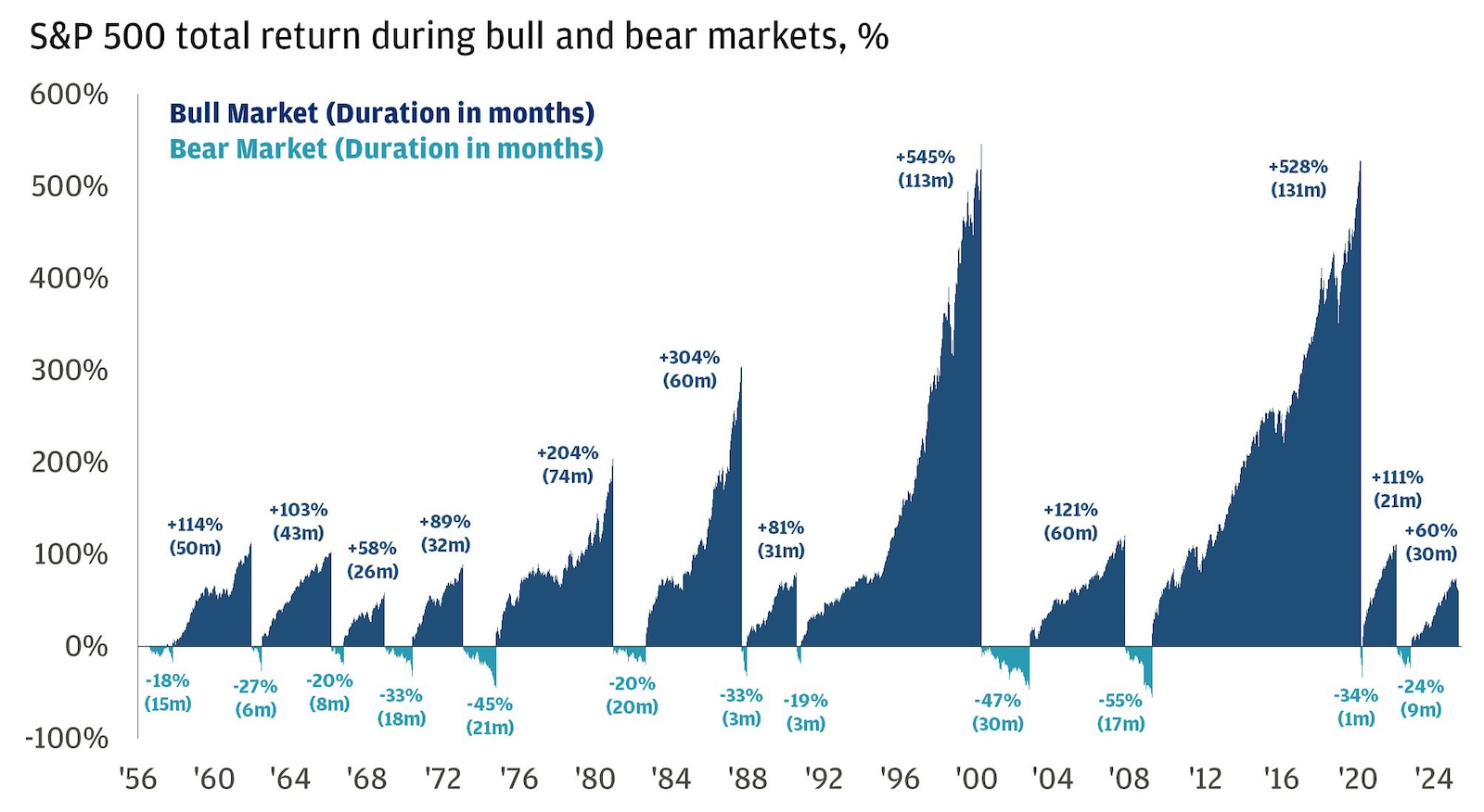
Here’s a guide on what market volatility is and how you may be able to turn it to your advantage.
What is market volatility?
Market volatility is a measure of how market prices fluctuate over the short term, whether that time is measured in days, weeks or months. Volatility is a normal part of how open markets function as buyers and sellers negotiate prices based on constantly changing information. The bigger the price swings, the greater volatility you have.
The Chicago Board Options Exchange (CBOE) tracks market volatility with its Volatility Index, known as the VIX, by following options trades that try to predict future prices. If you want to know how volatile stock markets are, the VIX could be a useful indicator.
But you don’t need to have a math degree or be a regular stock price watcher to know what volatility feels like. Seeing the balance of your investments fall one day and rise the next, just to fall again the day after, gives you a sense of what volatility is all about.
Get up to $1,000
When you open a J.P. Morgan Self-Directed Investing account, you get a trading experience that puts you in control and up to $1,000 in cash bonus.
What causes market volatility?
Markets are volatile when buyers and sellers have a hard time agreeing on the prices of assets, like stocks. Sellers may think it’s time to get out of risky positions, and buyers may think sellers are overestimating risk.
A recent example happened in April 2025 when President Donald Trump announced he was imposing a minimum 10% tariff on all exporters to the U.S. and additional reciprocal duties on approximately 60 nations with the largest trade imbalances with the U.S. The move triggered market volatility at levels not seen since the onset of the COVID-19 pandemic and the financial crisis of 2008.
This is just one example, but several things can trigger market volatility. Here are a couple of them:
Economic news (like inflation or job reports)
A major driver of market volatility is economic news. Every month, the U.S. government releases statistics on how many people are employed or unemployed, as well as a report on how quickly the prices of goods and services are rising or falling. Eight times per year, the government provides an update on whether the Federal Reserve will change interest rates or leave them as they are.
Additionally, at the end of every quarter, publicly traded companies must tell shareholders how their businesses are doing by releasing earnings reports, and taken collectively, that information can paint a picture of whether the economy is growing or contracting. Surprising news, whether good or bad, can cause market swings and volatility.
Political events
News of an upset in political stability can also lead to market volatility. The Russian invasion of Ukraine in 2022 and the war between Israel and Hamas beginning in 2023 have both led to short-term increases in volatility in some assets, like stocks and commodities. Once markets have an idea of how the new state of affairs is likely to play out, volatility generally subsides.
How can investors handle volatility?
Handling volatility comes down to preparation and mindset. Here are a few investing pillars to protect you during periods of volatility:
Revisit your financial plan
Market swings are a good time to revisit your investment goals. Ask yourself if your goals and risk tolerance are still aligned with your current strategy. For example, if you are within 10 years of retirement, and you haven’t updated your plan for a decade, you may want to be more aggressive in de-risking your investments. On the other hand, if you are in your late 20s or early 30s, and you have extra cash savings, this may be an opportunity to take advantage of market dips.
“Reaping the rewards of investing means tolerating the risks – generally speaking, using more volatile assets like stocks to pursue longer-term goals can offer a compelling risk-return trade-off,” Oden said. “They can have bad months, quarters, even years, but history shows that stocks tend to rise over multi-year time horizons.”
What does it mean to “buy the dip?”
Here, we’re not talking about tailgate party prep to have something to go with your chips. “Buying the dip” refers to the act of purchasing an asset when the price for that asset drops, often as a result of market volatility. Solid companies with a good product and a record of profits often get swept up in the downdraft of market volatility, and when their prices drop, it may be a good opportunity to “buy the dip.”
A recent example is the market correction that occurred when the Federal Reserve started raising interest rates in 2022. The S&P 500 went from a high of 4,778 in January to a low of 3,647 in October of that year, a 23% drop. Investors who bought at the low that year had a 64% return by January 2025, less than two years later.
Rebalance your portfolio
Volatility can shift your investment mix away from your original plan. Rebalancing means adjusting your portfolio to bring it back to your original investment goals. This keeps your risk at the level you're comfortable with. It is also an opportunity to offset capital gains in some stock sales with capital losses in others. This is called tax-loss harvesting, and it is an effective way to rebalance your portfolio without having to pay a large tax bill at the end of the year.
Keep things in perspective
Markets have historically recovered from volatility and downturns. Short-term losses might feel uncomfortable, but markets typically move upward over the long run. Keeping perspective means staying calm in the face of unpredictability and trusting that your financial plan is robust enough to weather market ups and downs.
Remember your long-term goals
Investing is about patience. Remembering your long-term goals helps you stay calm during market ups and downs because it keeps your focus on the bigger picture, not daily swings. When you're clear about what you want to achieve – like retirement, buying a home or creating generational wealth – short-term volatility becomes less scary. It reminds you that investing is about consistent progress over time.
“It’s crucial to establish a thoughtful plan that takes your goals, your time horizon and your risk tolerance into account,” Oden said. “Investing with intention can give you the confidence to stay invested, even when markets get bumpy.”
The opposite of centering your investment strategy in your long-term goals is attempting to time the market: buying or selling based on near-term impulses. Many studies over decades have shown that when individuals try to time their buying and selling based on market moves, their portfolios perform more poorly than investors who take a slow and steady approach.
Despite intra-year swings, equities tend to reward investors over time
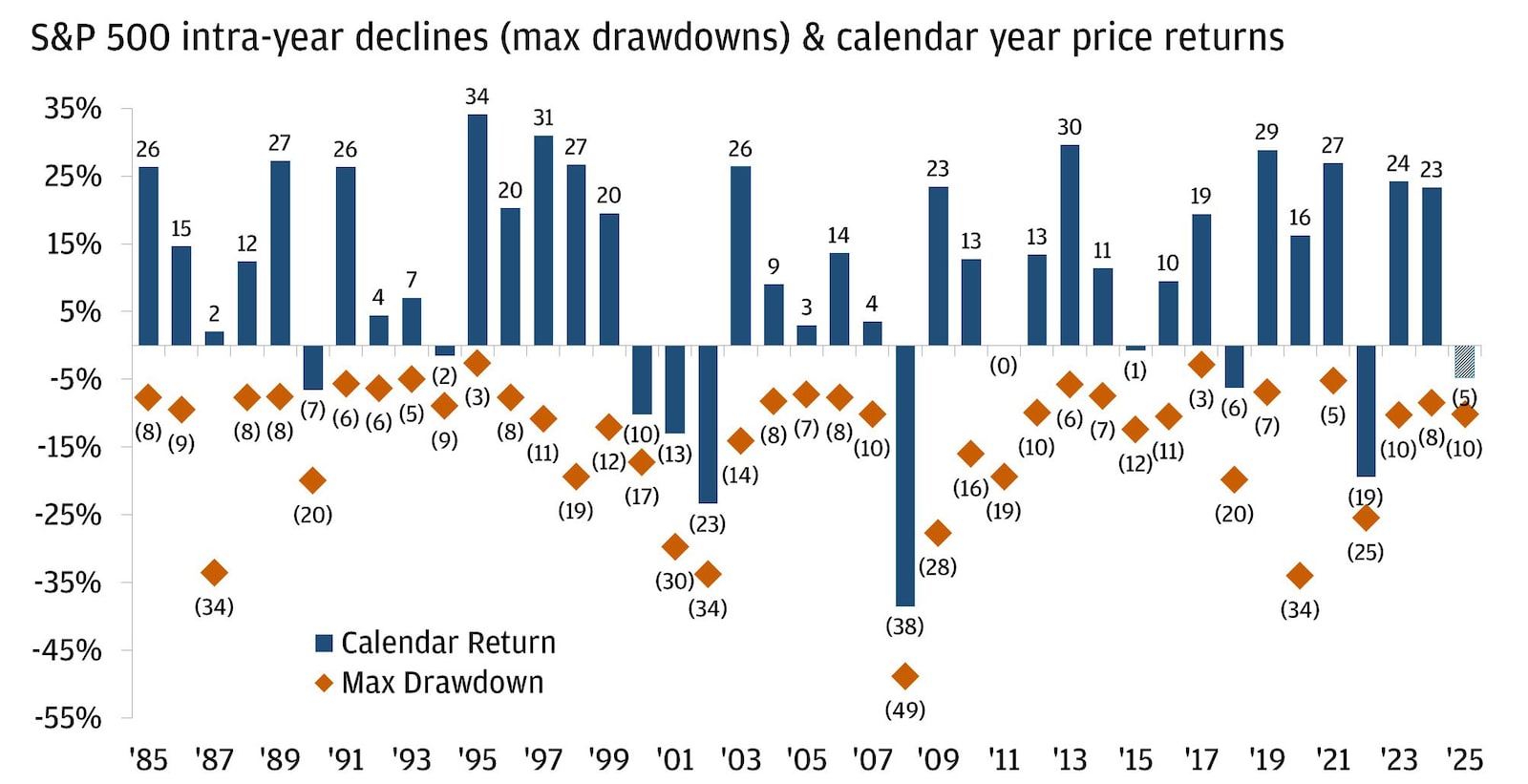
The bottom line
Market volatility is a normal part of investing. Instead of fearing it, try to see volatility as an opportunity. Stay calm, stick to your plan and consider taking advantage of market dips. Understanding and embracing market volatility can transform uncertainty into opportunities – if it aligns with your risk tolerance – helping you build your investment future.
If you have questions or concerns about your current plan, consider reaching out to a J.P. Morgan advisor.
Frequently asked questions about investing during market volatility
Volatility creates opportunities to buy investments at lower prices. It also helps investors understand their true risk tolerance.
During volatile times, investors often panic and sell investments at lower prices. Smart investors stay calm, follow their strategy and look for buying opportunities.
"Buying the dip" involves buying – and sometimes waiting to buy – stocks when prices drop. "Dollar cost averaging" means regularly investing the same amount of money periodically, regardless of market conditions. Dollar cost averaging usually reduces stress and risk, though keeping some cash savings on hand to buy the dip can potentially snag some bargains on quality investments.
Yes, volatility can offer potential opportunities. Investing consistently, even during volatility, has often led to better long-term results.
A diversified portfolio can help you weather market storms. Consider investing in diversified funds or exchange-traded funds (ETFs), bonds or stocks of reliable companies. Diversification can help manage risk and smooth out volatility.
Invest your way
Not working with us yet? Find a J.P. Morgan Advisor or explore ways to invest online.