Financial strategies for professional women athletes to help thrive during and beyond their sports careers

Executive Director, Wealth Advisor
J.P. Morgan Athlete Center of Excellence
- Set yourself up for success: Women athletes can face unique financial challenges, like the gender pay gap and fitting family planning into a sports career. Creating a financial plan helps ensure that your success on the court or field can carry over to your bank account.
- Understand your income and taxes: Learning the difference between income types and their tax implications, particularly if you have different income sources, can help you maximize your earnings.
- Start investing and revisit your portfolio regularly: Investing early gives your money time to grow. Checking in at regular intervals also allows you to adjust your strategy as your financial goals grow with you.
- Branding is key: Cultivating a strong personal brand can open doors to non-sports earning opportunities such as endorsements and partnerships. This may be especially important as you near the end of your playing career.

Financial planning, money management and leveraging your platform can be an ongoing challenge for professional athletes. Athletes often make money in nontraditional ways, juggle busy travel and training schedules and may have shorter career spans than non-athlete professionals.
Professional women athletes in particular face unique challenges and opportunities in their sports careers. On average, 82% of their pay comes from endorsements versus playing time. This is a byproduct of the gender pay gap, which remains large in professional sports, but also showcases the value of women athletes: Brands want to partner with them.
Nowadays, a key part of the endorsement equation is social media, and women athletes drive two times more social engagement with fans compared with male athletes. This means more time dedicated to their personal brand to help elevate their platform and land deals.
Family planning is another area that involves different considerations for women athletes than it does for men, and it can be hard to prepare for financially. But in spite of this and other challenges, many women athletes have successful careers. In the evolving landscape of professional sports, knowing how to manage your money can go a long way in maximizing your success and supporting your professional and personal goals.
Here’s a financial guide for women athletes in different stages of their careers with information on income types, investing, personal branding and more.
Types of athlete income and tax implications
The type of income you make as an athlete varies depending on the stage of your career, what income sources you have and how your sport structures pay. It’s possible and even common for one athlete to have multiple different types of income, such as income from a sports contract, partnerships or endorsements and even social media. This can make understanding the tax rules that apply to you more complicated.
Generally, it’s important to know two main types of income: W-2 income and 1099 income. W-2 income is taxable income you earn from an employer, and it’s called this because your employer will send you a Form W-2 for tax reporting purposes each year you’re on their payroll. This form details your gross and net income (gross being total, and net being after taxes and other deductions). Depending on how much you asked them to withhold from your paychecks for taxes, you might be owed a refund, or you might owe money to the IRS.
The other primary income type, 1099 income, is also called self-employment income. When you earn income from self-employment, you receive a Form 1099 from most sources of income you had throughout the year. Income that usually falls under the 1099 umbrella for athletes includes endorsements/sponsorships as a professional (depending on contract terms) and competition prize money. To avoid possible penalties and interest, you may need to make estimated tax payments each quarter for 1099 income.
A main difference between W-2 income and 1099 income is that with W-2 income, the employer shares some of your tax burden. With 1099 income, you’re required to pay payroll taxes (Social Security and Medicare) by yourself – on top of income taxes – which means you’re paying a higher percentage toward taxes.
You should consult with a tax professional to understand specific tax implications and how those apply to your sources of income.
Income for athletes across their career
Here's how your income as a professional athlete may be structured across your career:
Early professional career – Finding your footing and establishing goals: This is the time you may be hustling to secure endorsement/sponsorship deals, building your brand, and envisioning the future of your career and finances. If you set a goal to buy a new car, for example, you can work toward it by securing a contract with a team/organization or landing a brand partnership. These early milestones pave the way to a successful career while instilling confidence in your money-management skills.
Mid-career – Remembering to check in with yourself: At this point you probably understand your sport and earnings capability a lot better. You may have several income sources. Importantly, and especially if your athletic career is your main income source, you’ve established an investing strategy that will make your earnings last well into retirement. This is a key area for professional athletes, as they may retire in their 30s and 40s (some even earlier).
Late career – Prioritizing retirement planning and personal branding: As you near the end of your playing career, the focus shifts to more advanced retirement planning. You may be considering things like charitable giving and tax strategy as you prepare your finances for the next step. You may also be investing in your personal brand and income opportunities outside your sport. This can look like sports analysis/broadcasting, coaching, continued endorsement deals or leveraging your personal brand to pursue an entirely different career path.
Financial education for women professional athletes
Looking at the career journey of a professional athlete, you might understand why financial education is so important. The average non-athlete professional who starts working full time between 18 and 22 years old knows they have many years – decades even – until they hit their max earning potential. But the average professional athlete has a relatively shorter amount of time to hit their stride and maximize their earnings before their playing days are done.
You don’t need to be an expert, but it’s good to start educating yourself on finances sooner rather than later. Money was on the mind of pro skier Lindsey Vonn well before she won her Olympic medals.
"When I was making my plan to make the Olympics, I went through it with my dad and he said, 'If you can make the team and reach these and these goals in five to 10 years, you could potentially be making this much money,'" she said in an interview with Chase Bank. "We had big, big goals. And that's where I give my dad a lot of credit, because I thought about that and have always thought about how I could transcend sport."
Some basic financial concepts that can prove useful to professional athletes include:
Cash-flow management
One key consideration is monitoring and controlling your cash flow, or the money coming in (what you’re earning) and going out (what you’re spending), so you can make sure you’re addressing short-term spending needs while also contributing to longer-term asset growth.
Budgeting
Creating a financial plan that stipulates what you spend (or save) during a given period of time is another important step toward financial success. For example, you could make a monthly budget that splits your income into different categories: bills/necessary spending, discretionary/fun spending and saving/investing. This can help you cut down unnecessary spending and put more money toward your financial goals, which vary person to person.
Building credit
You may also want to focus on building your credit score or taking steps to improve your current credit score. To start building your credit, you may open a new line of credit, such as taking out a car loan or applying for a credit card. It’s important to make regular, on-time payments and keep your credit utilization low, meaning you’re not using a high percentage of your total available credit.
These tools can help you learn how to manage your newfound income and create a solid financial foundation. Budgeting and cash-flow management can be tricky if you have fluctuating sources of income, as many athletes do, but it makes mastering those skills that much more rewarding. These are skills that also lend themselves to building credit. A good credit score can help you qualify for rentals and eventually better loan terms to help achieve key financial milestones like homeownership.
How women professional athletes can invest across their career to build long-term wealth
Learning the basics of investing can be especially valuable for professional athletes. Done thoughtfully, it can help build wealth over time and support long-term financial goals as you approach retirement.
Like with non-athlete professionals, your investing journey will probably look different at each stage of your career:
Early career: A young athlete may be more focused on getting started and developing a foundational investing strategy. This can look like learning the investing basics, opening investment accounts such as a standard taxable brokerage account or an individual retirement account (IRA) and determining what assets you’d like to invest in.
Mid-career: At this point, you likely understand investing. With more time and money, your portfolio may have expanded to include real estate; you may have started prioritizing retirement savings more; and if you have a family, you may have opened a 529 account to save for a child’s future education expenses. Throughout your career, you’ll want to periodically revisit your investing strategy as your income changes to make sure your contributions are aligned with your earnings and support your near- and long-term financial goals.
Late career: A late-career athlete is more likely to be focusing on retirement and tax management strategies. You’ll be gearing up for the transition to post-playing life, where your income may look different. If you’ve invested strategically, your portfolio will be set up to support you during this transition and as you step into new opportunities.
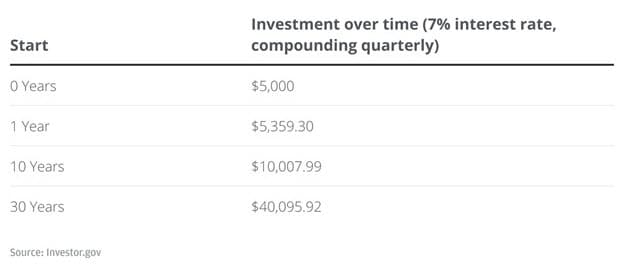
The best part about investing, through it all, is the magic of compound interest. Over time, the money you’ve invested grows as your investment assets appreciate. Then, not only are you earning returns on your initial investment/principal, but you’re earning returns on top of returns. This is why the simple advice to “stay invested” (rather than taking your money out of the market for a short-term gain) can help you build wealth in the long term.
If you invested $5,000 today, for example, compound interest would mean you’d have much higher returns if you stayed invested for 30 years as opposed to withdrawing your money in 10 years. Assuming an average annual return of 7% and quarterly compounding, with an initial $5,000 investment, after 30 years your balance would be $40,095.92.
Investment growth over time
Prepare for potential relocation
Frequent relocation is another aspect of many professional athletes’ lives, and one that has financial implications. Here are some questions you may want to ask yourself if/when you experience a job relocation:
- What states am I paying taxes in for that year, and what are the tax laws in each state? (This may include states you didn’t live in if you made income while traveling for your sport.) Consult a tax professional to understand the specific implications and what it means for your tax obligations.
- How much of my relocation expenses, if any, are covered by my employer?
- Can I write off any of my relocation expenses on my taxes? (Look to state tax laws in particular.)
- How is my cost of living changing and how does that affect my budget? (Consider any income change along with this.)
- Do I need to adjust my financial planning, like my advisor or investments, because of my relocation?
Personal branding for professional women athletes
With endorsements making up such a large portion of many athletes’ income – and even more so for professional women athletes, as endorsements comprise more than $8 of every $10 they earn – an athlete’s personal brand can be paramount to their finances. Their brand not only lands them deals while they’re playing but can also extend into their post-playing career. If an athlete has a big enough personal brand, they can often continue to secure deals after they’re retired and build on their popularity by staying relevant through channels like TV, podcasts and social media.
When considering brand partnerships, Vonn told Chase Bank, "I look at companies that fit my personality and I want to have long-term relationships with them. For me, personally, Rolex was the most gratifying sponsor to have. I wasn't necessarily getting paid a lot, but the name represented something so much more.”
Here are some different steps you can take, depending on your career stage, to grow your personal brand as an athlete:
Early career: This is when you’re creating your brand and what you want it to look like. You’ll gain insight from talking to other athletes and potentially securing an agent, if you don’t already have one, who can help you build your brand and land endorsement deals. Make sure your social media, press communication and brand deals reflect how you see yourself as an athlete/professional and where you want to be in the future. It can also help to have a public relations (PR) team or other experts around to ensure you’re maintaining a positive image.
Mid-career: At this point, you likely already have an established personal brand, and you’ll be more focused on brand upkeep/staying relevant. This includes consistent engagement with the public via social media and other channels. You’ll want to continue maximizing your endorsement opportunities by carefully curating your public image and, of course, staying at the top of your game performance-wise.
Late career: During the latter part of your career, you’ll want to think about how you can parlay your current brand into post-playing opportunities. This can mean leveraging relationships you have with current/former teammates, coaches, brand partners, etc., into projects that can go off the field – such as a podcast. If you have a longstanding relationship with a company/brand, you could also explore what that might look like when you’re done playing. There are plenty of former athletes who continue to represent brands after their playing careers have ended. The key is staying active and relevant in the sports media landscape.
Family planning for professional women athletes
Family planning is another area in which women professional athletes face unique considerations. While deciding if or when you want to take time off to devote to your family, it can be beneficial to understand your options and how to plan for those options from a financial perspective.
Figuring out the best timing and circumstances for those family milestones, personally and professionally, can go a long way to support your financial plan. You may consider questions such as: Do I want to have a child, and if so, when? How many children do I want to have? How much time can I manage to take away from work and does my league/association offer maternity leave benefits? How much will my lost income be during maternity leave and do I have sufficient savings or alternative income sources to support me and my family during that span? Are my current schedule and workload sustainable as a future parent, or do I want to make adjustments?
Another aspect to consider is how to have your child if you want one. There are a range of options that may or may not make sense for you and your family, including natural birth, in vitro fertilization (IVF), surrogacy and adoption. With each of these options, your financial plan should account for the timeline, potential change in income and costs associated with having your child. Several of these options can carry significant costs that may not be covered by health insurers, so you should carefully evaluate costs when determining which option makes sense for your family. Alternative income options may include leaning on your partner for more financial support, bolstering your non-sports income or setting yourself up to receive investment income while on leave from playing. It’s not so much what the plan looks like, but that you’re financially prepared for what’s to come.
The choices that surround family are hard to make in any athlete’s career, but with the right financial guidance and planning, part of the heavy decision-making load can be lifted.
The bottom line
In the rapidly evolving world of professional sports, effective financial planning, including tax management and investing, is increasingly important for women athletes’ success both during and after their playing careers. The good news is that while your finances may appear a little more complicated than the average person’s, you can still approach them the same way: with a learning mindset, knowing that your strategy and goals are likely to change over the years as your career advances and your source(s) of income evolve.
Financial education can help you manage your sports and non-sports income. But as your income grows and becomes more complicated, it may be worthwhile to consider working with a J.P. Morgan advisor to make the most of your wealth, both now and in the future.
Invest your way
Not working with us yet? Find a J.P. Morgan Advisor or explore ways to invest online.