Guide to AI in eCommerce: Benefits, risks and real-world use cases
Ease into AI for eCommerce growth and discover what your online business is capable of. Presented by Chase for Business.

- Many eCommerce businesses are using AI to work faster, improve efficiency, better serve customers and stay competitive.
- Learning how to use AI in eCommerce can help businesses leverage past and real-time data to predict demand, forecast revenue and turn insights into smarter decisions.
- Before adopting AI for eCommerce, businesses should assess whether they have enough accurate and consistent data across inventory, sales and customer interactions to support AI tools.
AI is giving eCommerce businesses new ways to improve how they sell online. Beyond basic product recommendations, AI tools can help enhance customer experiences, streamline operations and support smarter decision-making. This article explores practical ways to use AI in eCommerce and best practices to help you get started.
What is AI in eCommerce?
AI in eCommerce means using artificial intelligence to help businesses run and improve their online stores. In practice, AI tools learn from information like browsing behavior, past purchases, inventory levels and customer service questions. Then they use that data to recommend next steps or automate routine work.
Here are three common AI technologies you’ll see in online retail and how businesses use them:
- Machine learning (ML): Machine learning helps AI improve over time by studying real customer data and sales insights. eCommerce businesses often use ML to recommend products, identify likely repeat buyers, spot potential fraud and optimize pricing or promotions based on what’s working.
- Natural language processing (NLP): NLP helps computers understand and respond to human language. In eCommerce, businesses can use it to power chatbots and virtual assistants, summarize and route customer messages, and analyze reviews or support tickets to uncover common questions and pain points.
- Predictive analytics: Predictive analytics uses historical and real-time data to forecast what may happen next. Businesses use it to estimate demand, plan inventory, anticipate shipping delays and make revenue projections so they can stay prepared and reduce last-minute surprises. Together, these tools can help businesses personalize the shopping experience, respond faster to customers and make more confident operational decisions without adding more manual work.
Key benefits of AI in eCommerce
AI can help eCommerce businesses improve the customer experience and run operations more efficiently by turning data into faster decisions and more relevant interactions. The biggest benefits typically fall into three areas:
- A more personalized customer experience: AI can recommend products, tailor content and support faster discovery so shoppers spend less time searching and more time finding what fits.
- More efficient operations: AI can help reduce manual work by automating routine tasks like responding to common support questions, generating product descriptions and flagging potential inventory issues earlier.
- Smarter decision-making: AI can reveal trends in sales, customer feedback and demand signals to support better forecasting, pricing and merchandising decisions over time.
Common use cases for AI in eCommerce
Once you understand the benefits, the next step is seeing where AI can fit into your business. These are common ways eCommerce teams use AI across the customer journey and back-end operations:
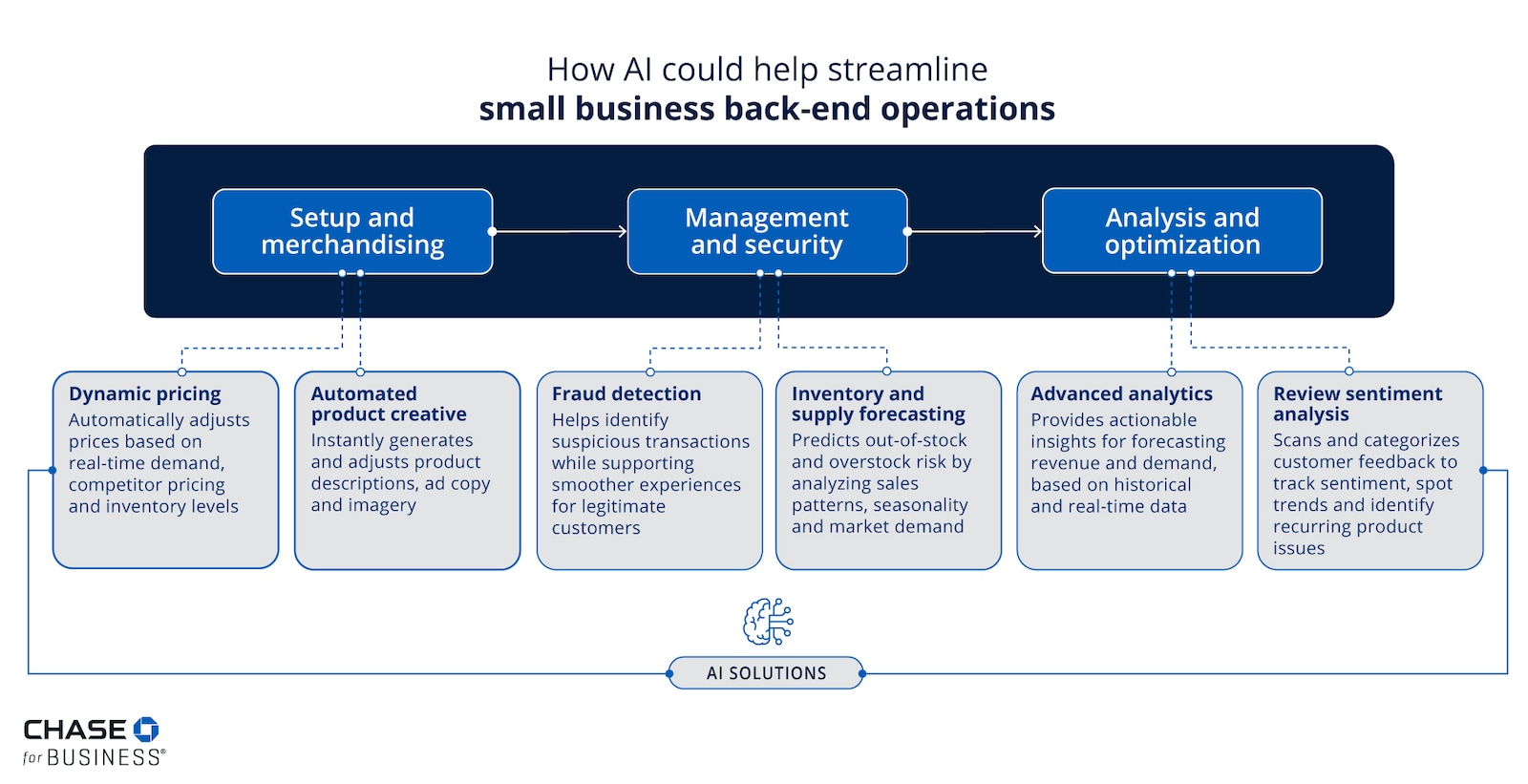
- Advanced analytics: AI analyzes historical and real-time data to predict demand, forecast revenue and highlight insights that can support smarter business decisions.
- Sentiment analysis: AI can scan and categorize customer reviews and feedback to spot themes across products, identify recurring issues and track opinions over time.
- Personalization: AI tailors the shopping experience for each customer by recommending products, content and offers based on browsing behavior, purchase history and preferences.
- Product creative: AI can generate and scale product descriptions, ad copy and other content. Some tools also help create or adapt product imagery, which can reduce manual work for larger catalogs.
- Dynamic pricing: AI can adjust prices based on signals like demand, competitor pricing and inventory levels. Businesses often set guardrails so pricing stays within brand and margin targets.
- Visual search: When shoppers upload an image to your website, AI can find similar products in your catalog, which is helpful for categories like apparel and home goods.
- Fraud detection: AI can help flag unusual transaction activity in real time to help reduce payment fraud and account takeovers while supporting legitimate purchases.
- AI-powered search and merchandising: Because AI can interpret what shoppers mean, rather than just what they type, it’s able to deliver more relevant results even when search terms do not exactly match product titles or descriptions.
- Inventory and supply chain forecasting: By learning from sales patterns, seasonality and external demand signals, AI can help predict out-of-stock and overstock risks so you can plan further ahead.
- Customer service automation: AI can handle common questions like order tracking, returns and FAQs so customers get faster answers and support teams can focus on more complex needs.
- Size and fit recommendations: For online apparel and footwear businesses, AI can suggest the right size based on purchase history, which can help reduce returns and improve satisfaction.
Case example: Riverside Roasters
Riverside Roasters is a fictional local coffee business that wants to grow online sales of its roasted and ground coffee. The owner adds a short pre-order quiz that asks about flavor preferences, roast level and brewing method, then uses AI to recommend coffees for each shopper.
After checkout, AI can help Riverside Roasters stay proactive by watching for shipping issues, sending updates and answering common questions like order or return status. Over time, reporting can show which recommendations lead to more purchases, helping the coffee business fine-tune its product line and how it merchandises products.

A closer look at advanced analytics for eCommerce
Many AI use cases depend on solid data, but advanced analytics can be one of the most straightforward places to start because it builds on information many businesses already track, such as sales, inventory and site traffic. Advanced analytics can also produce measurable outcomes, like better inventory management and more reliable revenue forecasts.
Below is a step-by-step approach to using AI-driven analytics to support smarter decisions in your eCommerce business.
Step 1: Define the business goal
Start with the outcome you want. Identify one specific problem where better forecasting or reporting could make a measurable difference. For example, you might aim to reduce out-of-stock issues by improving demand forecasts for your top 50 SKUs.
Step 2: Assess your data readiness
Take inventory of the data you already have, such as sales history, seasonal trends, supplier lead times, website traffic and promotions. Then look for gaps and inconsistencies. Clean up duplicates, standardize formats and connect data sources so your AI tool can learn from reliable inputs.
Step 3: Select the right approach
Match the AI approach to your goal and your team’s capacity. If you want to improve inventory planning, for example, start with demand forecasting that uses historical sales and a few outside signals, such as seasonality and campaign calendars.
Step 4: Launch a pilot
Test first, then expand. Run the model on a small set of products, and compare its forecasts to actual sales over 60 to 90 days. Use the pilot to confirm accuracy, spot data issues and refine your process before you roll it out more broadly.
Step 5: Keep humans in the loop
Use AI to inform business decisions, not make them. Have your merchandising or operations team review AI forecasts before acting on them, especially when supplier changes, new product launches or market shifts could affect results. Your team’s feedback will help you make better final calls.
Step 6: Monitor, measure and scale
Track a few metrics that tie directly to performance, such as forecast accuracy, overstock reduction and out-of-stock frequency. Once your pilot shows a clear business benefit, expand the model across more of your catalog — and keep it updated with fresh data so it stays relevant as demand changes.
Risks and challenges of AI in eCommerce
AI can create real value, but it also introduces risks that can affect customer trust and business performance. Install clear guardrails so that AI supports the customer experience instead of getting in the way.
Examples of risks to plan for include:
- Data privacy and AI security: AI tools may collect or store sensitive customer data, which can increase exposure if systems or vendors are not well protected.
- Algorithmic bias: If the data behind your AI is incomplete or skewed, it may make inappropriate recommendations or offers.
- High implementation costs: Some tools require data cleanup, integrations and ongoing maintenance, which can raise costs over time.
- Over-automation: Too much automation can frustrate customers, especially if it’s hard to reach a person for help with complex issues. To help manage these risks, set clear policies, be up front with customers and review your outcomes regularly.
What’s next for AI in eCommerce?
AI in eCommerce is moving beyond tools that support individual tasks and toward systems that can act on a shopper’s behalf. Two trends stand out for how they could reshape the online buying experience.
Synthetic product data and content
Brands are using generative AI to quickly create hundreds of product images and variations, including virtual try-ons and 3D renderings, instead of relying on traditional photo shoots for every update. This can help businesses refresh their content faster, test more formats and keep product pages current across large catalogs.
AI for eCommerce FAQs
How is AI changing eCommerce?
AI helps businesses personalize shopping, improve search and customer support, and use insights like review trends and fraud signals to make faster, smarter decisions.
How can small businesses start using AI in eCommerce?
Start with one clear, simple need, such as customer service or product descriptions. Then test a tool and measure results before expanding to more advanced uses, like forecasting.
How do I know if my eCommerce business is ready for AI?
You may be ready if you have reliable customer, sales and inventory data and a specific use case where AI can deliver measurable value.