US markets are a mixed bag: Gold rallies, small caps struggle and chip stocks bounce back

Global Investment Strategist

When it comes to markets, ups and downs come with the territory – but 2025 has been a year of performance dispersion in risk assets. While the re-election of President Donald Trump initially sparked hopes for a pro-growth era with continued U.S. market exceptionalism, the reality has been more complex.
Policy evolution (such as new tariff announcements, a substantial U.S. government tax and spending bill, and infrastructure and defense investment in Europe) have played a role in the S&P 500’s underperformance (+9% year-to-date) versus other major developed world markets like Europe (+21%) and Japan (+15%) in U.S. dollar terms. Investors are seeing differentiation under the surface, too – below, we explore the dynamics that have boosted gold’s returns to the front of the pack, dragged the performance of smaller companies and supported a strong rebound in chip stocks after they faltered earlier in the year.
All-time highs and outperformance: Gold
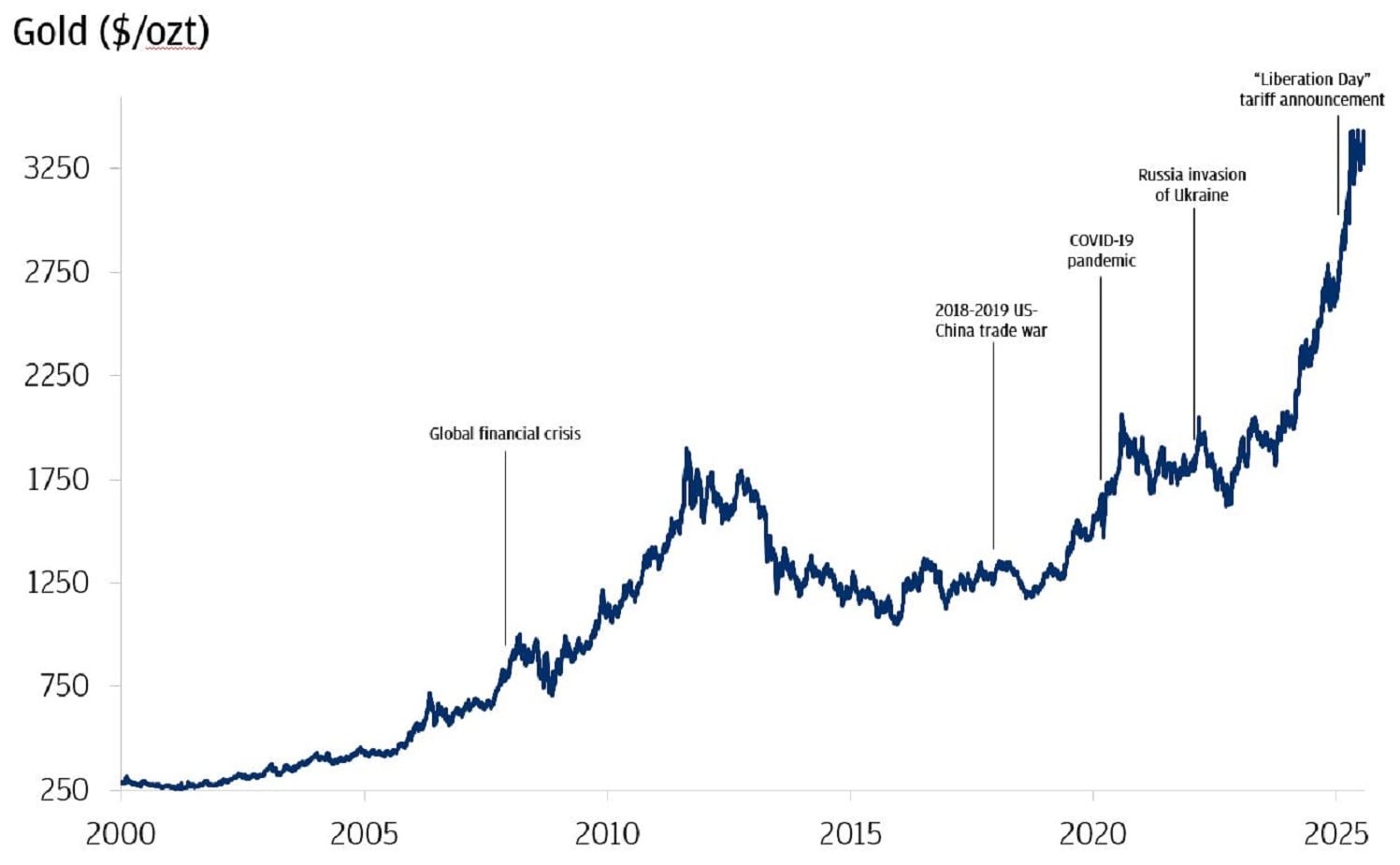
Since the turn of the century, gold has been a relatively stable asset for investors seeking diversification, an inflation hedge, or a safe haven during uncertain times, delivering an annualized return of about 11% since 2000, compared to the S&P 500’s annualized return of roughly 10% during the same period. Investors typically flock to gold during periods of global crisis and this year has been no different, with the precious metal soaring over 30% year-to-date as investors grapple with heightened geopolitical risks and economic uncertainty.
Gold has been one of the best-performing assets so far this year. With uncertainty around inflation still high, concerns about U.S. government deficits growing and central banks buying large volumes of the commodity as a means of diversifying their own reserves, we see potential for gold to continue to reach new highs.
Investors tend to flock to gold during periods of uncertainty
Work with an advisor
Our advisors can provide ongoing financial advice on how your portfolio can adapt to the changes in the market, your life and your goals.
Tariff headwinds and underperformance: Small cap stocks
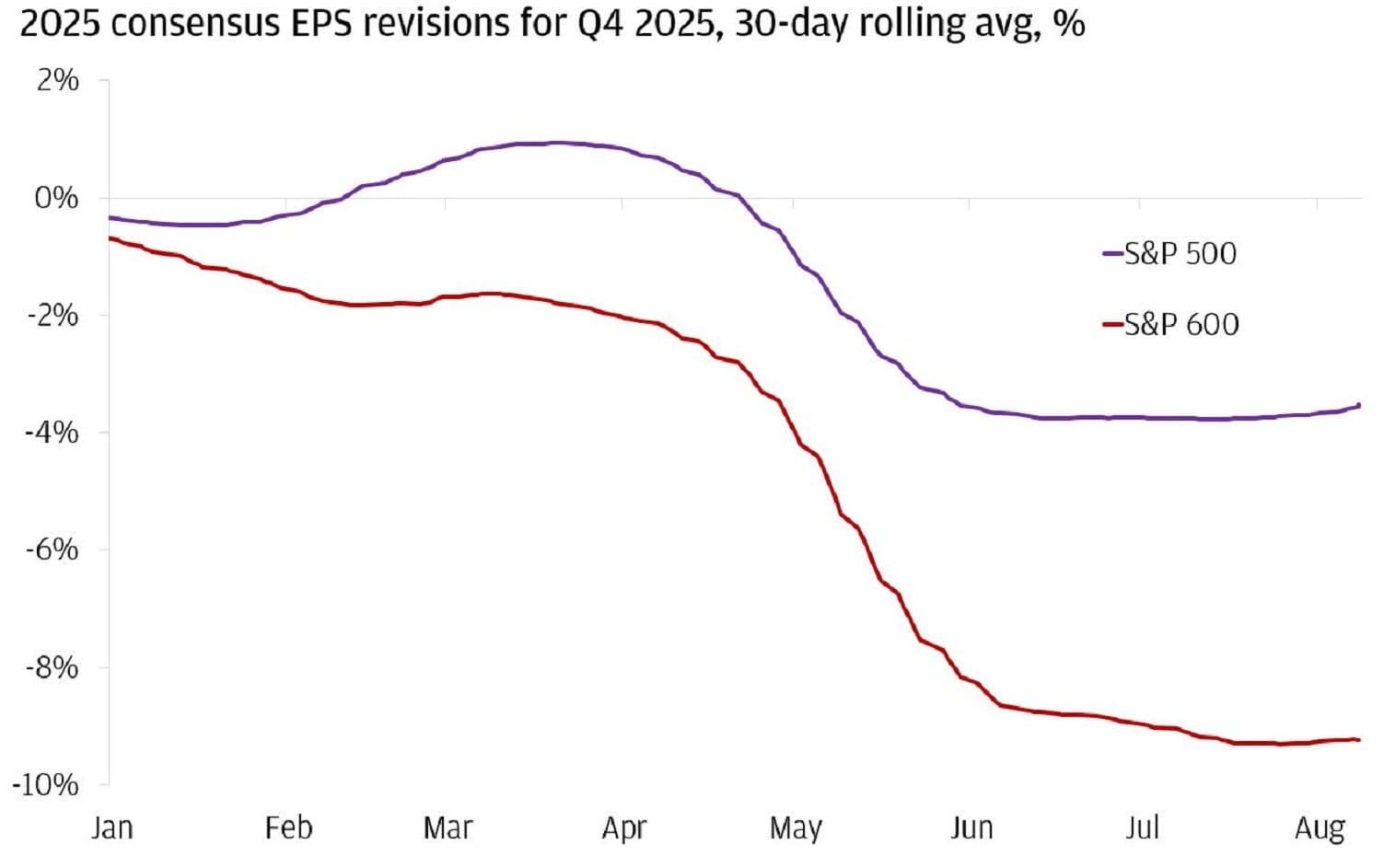
While gold has shined, small cap stocks have a different story so far this year. The S&P 600, which tracks small-cap U.S. companies, highlights lagging market performance of smaller businesses, down approximately -4% year-to-date. This is largely driven by expectations that smaller companies might not be able to weather higher tariffs as well as larger companies.
Tariffs, essentially a tax on imports, most impact companies importing goods or materials. Census Bureau data shows that smaller companies have less diversified supply chains, translating to less flexibility to reorient their trading towards countries facing lower tariff rates than, say, China. It’s no surprise, then, to see a survey from the Federal Reserve Bank of Atlanta showing that companies with less than 100 employees don’t expect to be able to offset as much of the cost of tariffs via price increases as larger companies anticipate being able to. This is evident in earnings revisions for the small cap S&P 600 index versus those for its large cap S&P 500 sibling, as the 30-day rolling average for consensus earnings have been revised down nearly 10% for Q4 2025 in comparison to where it was at the start of the year, highlighting potential headwinds smaller companies are facing.
Small cap companies are seeing greater downward earnings revisions
Artificial intelligence (AI) tailwinds and a rebound rally: Semiconductor chip stocks
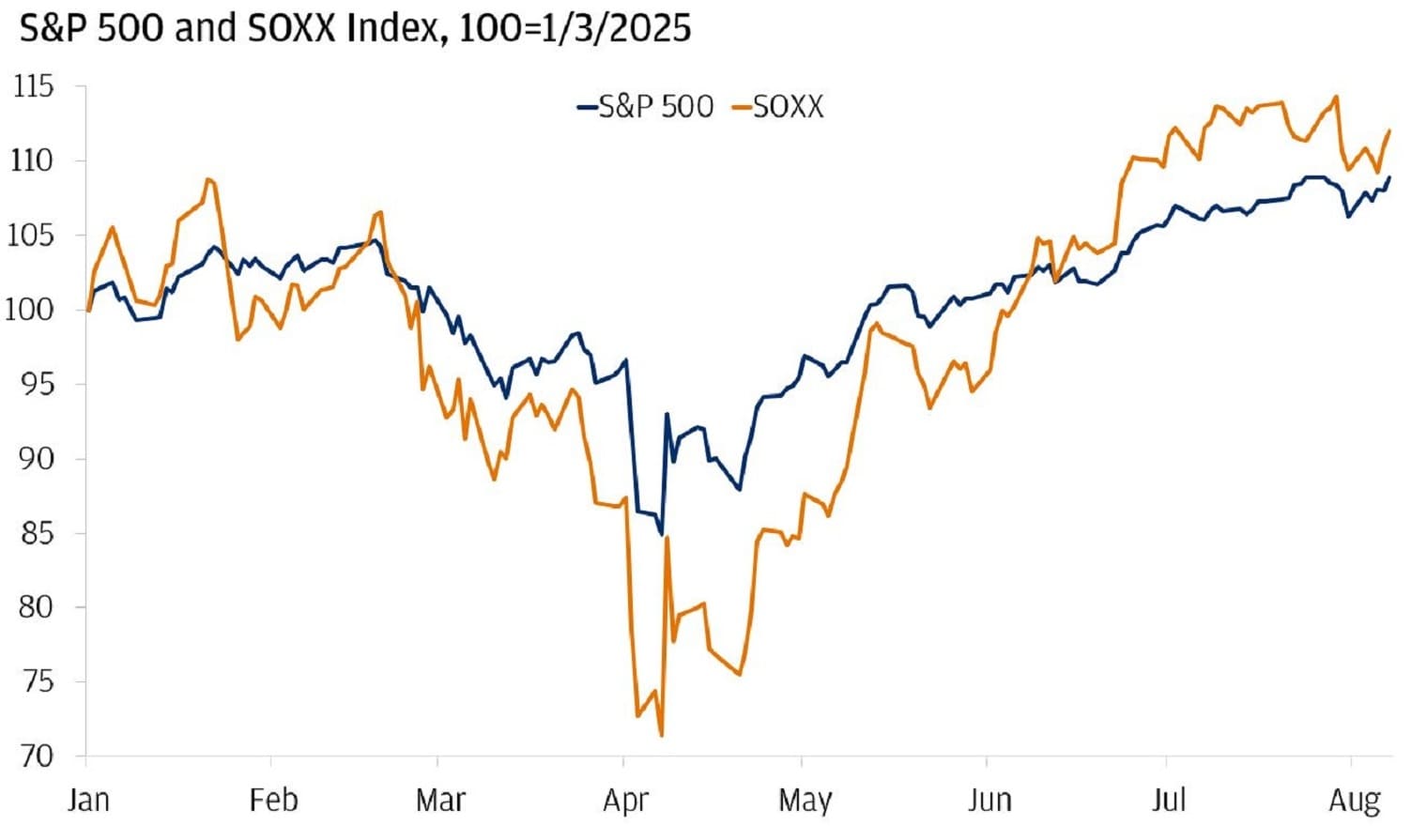
The Philadelphia Semiconductor Index, which tracks chip companies, sold off more sharply than the S&P 500 during the April sell-off but has since roared back about 36% and is now +13% year-to-date, outperforming the S&P 500. "Chip stocks" refer to companies that design, manufacture or distribute semiconductors, which power everyday devices like smartphones, computers and emerging technologies such as AI. Popular names that you may be familiar with include Nvidia and AMD.
A key driver of the sector’s performance has been the surging demand for AI chips, fueled by AI adoption. According to the Census Bureau, the percentage of firms reporting they’ve used AI in the last two weeks has doubled to over 9% since last year. While adoption is currently low, the pace is increasing, with more than 11% of companies expecting to use AI in the next six months. This trend is fueling increased capital expenditure by major hyperscalers, potentially creating a positive feedback loop where adoption could fuel sales and that could further future investment in the space. Deloitte predicts that chip sales will soar 11% in 2025 to nearly $700 billion, led by generative AI and data center buildouts. We continue to see opportunity in the tech sector in companies that provide computing power and the software companies that harness that power.
Chip stocks have bounced back from April lows
As policy developments continue to evolve, investors are eagerly waiting to see their impact. It’s likely that the dispersion in returns across risk-assets will continue and we suggest investors continue to be mindful with their allocations as they consider rebalancing or adding money to their portfolios.
All market and economic data as of 08/13/2025 are sourced from Bloomberg Finance L.P. and FactSet unless otherwise stated.
Explore ways to invest
Take control of your finances with $0 commission online trades, intuitive investing tools and a range of advisor services.