Credit markets look for AI’s weak links

Global Investment Strategist

The artificial intelligence (AI) trade has hit turbulence over the past few weeks. AI-related stocks have fallen much more sharply than the broader market as investors reconsider the financing costs of building data centers, buying chips and supplying the electricity needed to run them.
Still, investors have seen rotations out of AI before. What makes this episode different is the simultaneous action in credit markets. The cost of insuring the debt of several AI-linked companies has reached record levels as the sector grows more reliant on debt financing.
The AI trade has underperformed the market
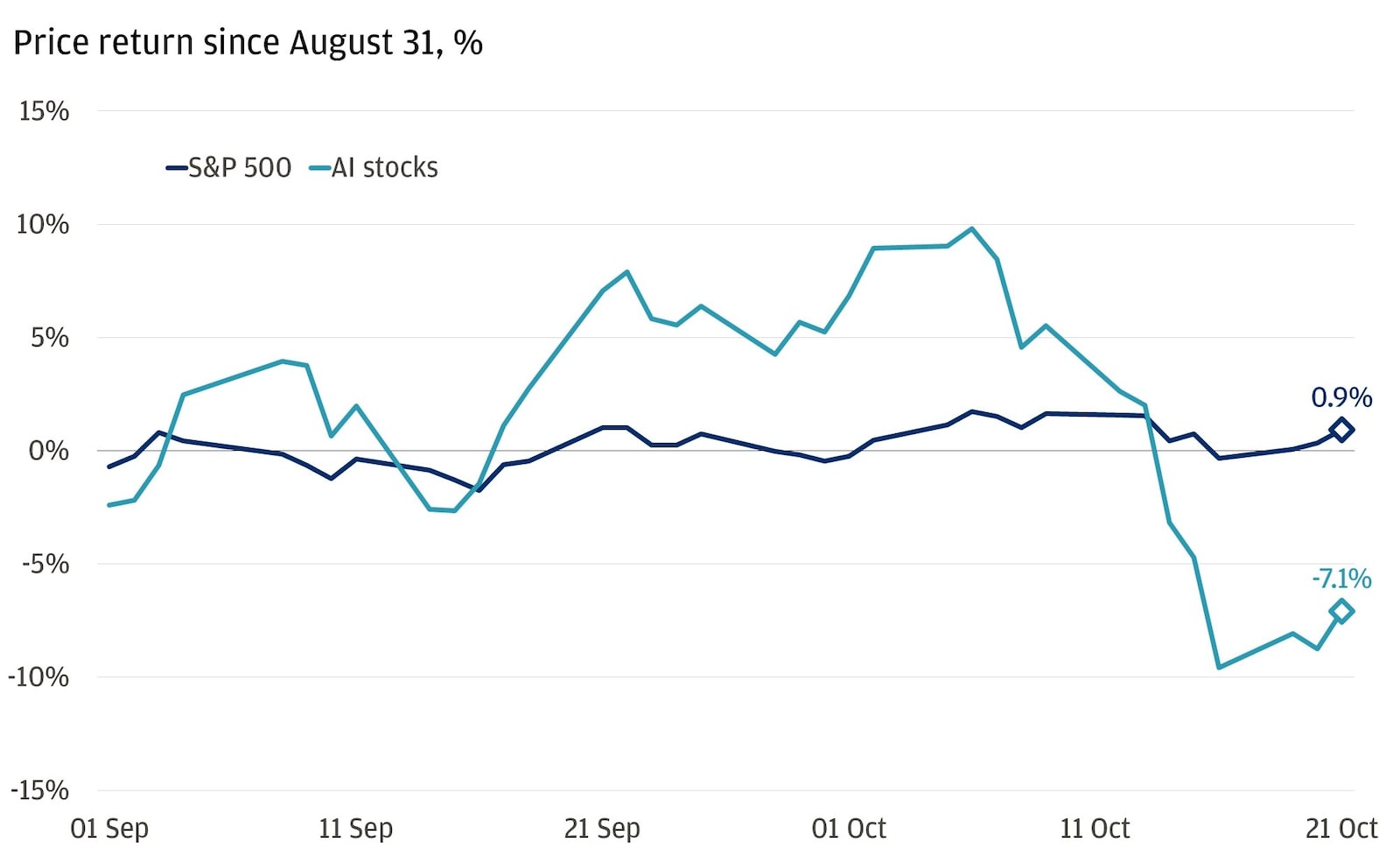
But rather than a blanket vote against the ecosystem, the rising cost of default protection reflects a targeted reassessment of repayment risk. In other words, credit markets are taking a hard look at the AI buildout and asking who can afford to keep at it.
What does default insurance tell investors?
Credit default swaps (CDS) act like insurance on a company’s debt. CDS buyers pay a recurring premium and, if the borrower experiences a major credit event, such as bankruptcy or failure to pay, the buyer will receive a large payout.
The premium is quoted in basis points. A CDS spread of 100 basis points broadly means that insuring $10 million of debt costs $100,000 per year. At 1,000 basis points, the annual cost rises to roughly $1 million.
Credit default swaps can provide a measure of market sentiment. A wider CDS spread does not necessarily signal an expected failure. It can also reflect greater hedging demand, heavy debt issuance or uncertainty about future financing. The level, speed and confirmation from other markets help distinguish routine insurance from genuine distress.
Ready to take the next step in investing?
We offer $0 commission online trades, intuitive investing tools and a range of advisor services, so you can take control of your financial future.
One trade, several credit stories
Credit spreads have widened over the past month, but technology-related borrowers have moved much more sharply than the broader investment-grade market. The spread between the two has spiked higher than even during the tech-driven downturn of 2022.
Excess risk in tech credit is rising
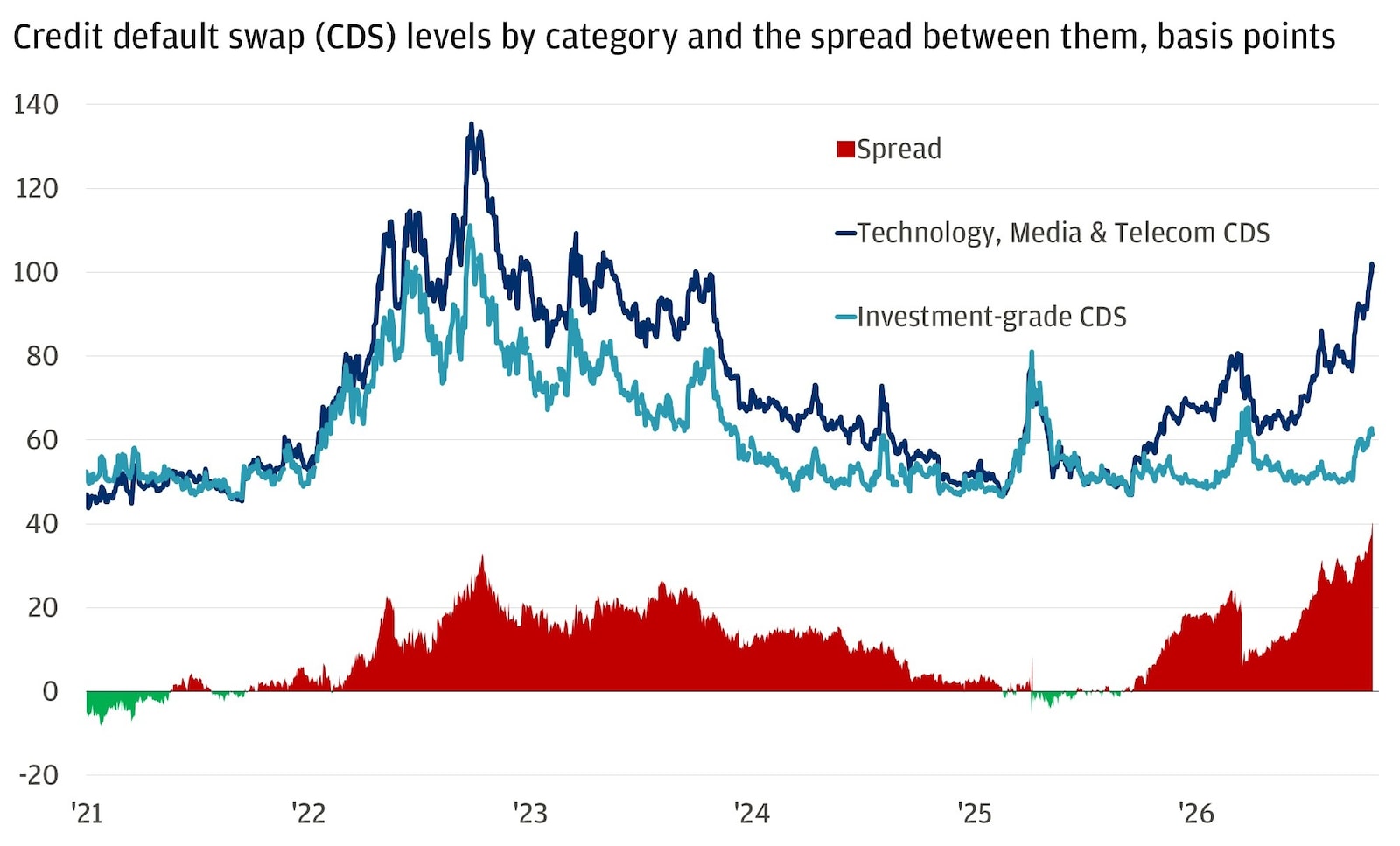
Going one level deeper, AI-related CDS have risen even more rapidly in the past month, but not all in parallel. For large, cash-generative AI leaders, five-year CDS spreads range from 50 to 120 basis points. These are elevated levels for companies with strong balance sheets, but they still look more like the price of portfolio insurance than a prediction of financial distress. These companies still have far lower leverage and higher interest coverage ratios than the average investment-grade borrower.
The picture changes as debt becomes more important to the business model. Default protection on some established investment-grade infrastructure borrowers has climbed toward 300 basis points. That represents a meaningful reassessment of credit risk.
At the weak end of the spectrum, one financing-dependent AI infrastructure borrower has taken on tens of billions of dollars in debt and other obligations. Its five-year CDS shot up to 1,100 basis points this week, so insuring $10 million of its debt would cost more than $1 million per year. Pricing at these levels implies near or above a 50% probability of default over five years, up from below 30% a year ago. That is not a forecast, but it is difficult to dismiss.
Put together, investors are demanding roughly 10 times as much to insure the weakest AI borrowers as the strongest companies in the ecosystem. Yet broad investment-grade protection remains comparatively contained. If markets were losing confidence in corporate balance sheets generally, that would not be the case. The concern is confined to business models that require debt markets to remain open while spending stays high and cash flow remains limited.
Credit can be an early signal
Lehman Brothers’ CDS averaged less than 100 basis points in the third quarter of 2007. By mid-September 2008, they had risen to over 1,400 basis points and the firm had filed for bankruptcy.
Lehman Brothers’ CDS flashed warnings as distress rose
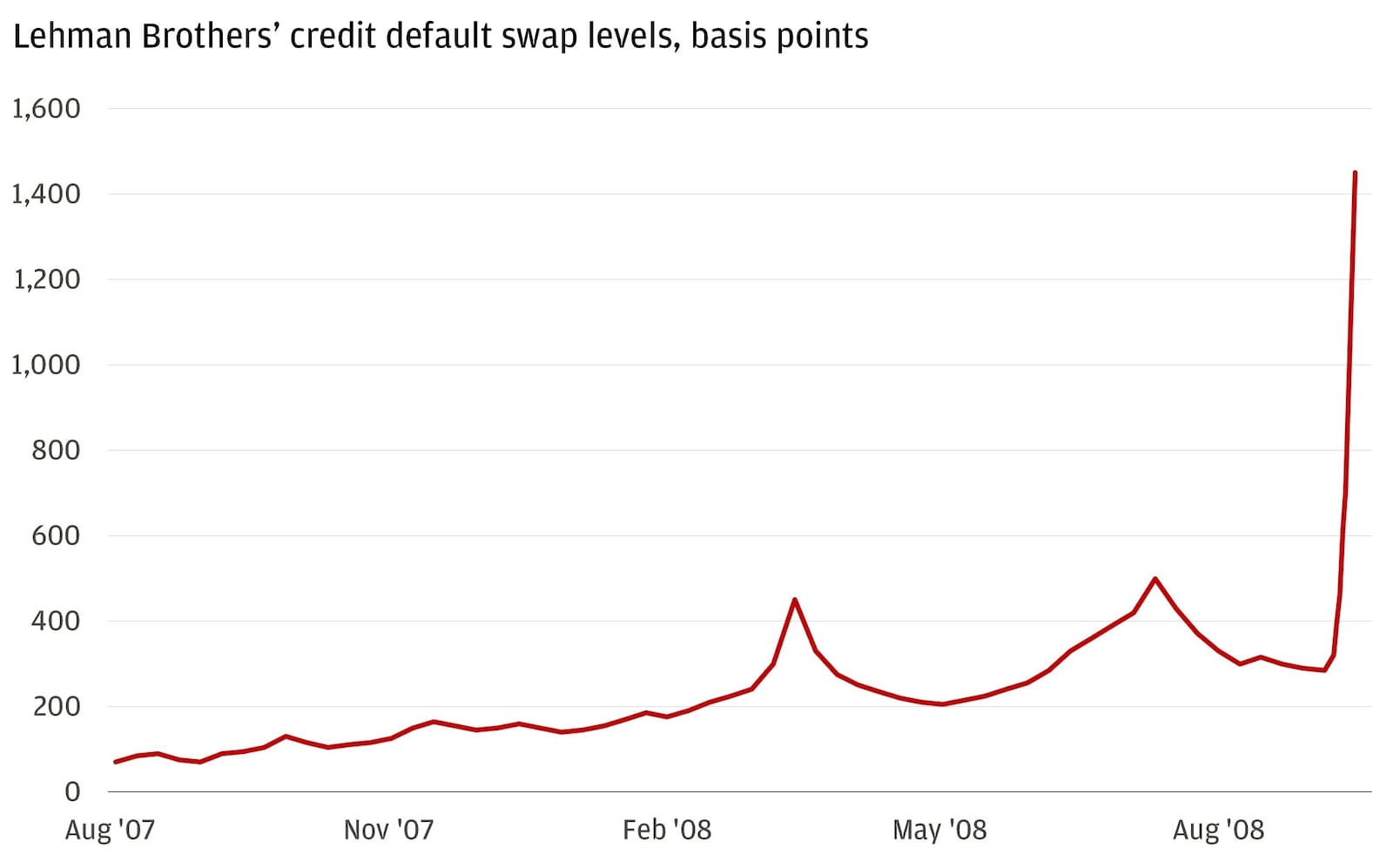
CDS did not predict the exact moment when Lehman would run out of options. But the steady rise in protection costs, reinforced by falling bond and equity prices and mounting funding pressure, clearly showed that the market was losing confidence in the firm’s ability to pay its debts.
Not every warning ends the same way. In 2005, default protection on a major U.S. automaker rose sharply ahead of its downgrade to high yield. The company’s financial pressure was real, but it raised liquidity, restructured and avoided bankruptcy.
That is how investors can view CDS today – as warning lights rather than countdown clocks.
What does this mean for the AI trade?
As long as broad investment-grade spreads remain contained and stronger borrowers retain access to capital, stress among the riskiest issuers is unlikely to derail the broader AI buildout.
However, the AI label alone is no longer enough to reassure lenders. Companies must show that they can finance investment, service their debt and eventually turn spending into cash flow. Credit markets are scrutinizing the AI buildout and deciding who is financially equipped to finish it.
All market and economic data as of 10/22/2026 are sourced from Bloomberg Finance L.P. and FactSet unless otherwise stated.
You're invited to subscribe to our newsletters
We'll send you the latest market news, investing insights and more when you subscribe to our newsletters.