Jumping hurdles: The race to year end

Any investor could write up a long list of market risks – whether it’s questions over spending on artificial intelligence (AI), financing the buildout and profitability timelines, or strain in European government bond markets. Add uncertainty around the U.S. midterm elections and renewed fears of military escalation in Iran, which could happen shortly after. And yet, the S&P 500 remains within 1% of its all-time high – again.
A strong setup
Resilience doesn’t come without volatility, especially when the calendar is filled with risk events – high-profile catalysts that could determine the trajectory of conflict in the Middle East, the signals around the AI buildout or even some of the plumbing in international markets. But with the risks well known, investors typically hedge in anticipation. That often means these market moments act as clearing events – a point where uncertainty or pressure in financial markets gets resolved, allowing investors to reposition, typically setting the stage for gains. The October Federal Open Market Committee (FOMC) meeting and subsequent rate hold is an example of a market event with the potential for market volatility that ultimately yielded little price movement.
And this time, historical performance is on the side of investors seeking a jolly mood into the holiday season. Over the last 29 years, the S&P 500 has averaged a 2.3% gain in November, the strongest of any calendar month. Those returns are even larger in midterm election cycles, with November yielding an average 2.75% return when the White House isn’t on the ballot. In the six months that follow, the S&P 500 has averaged gains of about 13%.
Midterm elections bring volatility, but outperformance may be ahead
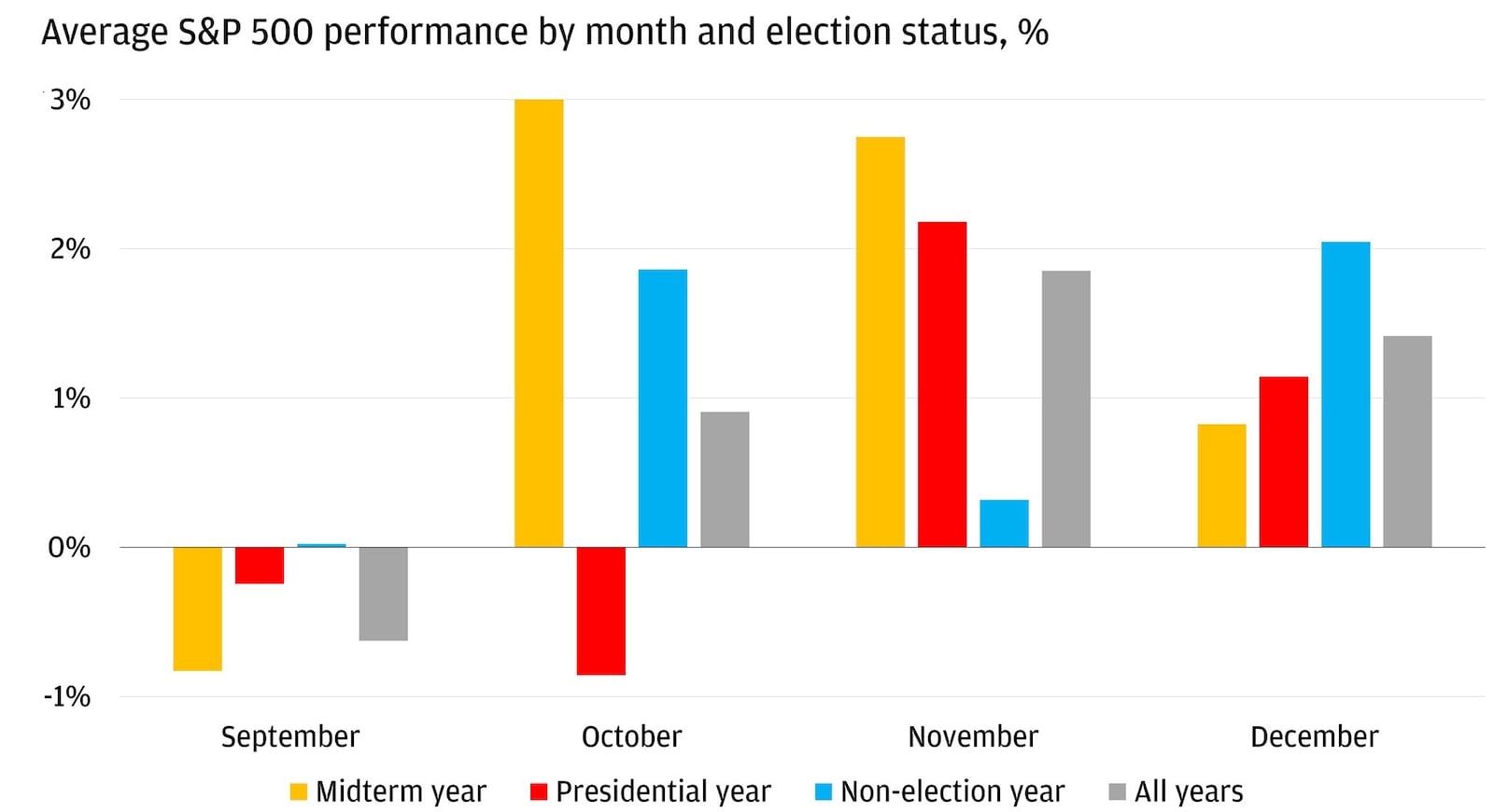
Source: Bloomberg Finance L.P. Data as of August 2026. Data begins in January 1950. Outlooks and past performance are no guarantee of future results. It is not possible to invest directly in an index. Please refer to “Definition of Indices and Terms” for important information.
The 2026 midterm election cycle has two key long-term market implications – both of which may already be priced in by investors.
The first is the debate around AI, which has moved beyond whether the technology is useful. Investors increasingly want to know how much infrastructure will be built, who will finance it and when the spending will generate sufficient returns to make the investment worth it. A key element of that trade is the power supply, which has put utilities – a traditionally defensive and stable sector – at the heart of the AI buildout.
Investors have long worried about a federal freeze on the data center buildout, based on how Congress is made up after the midterm election. But over the summer, many of the fears of what would happen on a national level trickled down to the state level, where most of the public backlash was felt. New York and Texas – two states on opposite sides of the political spectrum – announced data center moratoriums or holds that served as an overhang on the utilities sector.
The second implication is in fiscal spend as the United States enters the midterm elections with little fiscal room to maneuver. These spending priorities are significant in light of a potentially mixed Congress. The political pendulum tends to swing away from the party in power, with majority control changing hands in at least one chamber of Congress. That has been the result in three of the past four midterm elections.
Whereas ordinarily that means little to no policy change, in some cases, gridlock doesn’t reduce spending but amplifies it instead. In the face of a true impasse, lawmakers can be encouraged to fund priorities from both parties – yielding more spending, not less. In a world where global bond markets are sensitive to growing government deficits, this dynamic can have long-term consequences for the term premium commanded by investors to hold U.S. government debt. And that can have ripple effects into other financial markets, especially stocks.
Ready to take the next step in investing?
We offer $0 commission online trades, intuitive investing tools and a range of advisor services, so you can take control of your financial future.
Broadening the trade
Even in the face of ongoing risks, the stock market is showing early signs of breadth. Realized correlations between stocks remain low, which means stock performance is differentiated to some degree and individual stocks aren’t all moving in the same direction at the same time.
While the Nasdaq 100 fell as much as 8% in October from peak to trough and later recouped its losses, the S&P 500 Equal Weight Index rose approximately 4% over the same month. The share of S&P 500 stocks hitting new 20-day highs has exceeded 50% for the first time since the second quarter of 2025. That kind of broad-based price action has historically preceded further gains in equities on both a three-month and six-month basis.
S&P 500 breadth has historically signaled gains
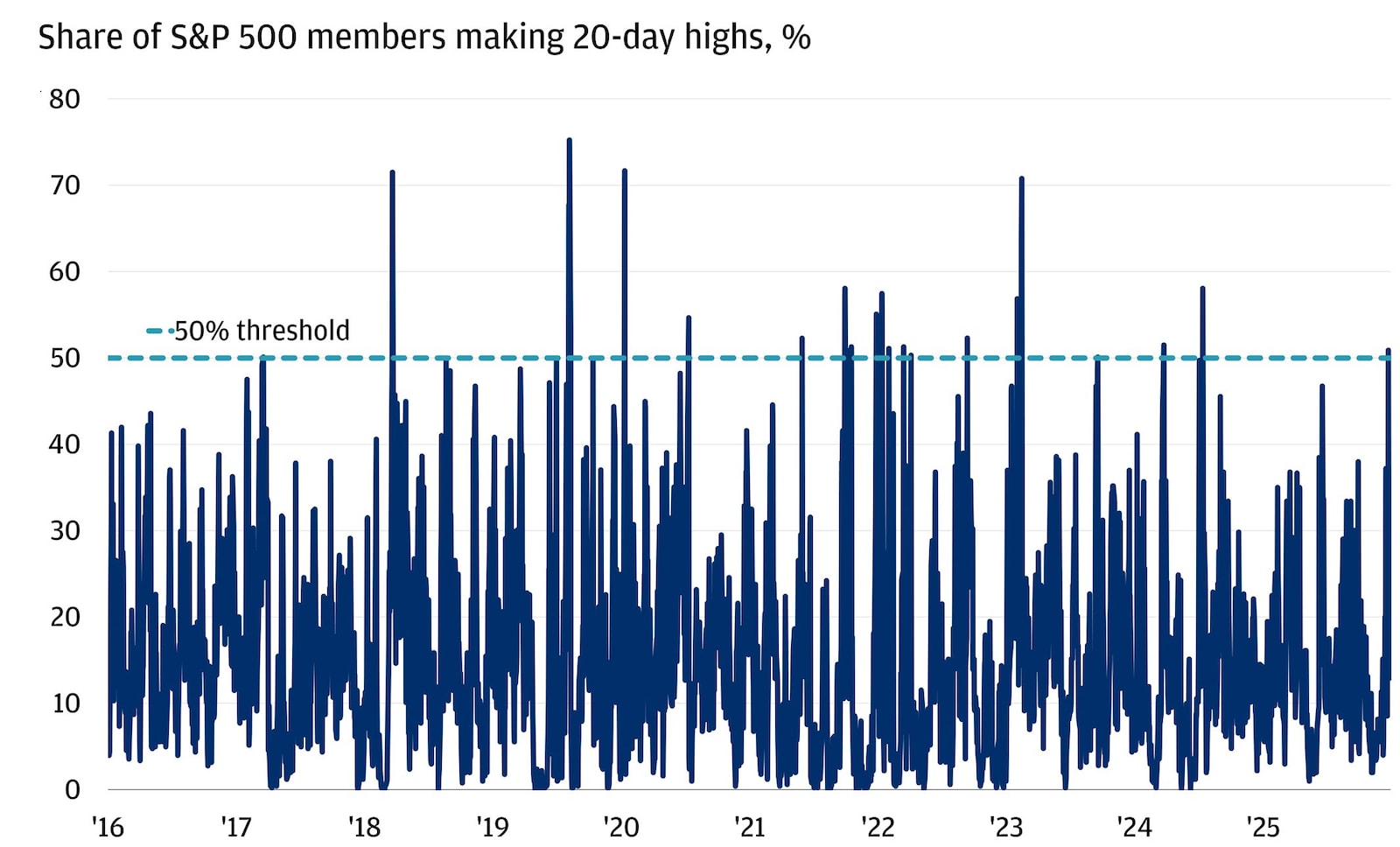
Source: Bloomberg Finance L.P. Data as of October 28, 2026.
The path to year end is unlikely to be a straight line. There are still plenty of hurdles to clear, from the midterms and geopolitics to questions around the durability of the AI buildout. But volatility doesn’t necessarily mean the bull market is running out of road. If anything, resilient markets, broader participation and a history of strength into year end suggest investors may be better served looking past bouts of uncertainty rather than heading for the sidelines. The hurdles are real. So far, the market has shown it can clear them.
All market and economic data as of 10/29/2026 are sourced from Bloomberg Finance L.P. and FactSet unless otherwise stated.
You're invited to subscribe to our newsletters
We'll send you the latest market news, investing insights and more when you subscribe to our newsletters.