From Tokyo to London to Washington, debt is in the doghouse

Executive Director, Global Investment Strategist, J.P. Morgan Private Bank

By: Kriti Gupta and Nick Roberts
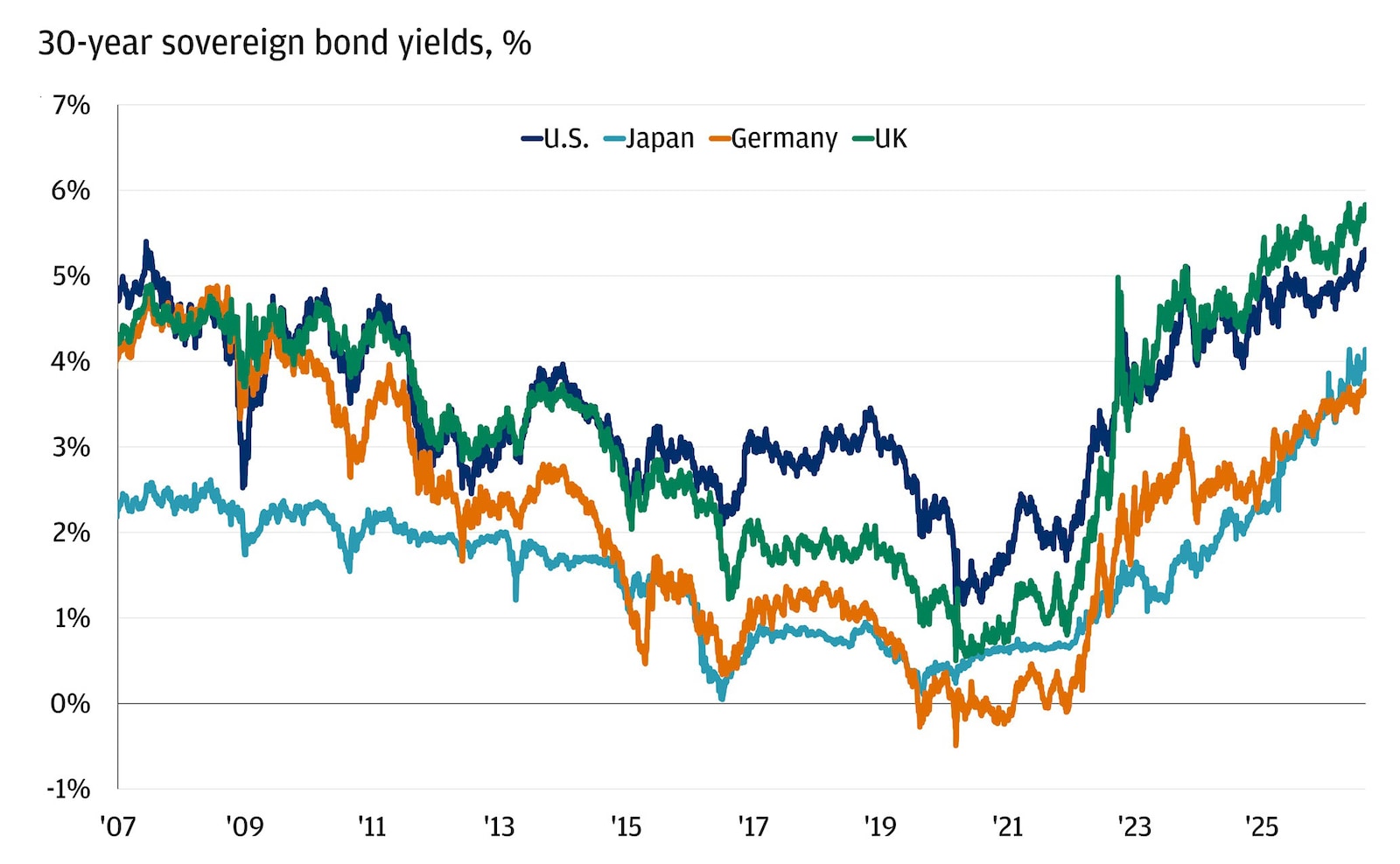
A move in bond yields is afoot – from Tokyo to Frankfurt to London and now, Washington. The repricing has sent the U.S. 30-year Treasury yield to levels last seen in 2007, with 30-year U.K. gilts back at levels seen right before the turn of the century. Around the world, it’s a similar story. The 10-year German Bund yielded the most since 2011, French 10-year yields hit a 17-year high and 10-year Japanese government bond yields touched a 30-year peak.
It’s tempting to blame the bond sell-off entirely on rising government debt. But the market may be grappling with something bigger. It seems investors are increasingly pricing a world in which the next decade will look less like the low-rate world of the last 10 years.
Long-end yields take a U-turn
Past performance doesn’t indicate future returns.
Ready to take the next step in investing?
We offer $0 commission online trades, intuitive investing tools and a range of advisor services, so you can take control of your financial future.
So what’s driving it?
At first glance, it looks like it’s driven by fears around growing sovereign debt piles – a market narrative that often permeates in the early autumn every year. But this feels different in both margin and motive. Although the yields across various bonds are at historic highs, the difference in yields isn’t a shock in itself. Purely debt-driven sell-offs have often produced moves of anywhere from 10 to 30 basis points that ripple into other asset classes. This isn’t quite the same. Not only are the moves within their average long-term one-day ranges, but it seems indiscriminate across regions: High-debt-carrying countries like the United States and the United Kingdom have seen their bonds sell off alongside low-debt-carrying nations like Australia and Finland.
Some of it is growing debt
History has shown that there are three ways to climb out of a debt crisis: austerity measures as seen in Ireland and Greece after the Global Financial Crisis, defaults as seen in Argentina or economic growth and accompanying inflation that lessens the debt burden over time. So far, the United States has $40 trillion of national debt and annual interest payments of $1 trillion. For an economy of that size and the pace of innovation, it’s the third option that seems like the most likely solution.
It’s worth noting that while the U.S. government levered up, overall debt has remained stable for over 15 years. Households and corporations have reduced their debt burden relative to gross domestic product (GDP), fueled by economic growth, fiscal stimulus, tax cuts and a variety of other factors. That isn’t necessarily the case in other regions with comparable borrowing burdens.
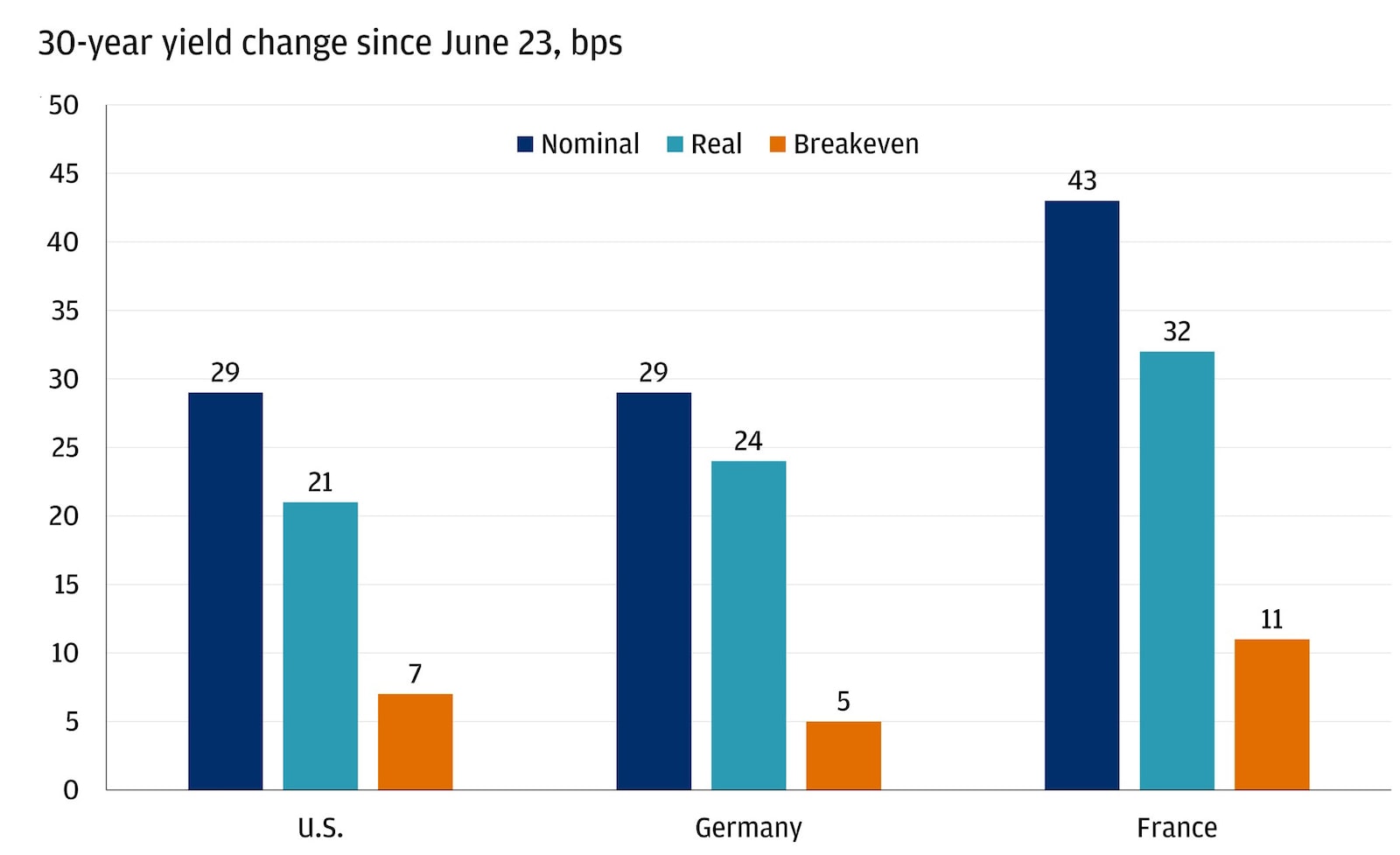
One way that’s showing up is in the breakdown of the yield move. With inflation breakevens – the market’s estimate of average inflation over a given period – less volatile than nominal yields, the move appears to be less about near-term inflation. Instead, it seems investors are adjusting to a world where interest rates in the years to come may not fall as far as they did in the last cycle. In other words, a new long run neutral rate, as shown by the fact that real yields are a bigger driver of the bond market move. As a result, bondholders are demanding greater compensation to lend over longer periods, creating a larger risk premium.
Real yield has been the driver of recent moves
A new economic regime
Global central banks are facing an economic regime that has few parallels in history. Inflation has been above long-term targets for five years, partially due to rolling inflation shocks. The post-pandemic recovery, extraordinary fiscal stimulus, the war in Ukraine and conflict in Iran have each contributed to bouts of inflation over the last five years.
Investors are increasingly expecting these types of shocks to become a recurring feature of the economic landscape, driving investments in defense, technology and nearshoring. Cue the boom in capital expenditure, largely driven by the hyperscalers. With up to $200 billion of corporate debt issuance expected from the hyperscalers this year alone, investors are starting to ask whether the growing supply of debt is starting to outpace the demand for longer-duration assets.
Don’t forget the Treasury
That question is enough to catch the attention of the U.S. Treasury, which announced the intention to increase buybacks of long-end Treasuries. Buybacks are a normal function of the Treasury; the size is what’s new. The U.S. Treasury conducts a buyback operation of about $2 billion per week. It has announced the intention to double that figure to $4 billion per week between September 9 and November 4.
While the program remains small relative to the overall Treasury market, it also comes on the back of a recent change in the language surrounding future Quarterly Refinancing Announcements (QRA) and U.S. involvement in Japanese Yen intervention. It highlights a growing sensitivity to rising long-term borrowing costs from policymakers.
Investors often attribute rising yields to concerns about government borrowing. But this move appears to reflect something broader. From defense spending and reshoring to artificial intelligence (AI) investment and persistent inflation shocks, the forces shaping the next decade demand more capital and imply a higher cost of money. For bond markets, the message may be simple: The era of exceptionally low long-term rates is becoming harder to justify.
All market and economic data as of 08/20/2026 are sourced from Bloomberg Finance L.P. and FactSet unless otherwise stated.
You're invited to subscribe to our newsletters
We'll send you the latest market news, investing insights and more when you subscribe to our newsletters.