3 lessons for investors as the AI boom continues

Global Investment Strategist
- AI’s concentration in the largest S&P 500 companies means shifts in the buildout can move markets. Recent volatility hasn’t changed the long-term opportunity, but it underscores three important lessons.
- Be selective within AI: As AI costs rise, we favor companies with the financial capacity to keep investing and with customer demand that is growing enough to support that spending.
- Don’t lose sight of earnings: Profit growth remains healthy beyond the largest technology companies, giving us reason to remain constructive on U.S. equities even as expectations around AI reset.
- Diversification still matters: High-quality bonds have provided more protection during recent equity sell-offs, reinforcing their role as a potential counterweight when growth concerns weigh on stocks.

Artificial intelligence (AI) continues to be one of the dominant investment themes shaping markets. Many of the companies at the center of the AI buildout are also among the largest stocks by market capitalization in the S&P 500, at a time when the 10 largest companies account for nearly 40% of the index. Such concentration means any shift in the AI investment story can increasingly influence the broader market.
That influence was on display following the U.S. midterm elections, as investors turned their attention to what the results could mean for the future of the AI data center buildout. Uncertainty contributed to a sharp repricing across technology stocks: The Nasdaq 100 fell more than 6% in a single session, its worst one-day decline since March 2020, while the S&P 500 fell more than 4%.
While the sell-off was sharp, we don’t think it changes the long-term AI opportunity. Instead, the recent volatility highlights three things investors should keep in mind as the AI buildout evolves: the trade is becoming more selective, earnings remain resilient, and high-quality bonds can help diversify portfolios when markets are under pressure.
The AI trade is entering a more selective phase
It isn’t a secret that the amount of money flowing into AI has been substantial. More than $2 trillion has been spent on AI-related capital investment since 2022, spanning everything from chips and data centers to the power infrastructure needed to run them. As spending has grown, so has the pressure to show that it can translate into attractive returns.
That might make the next phase of the AI trade more selective, as investors focus on which companies can both fund continued investment and show that their spending is translating into demand. We think the large cloud providers, or hyperscalers, are particularly well positioned. Their existing businesses generate significant cash flow that can help fund continued AI investment, giving them flexibility to sustain spending as the buildout grows.
Financial strength matters, but ultimately that spending needs to be supported by demand. As businesses adopt AI, they require more computing power, much of which they access through the hyperscalers’ cloud platforms. Cloud revenue growth has accelerated alongside greater AI adoption, providing an encouraging sign that customers are making use of the capacity being built.
Backlog and revenue growth have accelerated alongside heavy capex investments
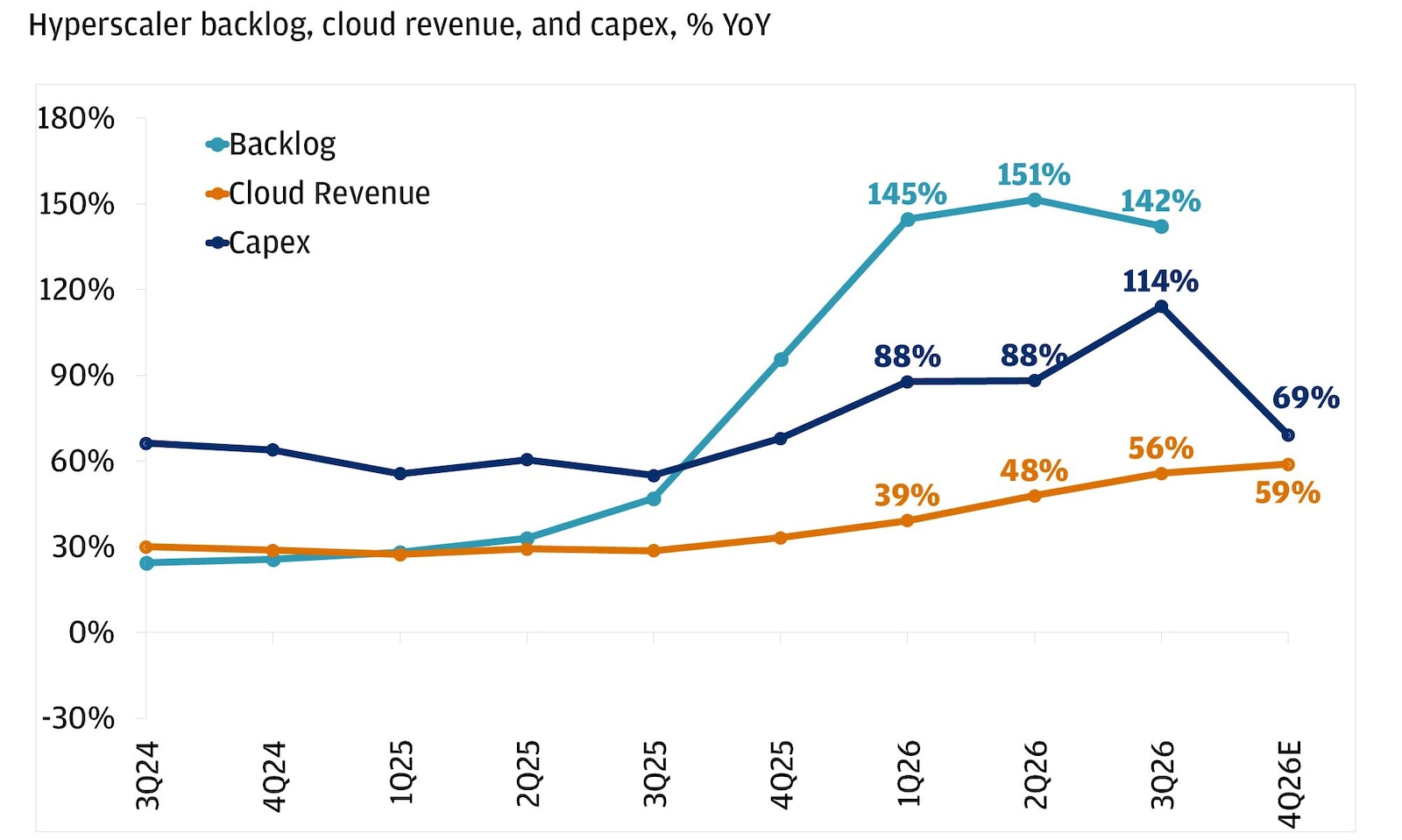
That combination of financial strength and growing demand helps explain why we continue to favor hyperscalers within the AI trade. While not every investment in the buildout will generate the same return, we think companies that can fund continued spending while demonstrating growing customer demand should be better positioned as investors become more discerning.
Interested in working with an advisor?
Work 1:1 with our advisors to help build a personalized financial strategy that’s built around you.
The earnings story is still intact
While questions around AI spending have dominated recent market moves, the broader earnings picture remains encouraging. That matters because, over the long run, earnings growth tends to be one of the most important drivers of stock market returns.
The companies at the center of the AI buildout continue to generate strong profits, but earnings strength extends well beyond the technology leaders that have received much of the attention. Median earnings-per-share (EPS) growth for companies in the S&P 500 accelerated from nearly 7% in the first quarter of 2025 to 15% in the second quarter of 2026, and is expected to remain in the double digits in the third quarter.
Median EPS growth accelerated in 2026
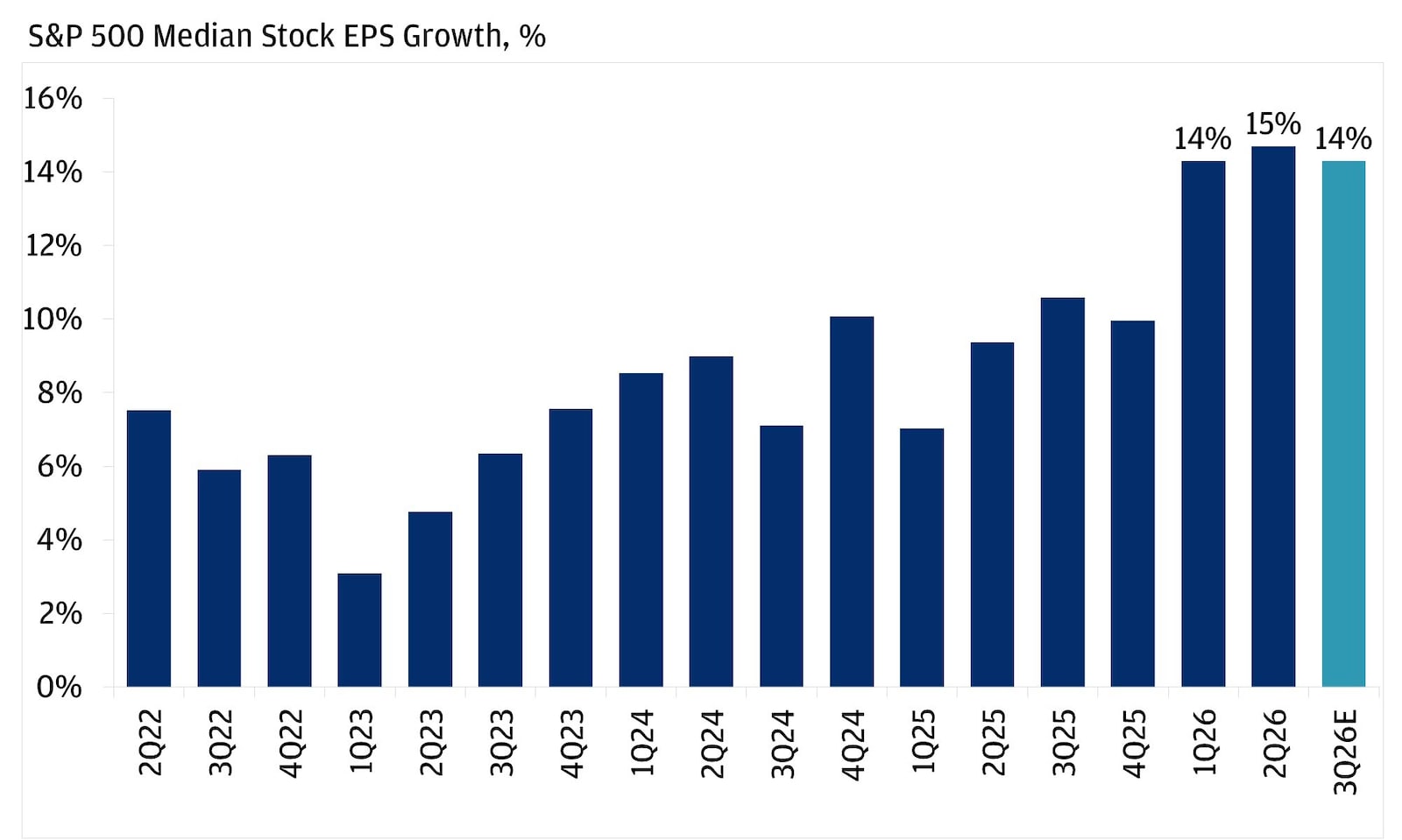
Double-digit earnings growth for the median company suggests that healthy profit growth isn't confined to the largest beneficiaries of the AI boom. Instead, earnings strength is increasingly evident across the index, providing a broader foundation for the market as investors reassess expectations around AI.
We expect earnings growth to remain a source of support as we look toward 2027. Strong profits won't eliminate periods of volatility, particularly as investors apply greater scrutiny to parts of the AI trade, but continued earnings growth across the market gives us reason to remain constructive on U.S. equities.
Bonds can play defense
November’s tech volatility has also reinforced the potential value of holding high-quality bonds alongside stocks. For much of 2026, that diversification had been less reliable as inflation concerns pushed interest rates higher and impacted both asset classes, but the relationship has started to shift as investors have focused more on risks to economic growth.
Over the past month, Treasuries rose on 86% of days when the S&P 500 declined by more than 0.5%, a significant improvement from just 37% of those days year to date, 44% over the past five years and 65% over the past 20 years. As equity volatility has picked up, high-quality bonds have increasingly provided the type of portfolio protection investors typically expect from them
Treasuries have performed well during recent equity drawdowns
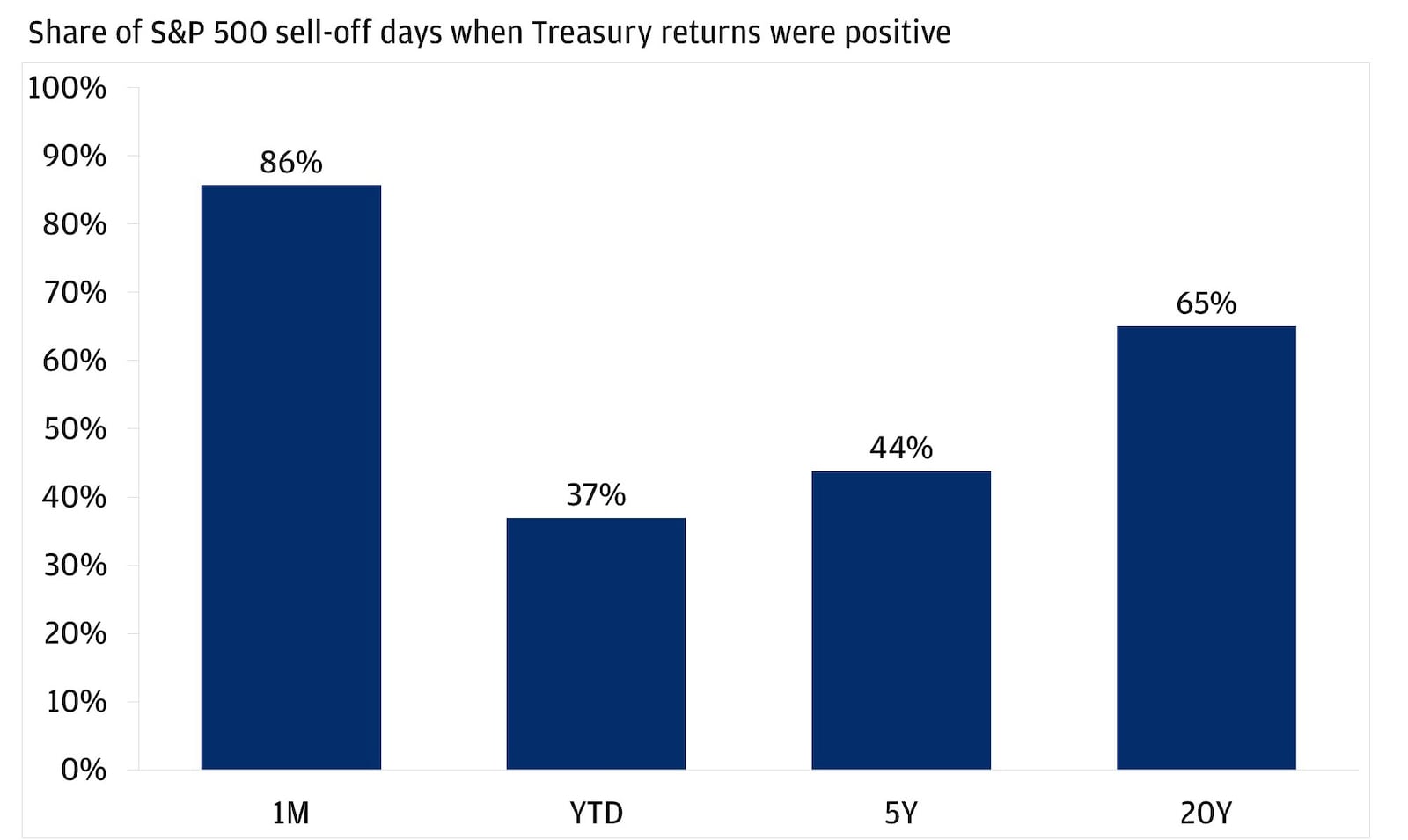
The shift partially reflects an important change in what has been driving markets. Earlier this year, inflation was a primary concern, which meant stocks and bonds could fall together as interest rates rose. More recently, attention has shifted toward questions surrounding the AI buildout and its implications for economic growth, an environment in which investors have tended to move toward Treasuries when equities come under pressure.
While bonds won't provide protection during every volatility episode, the recent experience reinforces the role high-quality fixed income can play in a diversified portfolio, particularly when concerns about growth are driving market volatility.
Looking ahead
The recent volatility hasn't changed our conviction in the long-term potential of AI, but it has highlighted how the investment opportunity may be evolving. As the buildout progresses, we expect investors to place greater emphasis on financial strength, growing demand and the ability to translate significant investment into sustainable returns.
At the same time, healthy earnings across the broader market give us reason to remain constructive on U.S. equities, while high-quality bonds can help provide diversification when growth concerns weigh on stocks. For long-term investors, we think the opportunity remains compelling, but the path forward may reward a more selective and diversified approach.
Invest your way
Not working with us yet? Find a J.P. Morgan Advisor or explore ways to invest online.