Treasury yields have surged: Here’s where investors can find opportunity

Global Investment Strategist
- Treasury yields have risen sharply, but the level of rates alone doesn’t tell the whole story. The reason rates are rising and how quickly they move can matter more for markets than a specific level.
- While we expect additional tightening by the Federal Reserve, another sustained move sharply higher in yields isn’t our base case. Markets are currently pricing more tightening than we expect as policymakers respond to resilient growth and inflation that remains above target.
- Higher yields are creating opportunity in fixed income. Today’s higher starting income can provide a larger cushion against additional rate volatility, which is why investors don’t necessarily need to wait for the perfect entry point.

The 10-year Treasury yield rose roughly 110 basis points through the first nine months of the year, a historically rare move. In September alone, the 10-year yield climbed about 50 basis points. Yield increases haven’t been isolated to the 10-year, however. While yields more recently have pulled back slightly, they remain significantly higher across much of the Treasury curve than they were this time last year.
For investors, the rise in yields naturally raises questions. Is there a level of interest rates that should make us concerned? What do higher rates mean for stocks and bonds? And if yields could still move higher, should investors simply wait before putting money to work?
The answers start with understanding why rates have risen in the first place.
Several forces have pushed yields higher
Thinking back to the market and economic environment investors were navigating this time last year helps put the move in perspective. In October 2025, the Federal Reserve (Fed) was cutting interest rates in response to some softness in the labor market, and investors were asking how low rates might go and how quickly they might fall.
Fast-forward to today, and that conversation has essentially flipped. Higher energy prices, partly stemming from the ongoing conflict in the Middle East, have added to inflation pressures. At the same time, economic growth has remained more resilient than expected, while expectations for Fed policy have shifted toward additional rate hikes. Together, those forces have helped push Treasury yields higher.
A historic rise in yields doesn’t mean investors need to be worried
With a move this large, it’s reasonable for investors to wonder whether yields have reached a level that should concern us. We don’t believe there’s a magic level of yields that automatically signals trouble, though; how quickly yields rise and what’s behind the move are also important.
One reason is that higher yields can reflect a stronger economic backdrop. Historically, outside of the period following the global financial crisis, the 10-year Treasury yield has tended to track nominal economic growth, which includes both real growth and inflation.
Except post-Great Recession, U.S. 10-year yield tends to track growth
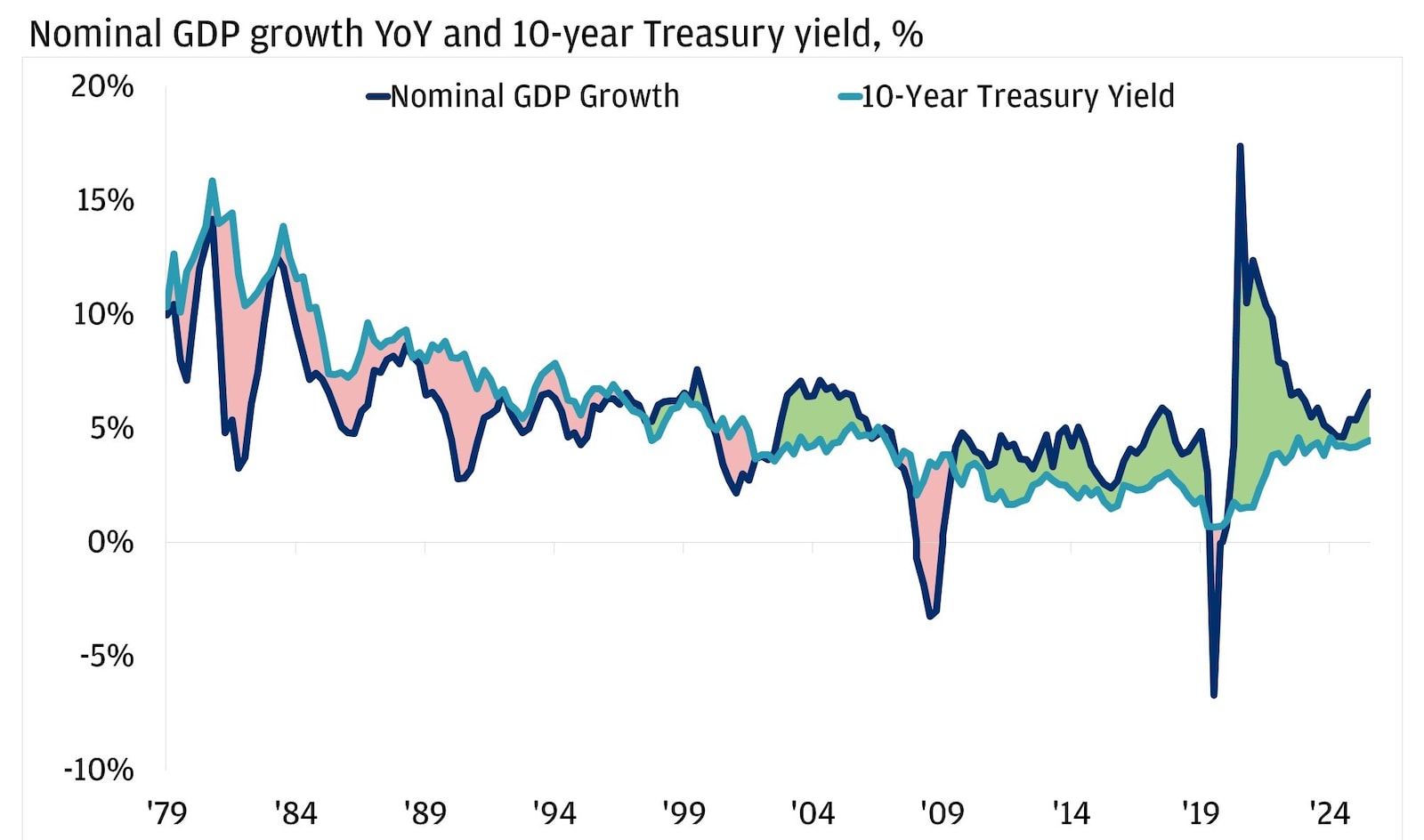
That relationship is relevant today. Economic growth has been more resilient than many investors anticipated. Higher yields may, in part, reflect that stronger nominal growth backdrop rather than a sign that something in the economy is breaking.
At the same time, we expect the Fed to raise rates further, which could put additional upward pressure on yields. But markets are currently pricing more tightening than our base case. In our view, the Fed will ultimately take back the 75 basis points of insurance cuts delivered last year.
While yields could still move higher, another sustained move sharply higher isn’t our base case.
Interested in working with an advisor?
Work 1:1 with our advisors to help build a personalized financial strategy that’s built around you.
Higher yields can still impact portfolios
For fixed-income investors, the relationship is relatively straightforward: When yields rise, bond prices generally fall, as existing bonds typically become less attractive relative to newly issued bonds offering higher yields. That can help explain some of the pressure investors have seen across fixed income this year.
Stocks can also feel the impact of higher rates. Higher interest rates can put pressure on valuations, as investors may be less willing to pay as much for future earnings. We’ve seen that adjustment this year, with the S&P 500’s forward price-to-earnings ratio falling from roughly 22 times at the beginning of the year to around 19 times.
Valuations are only one part of the story, however. Corporate earnings have remained a source of strength. S&P 500 earnings are expected to grow more than 20% in 2026, and earnings estimates for 2026, 2027 and 2028 have all been revised higher this year.
Put together, higher yields may have weighed on valuations, while exceptional earnings growth has provided an offset.
Today’s elevated starting yields can provide a bigger cushion
It’s true that the rise in yields this year may have led to short-term pressure for some investors, but we also believe it can create a unique opportunity moving forward. For fixed income in particular, today’s higher starting yields mean investors may earn more income and potentially have a larger cushion against rate volatility.
Remember, a bond’s total return reflects both changes in its price and the income it generates. If yields rise further, bond prices could fall, but the elevated income investors can earn along the way could help offset some of that decline. We refer to this as the “yield shield.”
Investment-grade corporate bonds can help illustrate that cushion. With investment-grade yields around 6%, if Treasury yields hypothetically were to rise another 100 basis points over the next year and credit spreads remained unchanged, the income earned could help offset much of the decline in bond prices – leaving the hypothetical total return essentially flat. Comparatively, if Treasury yields were to fall 100 basis points and credit spreads remained unchanged, investors could benefit from both today’s higher income and rising bond prices, resulting in a hypothetical double-digit return.
Importantly, neither scenario represents our base case. As mentioned above, we expect the 10-year Treasury yield to remain around today’s levels through the middle of next year. Rather, the scenarios illustrate how today’s higher starting yields can provide investors with a cushion if rates move higher, while also offering the potential for stronger total returns if rates fall.
Investors don’t need to wait for yields to peak
While typically associated with investing in equities, the familiar principle of “time in the market, not timing the market” also applies to bonds. Even with yields at attractive levels today, some investors may be tempted to wait and see if they move higher before putting money to work.
Over the past 35 years, the ultimate peak in yields has often occurred near the end of Fed hiking cycles. However, the 10-year Treasury yield has experienced several peaks during those cycles. That can make identifying the peak in real time difficult, and those waiting for it might recognize it only after it has passed.
Ultimately, we don’t think fixed-income investors need to predict exactly where yields will peak. Holding out to pick up a few extra basis points of yield could come at the cost of missing the potentially attractive opportunity available today. For those holding more cash than they need or sitting below their long-term fixed-income allocation, today’s higher yields may offer an attractive opportunity to put money to work while staying focused on longer-term goals.
The case for fixed income extends beyond today’s attractive yields. We continue to believe high-quality bonds can play an important role in diversified portfolios, particularly during periods of slowing economic growth when equities may come under pressure. That potential diversification benefit is another reason we think investors should consider maintaining an appropriate fixed-income allocation.
The bottom line
Higher interest rates may have created challenges for some investors, but they can also present unique opportunities. We believe today’s elevated starting yields have improved the potential return outlook for high-quality fixed income while providing a greater potential buffer against additional rate volatility.
Within fixed income, we continue to have high conviction in investment-grade corporate bonds and municipal bonds. Investment-grade credit offers attractive yields alongside healthy corporate fundamentals, while municipal bonds can offer compelling income for investors who may benefit from their tax advantages.
The path for rates from here is unlikely to be perfectly smooth. But that doesn’t mean investors need to wait for perfect clarity. Rather than trying to pinpoint the peak in yields, we believe today’s environment offers an opportunity to earn attractive income and ensure fixed-income allocations remain aligned with longer-term goals.
Invest your way
Not working with us yet? Find a J.P. Morgan Advisor or explore ways to invest online.