Stock market returns after Fed hikes, holds and cuts: What history shows ahead of the September 2026 meeting

Editorial Staff, J.P. Morgan Wealth Management
- The September Federal Open Market Committee (FOMC) meeting might bring the first rate change of 2026 as investors watch Fed Chair Kevin Warsh, who has offered less forward guidance, for signals about what comes next.
- In an analysis of FOMC decisions from December 1999 through July 2026, the S&P 500’s average decision-day move was a gain of 0.23%, and the market was positive 52.6% of the time.
- Historically, market reactions to Federal Reserve (Fed) decisions are context-driven. Stocks have tended to struggle when Fed policy tightening coincides with rising recession risk and falling earnings expectations, whereas they’ve sometimes held up better when growth is resilient and inflation is stabilizing.
- The biggest price moves often come from expectations and messaging, not a rate change itself. What matters is whether the Fed shifts its expected path for rates – including how high they might go and how long they might stay restrictive – not to mention how financial conditions respond.
- Consider your diversification, rebalance on a regular schedule, plan for liquidity and think through multiple scenarios so you can avoid reacting emotionally to “Fed-day” volatility.

Federal Reserve decisions can sometimes feel like the only events that determine whether the stock market rises or falls. Yet the market’s response has rarely been that simple. Historically, stocks haven’t moved in a consistent direction just because the Fed hikes or cuts interest rates; what has mattered far more is the economic backdrop those decisions reflect. A rate hike during a sturdy expansion can land very differently than a hike delivered amid slowing growth, tightening credit or fragile corporate earnings.
As the September Fed meeting approaches, that context matters even more because the stock market is forward-looking. Investors don’t react just to the Fed’s headline move; they react to what that move implies about inflation, growth and the path of policy. And when the central bank offers less explicit forward guidance, as new Fed Chair Warsh has favored, markets may have to infer more from the data and the Fed’s tone, which can amplify repricing around meetings and major data. When the Fed’s message changes expectations for how high rates might go, how long they could stay elevated or how quickly cuts could arrive, markets can reprice quickly – even if the Fed does exactly what everyone anticipated.
Over longer stretches, markets can still deliver strong returns through very different rate environments. For instance, the S&P 500 posted an annualized return of 12.9% during Jerome Powell’s 2018–2026 tenure as Fed chair. Paul Volcker, meanwhile, inherited runaway inflation but the market still managed a 15.6% annualized return between 1979 and 1987.
Understanding this dynamic can help you stay grounded during Fed-driven volatility. Instead of trying to guess every decision, a better approach may be to learn what markets tend to pay attention to in the moment, how stocks have typically behaved across different rate-cycle environments and what steps can help a portfolio stay resilient across a range of outcomes.
How Fed policy translates into stock prices
Monetary policy can impact stock prices in two common ways: valuations and earnings. The former is about what investors are willing to pay for a dollar of future profit. The latter is about how much profit companies are likely to generate and how confident investors feel about that outlook.
On the valuation side, stocks are essentially claims on future cash flows. When interest rates rise, investors typically apply a higher “discount rate” to those future cash flows, which can reduce what they’re willing to pay today – even if a company’s near-term results haven’t changed. This is why price-to-earnings multiples often come under pressure when rates move higher, and why the impact can feel larger for growth-oriented companies whose expected cash flows sit further out in time.
Earnings may be more straightforward but slower moving. Tighter policy can cool demand, lift borrowing costs, and make financing more expensive or harder to access – pressuring revenues, margins or both. Easier policy can reduce financing stress and support activity over time, but it’s also true that rate cuts sometimes happen when the economy is weakening, which can complicate the market’s immediate reaction.
Finally, markets often take their cues from the bond market, not just the Fed’s headline policy rate. Longer-term yields frequently matter more for equity valuation than the overnight rate, and real yields (that is, inflation-adjusted yields) can be especially influential. Investors may also watch financial conditions – defined as a broad mix of interest rates, credit spreads, the U.S. dollar value, equity valuations and liquidity – because they can tighten or loosen even without an actual Fed move.
The bottom line is that stocks often react less to the rate move and more to what the Fed signals about what comes next – how high rates might go, how long they could stay there, and what that implies for inflation and growth. Even a rate “hold” can move markets if it changes what investors believe comes next. That signal can be harder to read when the Fed is deliberately offering less forward guidance – as it is doing under Warsh, so markets may lean more on tone, projections and incoming data.
Below are three questions investors may ask on Fed days:
- Did the Fed defy expectations?
- Did the Fed change the expected path of rates?
- Did financial conditions tighten or loosen afterward?
How stocks have historically performed around Fed decisions
Historical data shows that Fed rate moves don’t consistently produce one stock market outcome. The same action – whether a rate hike, hold or cut – can land very differently depending on the backdrop for inflation, growth, earnings and recession risk. In practice, markets tend to react less to the label of the decision and more to what it implies about the economy and the path of policy ahead.
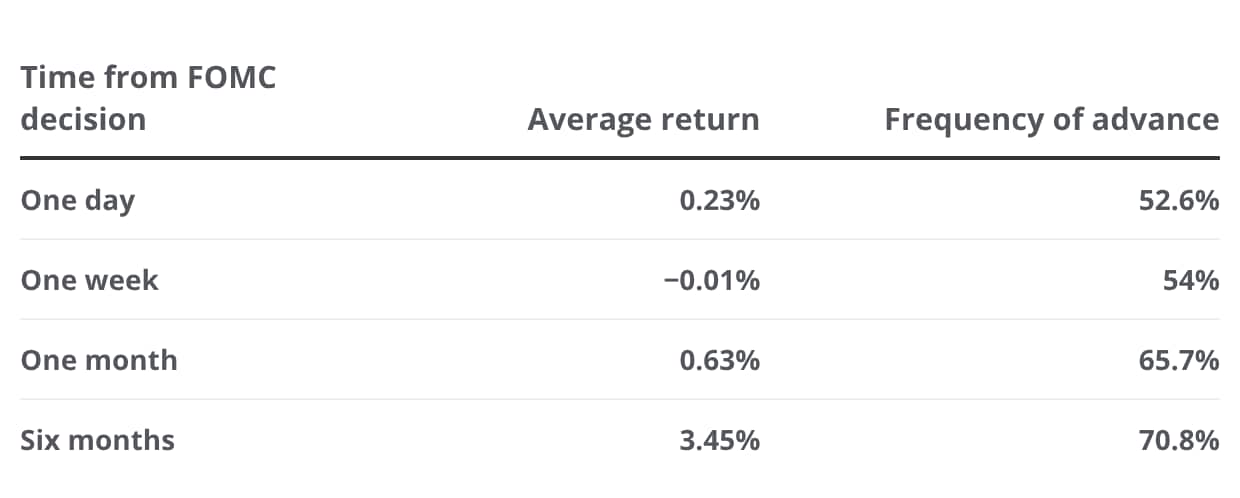
That’s also why the “Fed-day” pattern is real but easy to overinterpret. Across scheduled FOMC decisions from December 1999 through July 2026, the S&P 500 posted an average gain of 0.23% on decision day, yet average returns over the next week were slightly negative, down 0.01%. Put differently: A Fed-day rally isn’t a law of nature, and the market can give some of those gains back soon after.
Stocks historically haven’t responded to rate hikes in one consistent way. In many cycles, equities have held up early on when growth is still solid and profits are rising, even as higher rates put some pressure on valuations. Trouble tends to come when higher borrowing costs start slowing spending and hiring, and investors begin to expect weaker earnings. In that environment, “higher for longer” can matter as much as the first hike, because expectations for how long policy stays restrictive can influence both multiples and the earnings outlook.
Rate cuts aren’t automatically bullish, either. Historically, rate cuts often begin when economic growth is weakening or recession risk is rising, which can cause stocks to fall if investors think profits are about to deteriorate. Cuts tend to look more supportive when they help prolong an expansion, rather than when they arrive as damage control in a downturn.
S&P 500 price returns after scheduled FOMC decisions (December 1999 to July 2026)
Pauses and pivots can be especially tricky to read. A pause might mean inflation is easing and the Fed can wait, or it might mean something in the economy or markets is starting to strain. Historically, the inflection is often about communication and context – that is, how the Fed describes risks and the outlook, not just what it does at a given meeting.
Even the Fed-day pattern varies by era. Data shows that average decision-day returns differed by Fed chair. For instance, returns were higher on average during Ben Bernanke’s tenure than during Powell’s, a fact that underscores how the policy framework and macro environment can shape outcomes. The practical takeaway for investors is simple: History rarely rewards guessing each meeting; rather, it tends to reward sticking with a plan and managing risk through diversification and discipline.
Get up to $1,000
When you open a J.P. Morgan Self-Directed Investing account, you get a trading experience that puts you in control and up to $1,000 in cash bonus.
Why Fed decisions move markets differently today
A recent example shows why Fed-day moves can be about messaging and interpretation as much as the rate decision itself: The S&P 500 fell 1.2% after Warsh’s first Fed meeting on June 17, with losses steepening during and after his inaugural press conference. What made the reaction notable is that the Fed held rates steady, as markets broadly expected.
In part, investors were adjusting to a new communication style. Warsh’s first months in charge have featured a shorter policy statement and less guidance about future rate moves – so markets have had to infer more about what comes next.
Investors instead focused on what Warsh’s emphasis on price stability and an operational regime change might mean for the path of policy and the likelihood of future hikes or cuts. That’s a useful lens for understanding why today’s market moves may seem “illogical”: Markets are often reacting to the gap between expectations and new information, not simply to whether the Fed hiked, cut or held rates steady.
In this environment, prices can adjust faster because investors are continuously updating their views not just on where rates are today, but on where they’re headed and how long they might stay there. With less certainty about the Fed’s future path, relatively small changes in wording, tone or emphasis can quickly ripple through long-term bond yields, the dollar and broader financial conditions – which then feed back into stock valuations.
That’s why Fed-day market action often hinges on the details, among them the statement language and the press conference, as well as any guidance on how policymakers are thinking about inflation, growth and risks. Research shows that Fed-day market behavior can differ meaningfully by chair – including late-day weakness after Powell press conferences and weak early Warsh Fed days – which further highlights how communication style can reshape intraday market moves.
That whipsaw effect is also visible in the long-run data: Between December 1999 and July 2026, returns on scheduled FOMC decision days were positive on average, but the average return over the following week was slightly negative. This trend suggests initial reactions may fade as investors digest the central bank’s message.
Here’s a practical post–Fed meeting list of questions for investors to consider:
- Did market expectations for the next few meetings change?
- What happened to long-term yields after the decision?
- Did the dollar strengthen or weaken?
- Are credit conditions looking easier or tighter?
- Did the market move because of the decision, or because of the outlook?
How investors can prepare for Fed decision day
Fed days can bring sharp, short-lived market moves – and reacting to the first headline can lead to costly whipsaws. That’s not just theory: Historical data shows that early market moves following a Fed decision can fade or reverse in the days and weeks that come after, reinforcing the value of a plan over a prediction.
A good starting point for investors is to re-center on time horizons. If your goals are measured in years, not days, then a single Fed meeting usually shouldn’t change a long-term plan. What can help is making sure your portfolio isn’t built around one narrow outcome: Diversification can help reduce the risk that one surprise throws your entire strategy off course.
In the same spirit, many investors emphasize quality. Companies with stronger balance sheets and more resilient cash flows, for example, may be better positioned when financing costs are higher and uncertainty rises. And balanced exposure matters, too. Appropriate allocations across equities, high-quality fixed income and liquidity can help manage both opportunity and downside, depending on an investor’s objectives and risk tolerance.
Discipline is the other key ingredient. Rebalancing your portfolio by adding to areas that have fallen and trimming those that have risen, within pre-set ranges, may turn volatility into a process rather than an emotional decision. Liquidity planning plays a similar role: Matching near-term spending needs with lower-volatility resources may reduce the odds of being forced to sell risk assets at an inopportune time.
Finally, it can help to think in terms of simple scenarios instead of single forecasts. These might include a soft landing where economic growth cools but stays positive; a “higher for longer” path where rates remain elevated; or a downturn where cuts arrive faster but earnings risk increases.
Preparation in any scenario tends to look similar: Stay diversified, avoid concentrated bets, revisit risk tolerance as conditions change and lean on processes like rebalancing instead of reacting to each meeting. Consider speaking to a qualified financial professional about your time horizon, liquidity needs and whether your portfolio is positioned for multiple rate-path scenarios.
Invest your way
Not working with us yet? Find a J.P. Morgan Advisor or explore ways to invest online.