Moody’s downgrades US government debt rating

Global Investment Strategist

As we were all getting ready to start the weekend last Friday, Moody’s Ratings decided to throw a wrench in the weekend ‘mood’ by downgrading U.S. government debt from ‘AAA’ (the highest credit rating) to ‘Aa1’ (the second highest credit rating). In their report, Moody’s cited persistently large budget deficits and rising interest costs as reasons for the downgrade. This is not the first time that the U.S. has been downgraded from the highest tier: S&P Global Ratings downgraded the U.S. back in 2011 and Fitch Ratings followed suit in 2023.
Government bond ratings are helpful to understand the reliability of a country paying back its government bond holders. The higher the score, the better, as it allows governments to borrow at lower interest rates than those countries that are deemed to be riskier. With the Moody’s downgrade, the U.S. now has the same rating as countries like Austria and Finland and above countries such as the United Kingdom and France. Despite the downgrade, Moody’s did reiterate that “the U.S retains exceptional credit strengths such as the size, resilience and dynamism of its economy and the role of the U.S. dollar as a global reserve currency.”
Work with an advisor
Our advisors can provide ongoing financial advice on how your portfolio can adapt to the changes in the market, your life and your goals.
The timing of this downgrade is noteworthy, especially as Congress is currently debating a large reconciliation bill that includes extending the 2017 tax cuts, which could significantly increase the budget deficit in the coming years. We explore this issue further in our 2025 Mid-Year Outlook. We are closely monitoring the negotiations between the House and Senate and expect more details about the bill as the summer progresses.
While the downgrade does not dramatically shift the narrative as the U.S. fiscal picture is well-known amongst many investors, it does suggest further upside risks to U.S. government bond yields. While U.S. assets will continue to be valuable core holdings in portfolios, the recent downgrade is a good reminder that relying too heavily on one market can be risky. Diversifying across different regions and currencies could help build a more resilient portfolio.
Senate instructions for reconciliation bill would dramatically increase deficit
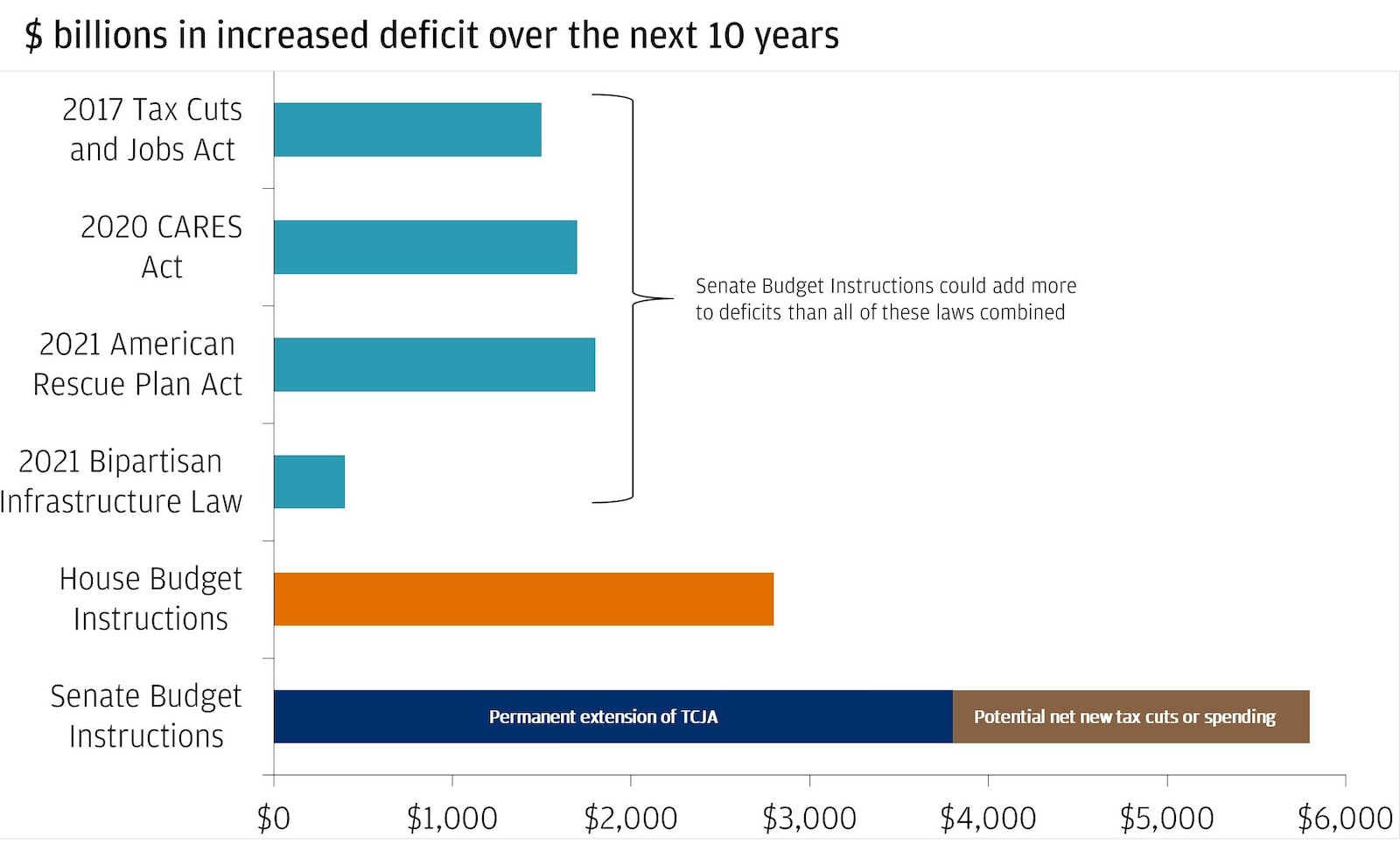
All market and economic data as of 05/19/25 are sourced from Bloomberg Finance L.P. and FactSet unless otherwise stated.
Explore ways to invest
Take control of your finances with $0 commission online trades, intuitive investing tools and a range of advisor services.