How does the stock market perform during midterm election years? A guide for investors

Editorial Staff, J.P. Morgan Wealth Management
- History shows that midterm election years can bring elevated uncertainty and volatility, especially earlier in the year.
- Weakness can be front-loaded, with stock market returns often improving significantly later in the year as election uncertainty resolves.
- Politics can move markets in the short run through expectations, but over time, earnings, inflation and interest rates tend to matter more.
- A volatile year can still finish positive – large drawdowns and positive full-year returns can coexist.
- For long-term investors, the playbook is behavioral: Stay diversified, rebalance with discipline and avoid election-driven market timing.

Midterm election years, which take place in the second year of a president’s term, can test investor patience. With control of Congress at stake, policy priorities shifting and the overall economic backdrop evolving, markets can face a wider range of potential outcomes. That uncertainty can show up as choppier trading and weaker market performance earlier in the year, especially as headlines, polls and policy debates intensify.
At the same time, history suggests that once the election passes and uncertainty is lifted, markets often refocus on fundamentals like earnings, inflation and interest rates. That’s why it is important to understand the historical pattern, why election anxiety can move markets in the first place and how long-term investors can stay focused when volatility picks up – by using history for context, not predictions.
What is a midterm election year – and why do investors pay attention?
During a midterm election year, Americans vote for all House seats and a portion of the Senate. It corresponds with the second year of a U.S. president’s four-year term. Investors pay attention because the results can shift the balance of power in Congress and change the odds of policy outcomes – from taxes and government spending to regulation and oversight – over the next two years. All 435 House seats and 35 Senate seats are on the ballot this year, along with 39 gubernatorial races.
Elections typically matter to markets most in terms of expectations and uncertainty, not as a direct driver of investment returns. Politics can still matter – but often by widening the range of plausible outcomes, which can amplify short-term volatility.
A common narrative is that midterm years can be choppier, especially in the first half of the year, though that performance can improve as investors get more clarity closer to and after Election Day. Still, it is not a rule. Averages can be skewed by outlier years or the economic backdrop itself (e.g. economic growth, recession risks, geopolitics and other factors). In addition, there is no guarantee that what has happened during past cycles will come to fruition this year or around future midterm elections.
How the stock market has performed in past midterm election years
Historically, midterm election years have tended to come with lower average returns and higher realized volatility than non-midterm years. One clean way to look at midterm years is through the four-year presidential cycle: The second year has historically been the weakest on average. From 1945 through the end of 2025, the S&P 500 posted an average gain of just 3.8% during midterm election years – compared with an average gain of 10.9% for the other three years of the presidential cycle.
S&P 500 average price returns during the presidential cycle since 1945
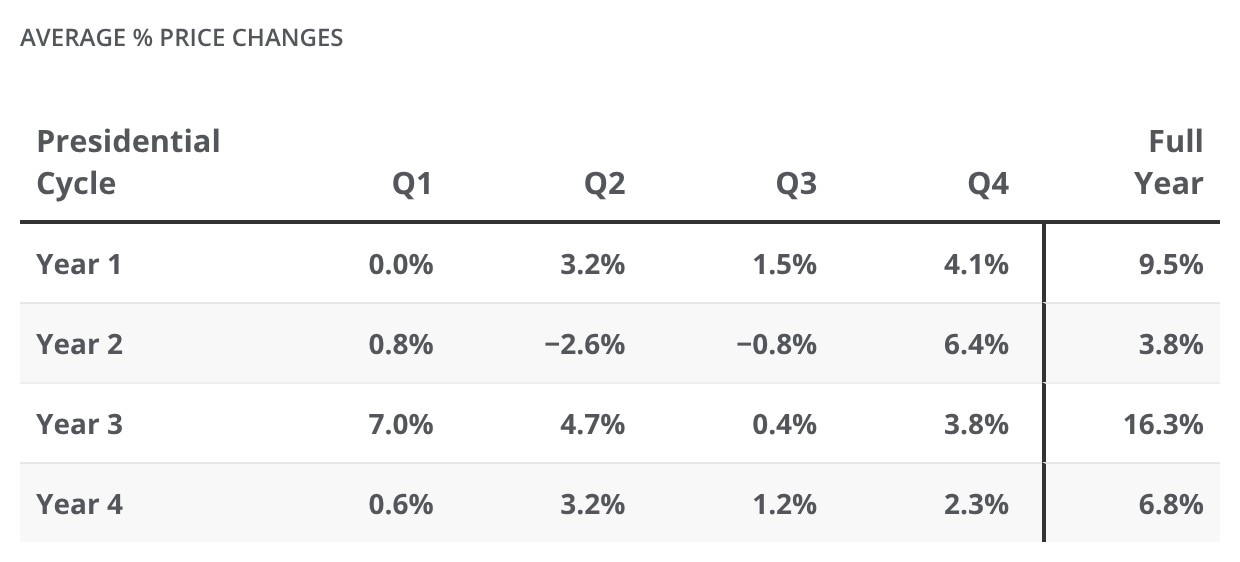
It is also important to note that a volatile year for markets – complete with big drawdowns – can still finish positive. Midterm election years are shown to have the largest average drawdowns with 18%, versus an average drawdown of 12.4% for the other three years in the cycle.
Another pattern that shows up in historical averages is front-loaded uncertainty. As campaigns heat up and policy narratives shift, markets can reprice risk quickly. After results are known, markets often spend less time handicapping political scenarios and more time focusing on fundamentals – earnings trends, inflation data and the Federal Reserve path.
The first three quarters of a midterm election year have historically been weak, with the S&P 500 falling by an average of 0.9%. In the fourth quarter, however, the benchmark index has seen an average gain of 6.4%, reflecting that markets often rally once election uncertainty is lifted.
Even when a pattern shows up in hindsight, it is difficult to act on it in real time because markets move on expectations – and those expectations can shift quickly. By the time the “midterm pattern” feels obvious, prices may have already adjusted, which can turn a seasonal rule of thumb into a timing mistake.
Interested in working with an advisor?
Work 1:1 with our advisors to help build a personalized financial strategy that’s built around you.
Why ‘election anxiety’ can move markets
“Election anxiety” isn’t just about who wins but about how policy probabilities shift and how quickly markets must reprice uncertainty. When potential outcomes widen, investors may demand a higher return to hold risk assets, which can translate into lower prices in the short term.
The biggest market-moving headlines are usually the ones that change the expected policy path, not the day-to-day noise. Three channels tend to matter most:
- Policy uncertainty: Taxes, regulation and oversight can affect after-tax profits, compliance costs and sector-level sentiment (e.g., healthcare reimbursement, energy permitting, defense spending, tech oversight).
- Fiscal expectations: Markets watch the outlook for government spending, deficits and debt-ceiling dynamics because they can influence growth expectations, Treasury supply and interest rates.
- Trade policy and geopolitics: Shifts in tariffs, sanctions or international tension can affect supply chains, commodity prices and corporate margins.
When outcomes are unclear, investors may build an “uncertainty premium” into prices, essentially requiring more compensation for taking on risk. Once results are known, however, the premium can shrink quickly because probabilities resolve and timelines become clearer. In some scenarios, Congressional gridlock can also reduce the odds of large policy swings, which markets may interpret as lower near-term policy risk.
Historical data shows that markets often stabilize after election results, which is why investors may want to stick to long-term plans rather than trade headlines. Looking at S&P 500 data back to 1968, the index posted an average gain of 13.3% in the six months after an election, versus an average gain of 4.4% in non-election years. While that doesn’t mean a postelection rally is guaranteed, it is a reminder that markets can move quickly once uncertainty starts to clear.
For investors trying to stay focused, ask yourself the following: Does this news change the likely direction or timing of fiscal policy, regulation or interest rates? If not, it may be more noise than signal. For most long-term investors, fundamentals like earnings, inflation and the Federal Reserve tend to dominate over time.
What long-term investors should (and shouldn’t) do in midterm years
Midterm years can create a lot of decision pressure for investors. The goal isn’t to predict politics but rather to make sure your plan can withstand volatility. Start with the basics: Your time horizon, near-term cash needs and risk tolerance.
Investors can take several steps when checking their portfolios:
- Rebalance with discipline: If a sell-off pushes your portfolio away from its target mix, rebalancing can help you “buy low/sell high” systematically rather than emotionally.
- Check diversification: Make sure you’re not overexposed to a single stock, sector or theme that could be sensitive to policy narratives.
- Right-size cash: Holding some cash equivalents for near-term needs can reduce the chance you’ll be forced to sell long-term investments at an inopportune time.
Volatility is normal, but politics can sometimes make it feel personal – and that’s when mistakes can happen. Try not to confuse political certainty (a result you feel confident about) with market certainty (how investors will price that result).
And, keep an eye out for these common mistakes:
- Trying to time the market around Election Day: Markets often move before outcomes are official and can reverse quickly.
- Overweighting sectors based on campaign narratives: Policy outcomes are complex, and markets may have already priced in the obvious parts.
- Letting short-term news override long-term goals: A plan built for years shouldn’t be rewritten because of a week of headlines.
The bottom line: Use history for context, not forecasts
Midterm election years have often been bumpier than average, especially earlier in the year, but outcomes vary widely – and fundamentals still do most of the long-run work. What’s more, historical data shows that investors who stay focused on the long term are often rewarded: Once election uncertainty is lifted, markets have historically tended to rally.
Investors may want to use historical patterns as perspective, not as a trading signal, and focus on what you can control: diversification, rebalancing discipline and a plan aligned to your time horizon. If you’re unsure whether your portfolio still matches your goals, consider reviewing your allocation and risk level, or speaking with a qualified financial advisor about your broader plan.
Invest your way
Not working with us yet? Find a J.P. Morgan Advisor or explore ways to invest online.