Why AI should still be a focus for investors

Global Investment Strategist

You may have noticed that artificial intelligence (AI) isn’t dominating headlines as much lately, with uncertainty surrounding tariff and tax policy taking precedence for many investors. Despite the reduced attention, our 2025 Mid-Year Outlook emphasizes that AI remains a transformative force in the technology sector, with spending growth by tech giants expected to increase in 2025.
Work with an advisor
Our advisors can provide ongoing financial advice on how your portfolio can adapt to the changes in the market, your life and your goals.
Why is this important? AI continues to enhance productivity and efficiency across various industries, not just within the tech sector. It enables outputs comparable to doctorate-level work at significantly reduced costs. Like past technological revolutions, such as the advent of personal computers and mobile phones, we expect lower costs and better performance to drive widespread AI adoption.
Furthermore, we see AI as a global investment theme. For example, the tech sectors in Europe and China were closing the performance gap with U.S.-based tech companies following the release of ChatGPT in November 2022, prior to recent tariff shocks affecting markets.
Looking ahead, we will continue to focus on global companies across sectors poised to benefit from cost savings and productivity gains driven by AI technology, such as those in the software and financial industries.
AI is helping to drive tech sector gains across global markets
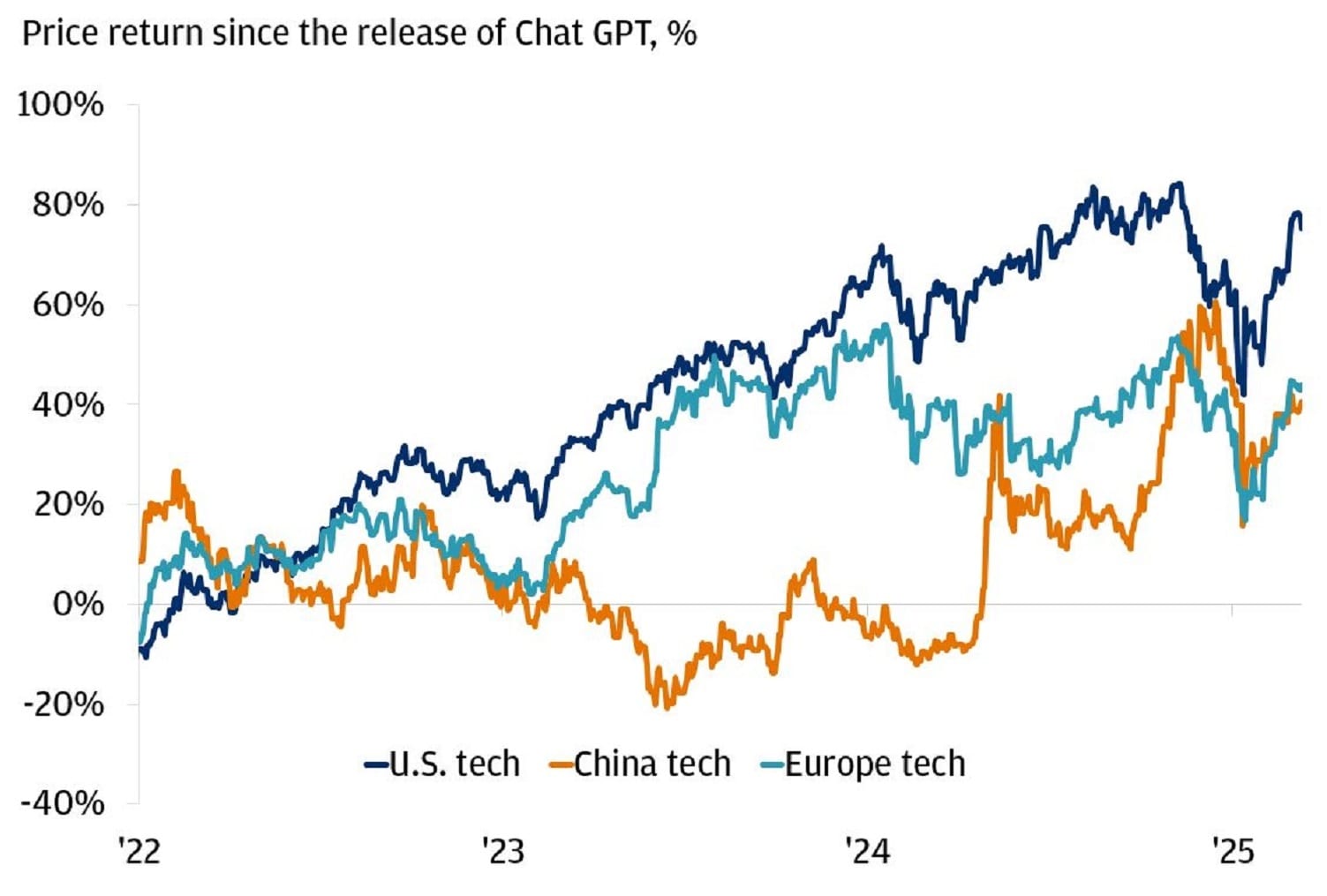
All market and economic data as of 05/22/25 are sourced from Bloomberg Finance L.P. and FactSet unless otherwise stated.
Explore ways to invest
Take control of your finances with $0 commission online trades, intuitive investing tools and a range of advisor services.