US government shutdowns have minimal market impact

J.P. Morgan Wealth Management

This Friday, March 14 marks the deadline for Congress to allocate funding to various government agencies via appropriations bills or a continuing resolution. If some kind of bill isn’t passed by then, we could see a government shutdown.
Reports suggest that representatives from both political parties are keen to avoid such an outcome, but slim majorities in both the House of Representatives and the Senate mean an agreement could be difficult to achieve. So, let’s say that we pass the deadline and see a government shutdown go into effect this weekend – what should investors know?
Work with an advisor
Our advisors can provide ongoing financial advice on how your portfolio can adapt to the changes in the market, your life and your goals.
First, it’s worth understanding what a government shutdown actually means. It is the closure of "nonessential" U.S. government departments due to the exhaustion of "discretionary" funding. Impacted areas include the Environmental Protection Agency, the Labor Department and parts of the Internal Revenue Service, among other agencies. However, "essential" activities funded by the "mandatory" budget, such as national security, safety and medical care, continue. Programs like Social Security, Medicare and Medicaid would remain uninterrupted, and tax collection and debt repayment are not affected.
We have been through this before. Since 1980, we’ve experienced 14 government shutdowns, with some as short-lived as just one day. The longest occurred from December 2018 to January 2019, lasting 34 days. Regardless, it’s worth noting that shutdowns have historically had little impact on markets.
Government shutdowns have had limited impact on markets
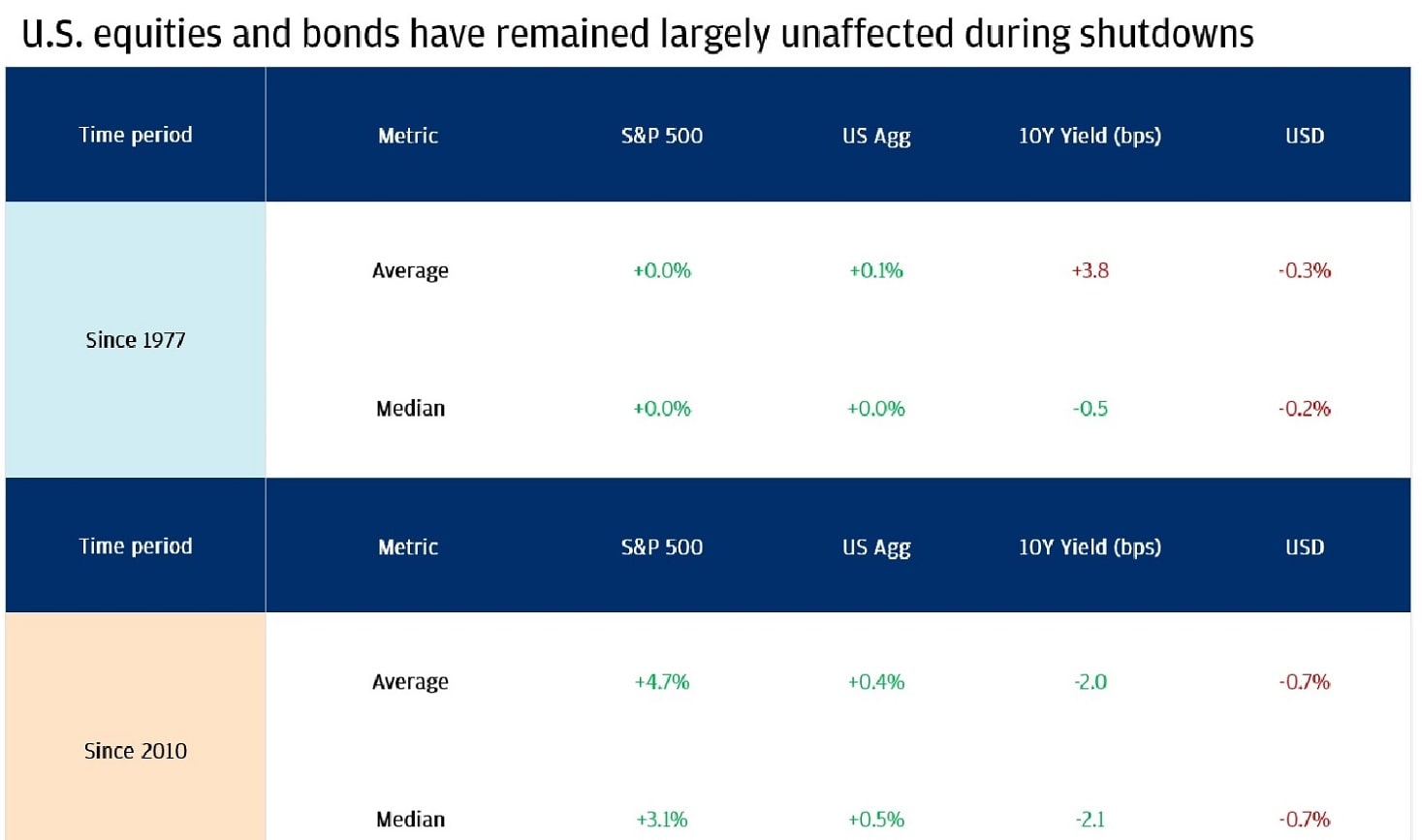
The historical precedents perhaps help explain why the potential for a government shutdown seems low on the list of market drivers right now. At the present, investors are much more focused on the potential impacts of policy related to areas like trade and immigration, economic data developments, the outlook for central bank policy and interest rates and corporate earnings – and rightfully so. We expect these dynamics to remain the primary drivers of markets for the foreseeable future, regardless of whether a shutdown occurs.
All market and economic data as of 03/10/25 are sourced from Bloomberg Finance L.P. and FactSet unless otherwise stated.
Explore ways to invest
Take control of your finances with $0 commission online trades, intuitive investing tools and a range of advisor services.