US assets: Is investor confidence dropping?

Global Investment Strategist

In recent weeks, we've observed movements in U.S. financial markets that often reflect investors' concerns about holding a specific country’s assets. On certain days, we've seen U.S. stock prices drop, the value of the U.S. dollar decline and interest rates on U.S. treasury bonds rise (bond prices fall) – meaning that the value of each asset has declined in tandem.
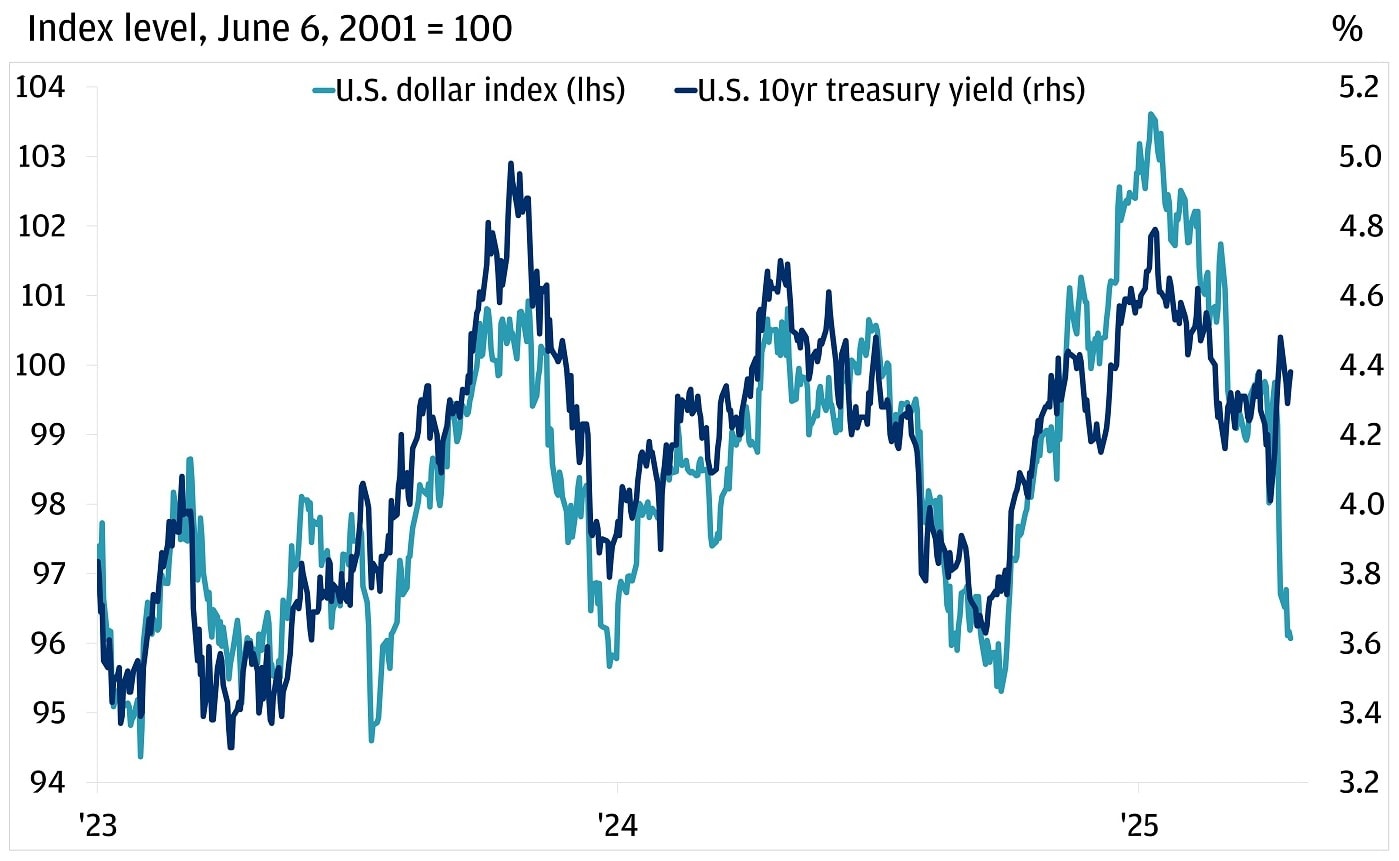
Historically, during periods of U.S. equity market declines, we would expect U.S. yields to drift lower (bond prices rise) and for the U.S. dollar to also move lower (outside of crisis periods) as investors embed a higher probability of future Federal Reserve rate cuts. The chart below shows the relationship between the U.S. dollar and U.S. treasury yields over the past few years and how unusual the recent divergence has been where the U.S. dollar has weakened, while U.S. treasury yields have remained elevated.
Work with an advisor
Our advisors can provide ongoing financial advice on how your portfolio can adapt to the changes in the market, your life and your goals.
We are monitoring three key factors that might be affecting investor confidence both domestically and internationally:
- Ongoing tariff uncertainty: There is still a lot of uncertainty about the goals of U.S. trade policy as well as the potential for trade deals. This uncertainty, along with concerns that existing tariffs could significantly slow down economic growth, could be weighing on investor sentiment.
- Challenges to Federal Reserve independence: Recently, there have been discussions in the White House about the possibility of removing Federal Reserve Chair Jerome Powell before his term ends in 2026. This possibility could undermine trust in the Federal Reserve, a crucial U.S. institution, which could hurt investor confidence in U.S. assets.
- Increasing budget deficits: The latest Senate budget proposal suggests a significant increase in the national debt relative to gross domestic product (GDP) in the coming years. This means more U.S. treasury bonds would need to be issued to cover larger budget deficits, which could lead to higher interest rates on U.S. treasury bonds.
Despite these uncertainties, it is important to remember that the U.S. remains the largest economy in the world, with a dynamic private sector. However, these challenges highlight the importance of diversifying investments across different countries and asset classes to create more resilient portfolios, no matter how the future unfolds.
Recently the U.S. dollar has weakened while U.S. treasury yields have risen
All market and economic data as of 04/22/25 are sourced from Bloomberg Finance L.P. and FactSet unless otherwise stated.
Explore ways to invest
Take control of your finances with $0 commission online trades, intuitive investing tools and a range of advisor services.