Funding AI: IPOs are sending a new signal

Funding the artificial intelligence (AI) buildout began with cash – over $700 billion sitting on the balance sheets of the biggest tech companies in the world. Then came private capital, with alternative investors expected to supply $1.4 trillion over the next five years, followed by a wave of public corporate debt issuance to the tune of $2.1 trillion of expected AI-related debt financing over the same period. Now, the next level of financing is moving into one of the most traditional venues: the stock market. That means more equity issuance, and for some companies, an initial public offering (IPO).
Drop in the bucket
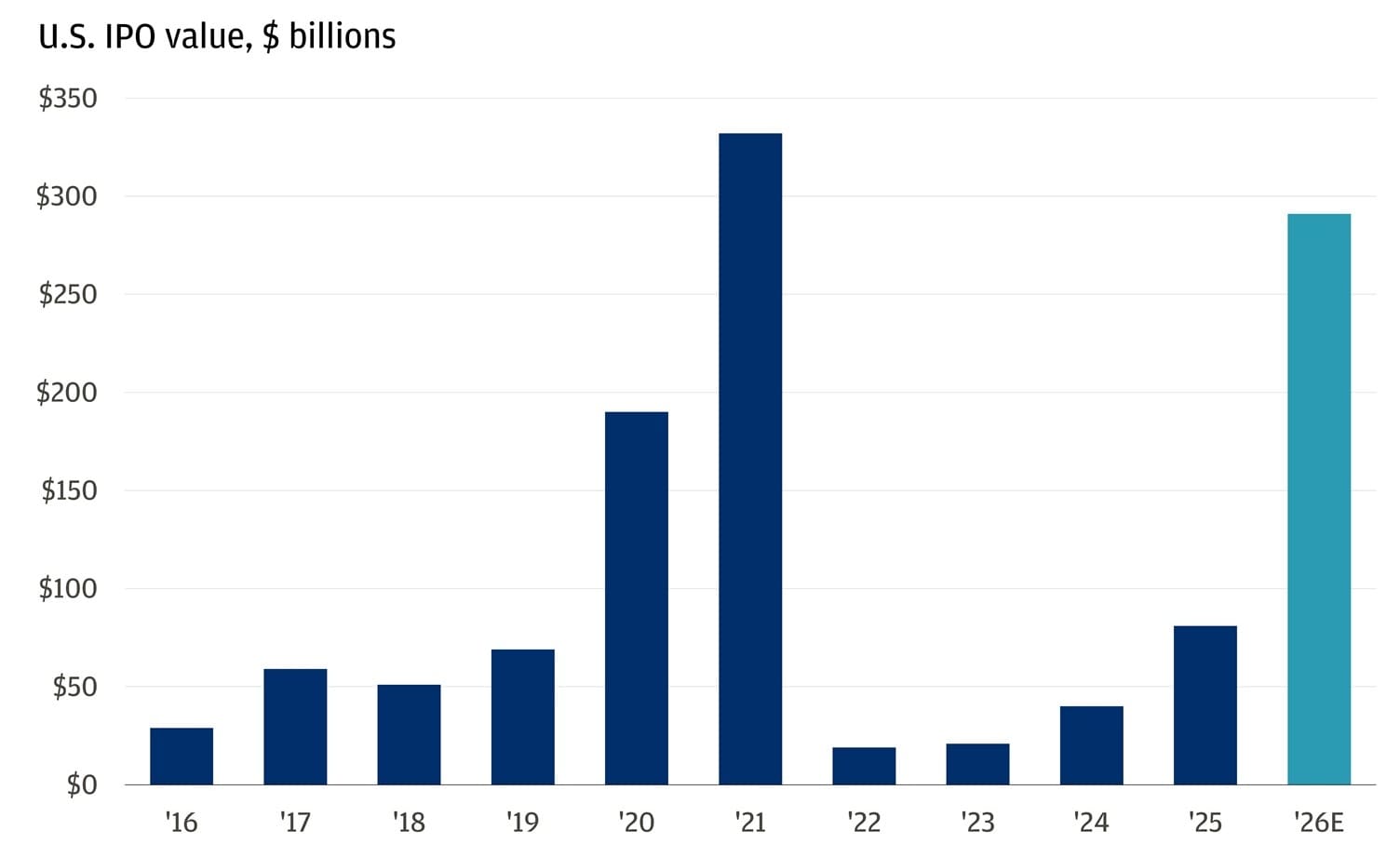
Companies in the United States are on track to raise around $290 billion in 2026 through just IPOs, approaching the 2021 peak of roughly $330 billion. That marks one of the strongest years of issuance in the last two decades before accounting for secondary offerings, special purpose acquisition companies (SPACs) or convertible notes. But just as the AI buildout grows, so do the capital markets. It’s a large amount, but in the context of today’s $70 trillion stock market, expected issuance amounts to less than 1% of the total.
2026 marks the biggest year of IPOs since 2021
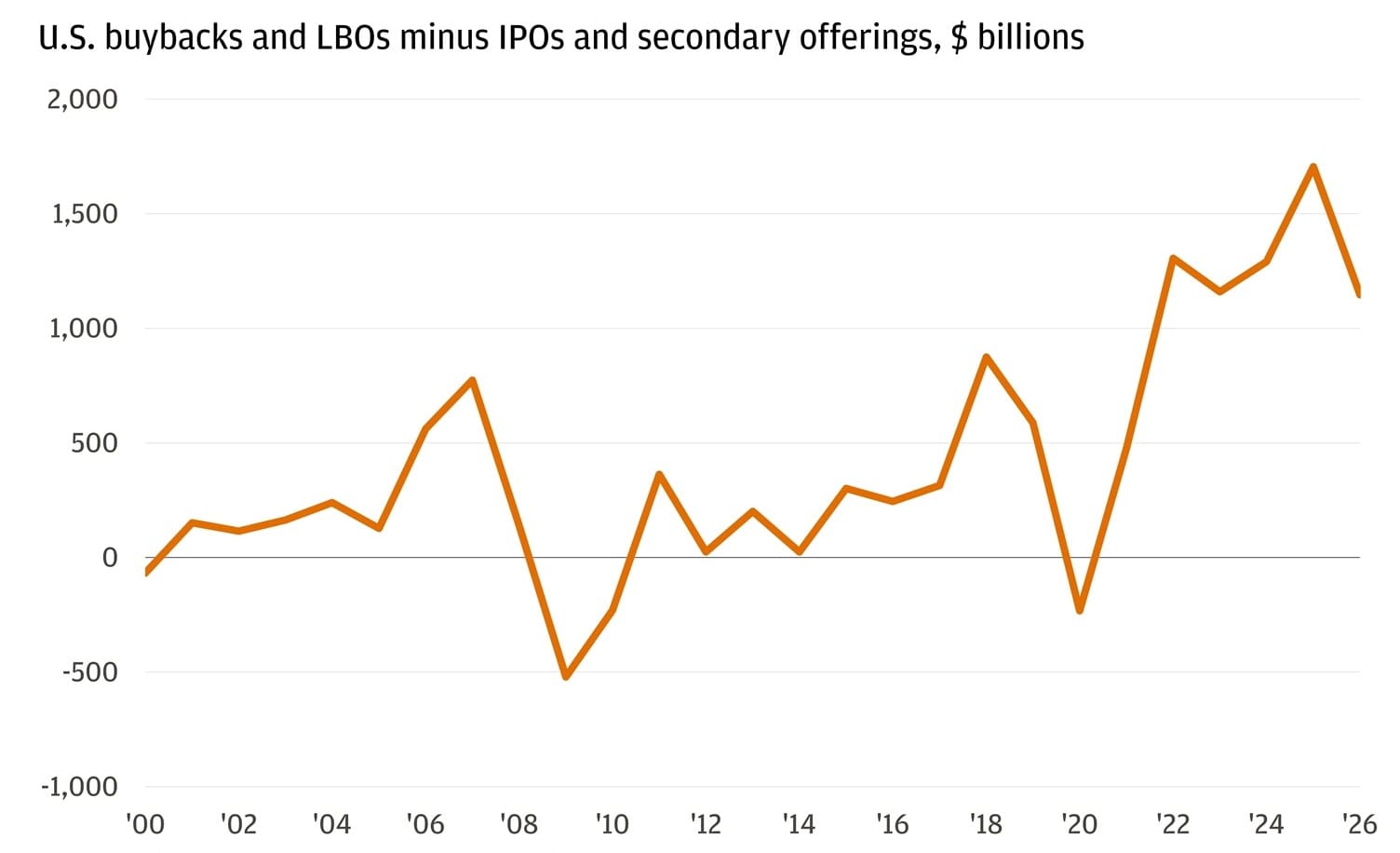
For investors worried that IPOs of size can zap liquidity in the stock market or that AI is consuming more capital than financial markets can absorb, it’s worth noting the scale. Yes, the IPO wave may be big. The pool of capital waiting on the other side is bigger, thanks to demand drivers ranging from corporate buybacks to international, retail and pension investors.
Take U.S. households as an example – after years of fiscal stimulus and household deleveraging, equity participation is at multidecade highs. Net household demand for equities is around 3% of the total market, well above the 30-year average. The cohort has purchased more than $800 billion of equities in the first half of 2026, while international investors added more than $350 billion.
Companies themselves also remain a major source of demand: Corporate buybacks have risen to over $1.3 trillion year to date, while cash-funded mergers and acquisitions have provided additional support, with more expected in 2027.
Overall, net equity supply has turned positive for the first time since the 2020–21 IPO boom, but demand – thanks to a multitude of factors – is growing even faster.
Diverse demand drivers far outpace equity supply
Ready to take the next step in investing?
We offer $0 commission online trades, intuitive investing tools and a range of advisor services, so you can take control of your financial future.
Index inclusion
The IPO itself isn't the end of the demand story. For the largest companies, index inclusion can quickly create another wave of demand, especially as the path to joining U.S. benchmarks has become smoother. A faster process can compress the timeline over which trillions of dollars in index-linked assets need to purchase shares.
Joining the Nasdaq-100 can happen as soon as 15 trading days, while inclusion in the S&P 500 takes into account financial viability screenings, a seasoning period and a minimum investable weight requirement.
IPOs with a $100 billion raise and $2 trillion valuation have been estimated to have a 1%–1.2% weight in the Nasdaq-100 and S&P Total Market Index. In the MSCI World indexes, large IPOs can amount to a weight of roughly 10–11 basis points and be considered for early inclusion as soon as the 10th trading day.
Private for longer? Still holds
Even with a pipeline of private companies ultimately debuting in the public markets, the case to stay private for longer still holds. It’s the role of public markets that’s changing.
Debuting on the stock market used to be mainly a way for companies to raise money that funded their future growth. But for today's largest private companies, an IPO is increasingly about something different: creating liquidity and broadening access. By the time these businesses go public, a meaningful amount of growth and value creation has already happened. It’s just happened in the private market ecosystem rather than the public one.
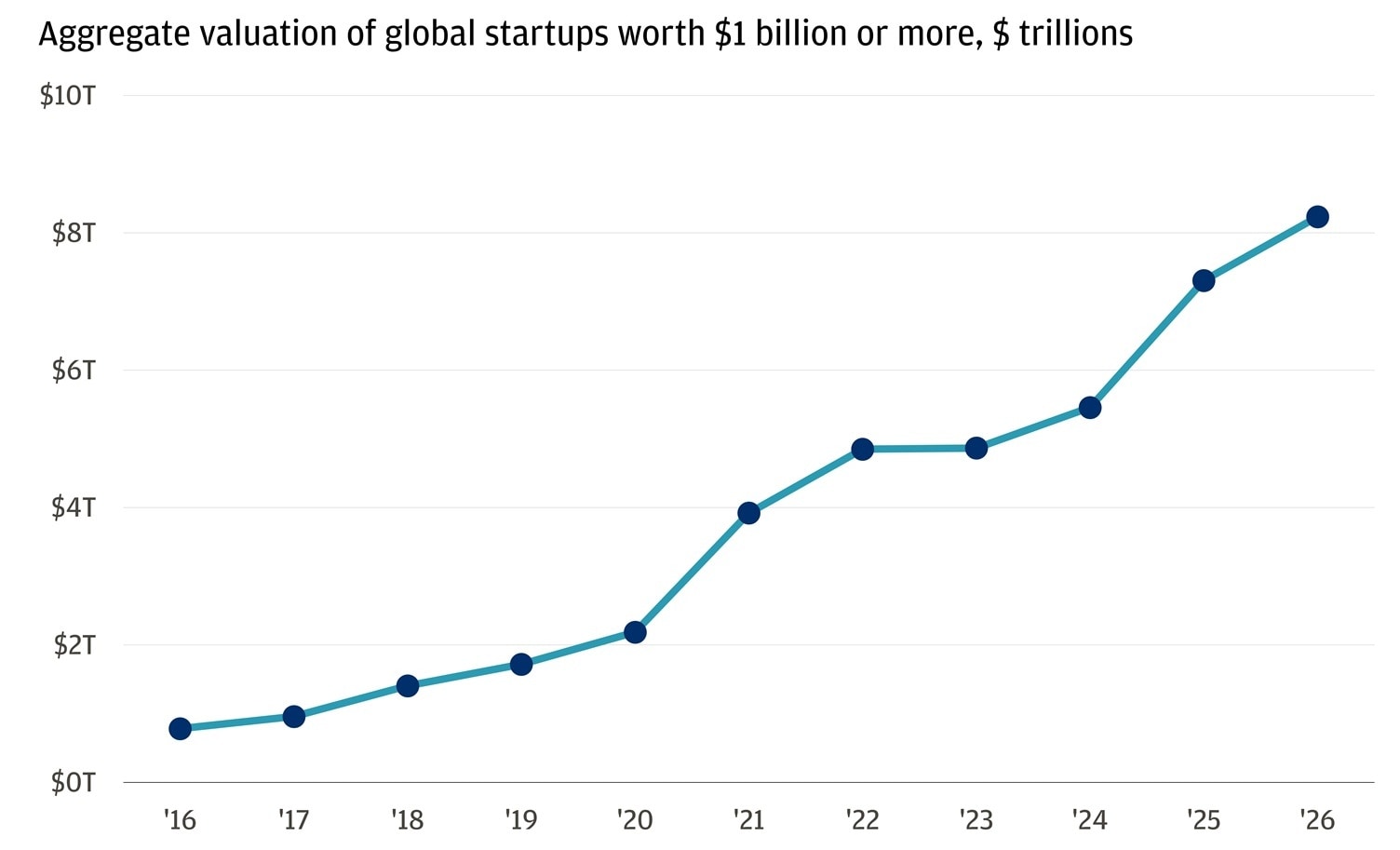
About 85% to 95% of companies globally with more than $100 million in revenue are private, and private companies valued at over $1 billion – deemed “unicorns” – have reached a total of $8 trillion. That’s larger than the world's third-largest economy. A wave of large IPOs is unlikely to change that kind of growth mechanism.
Billion-dollar startups are now valued at over $8 trillion
So, what’s keeping companies private? For starters, the abundance of private capital. Take venture capital fundraising in the United States, which has already reached nearly $110 billion through the third quarter of 2026, surpassing the total raised in all of 2025. Companies may also prefer to avoid pressure around quarterly earnings and the additional regulatory requirements that come with being public.
Today, an IPO isn't the only way for early investors to cash out. Companies have far more options, including private sales and acquisitions. The track record of AI innovation shows that. Recent mega-IPOs suggest public investors are willing to pay a premium for companies that have become clear leaders in their markets. Given the pace of technological advancement, the eventual winners in AI may not even exist yet. That puts a premium on the value of patient capital and hands-on guidance in private markets.
All market and economic data as of 11/19/2026 are sourced from Bloomberg Finance L.P. and FactSet unless otherwise stated.
You're invited to subscribe to our newsletters
We'll send you the latest market news, investing insights and more when you subscribe to our newsletters.