Is it all one big AI trade?

Global Investment Strategist

Artificial intelligence (AI) is the buzzword everywhere you go: The Nasdaq 100 is up +15% year to date (YTD), hyperscalers are expected to spend +$750 billion on capex (and that estimate seems to rise each earnings season), and LLM companies like Anthropic and OpenAI have increased revenues at an unbelievable pace. (Anthropic’s annualized revenue run rate reportedly rocketed from $9 billion to $47 billion in about six months.) All of this is happening after two years of +20% S&P 500 returns, amid geopolitical conflicts, tariffs, the worst energy shock in history and consumer confidence near historic lows – so it’s understandable that many investors feel uneasy.
AI is a broad ecosystem (not a single narrow trade)
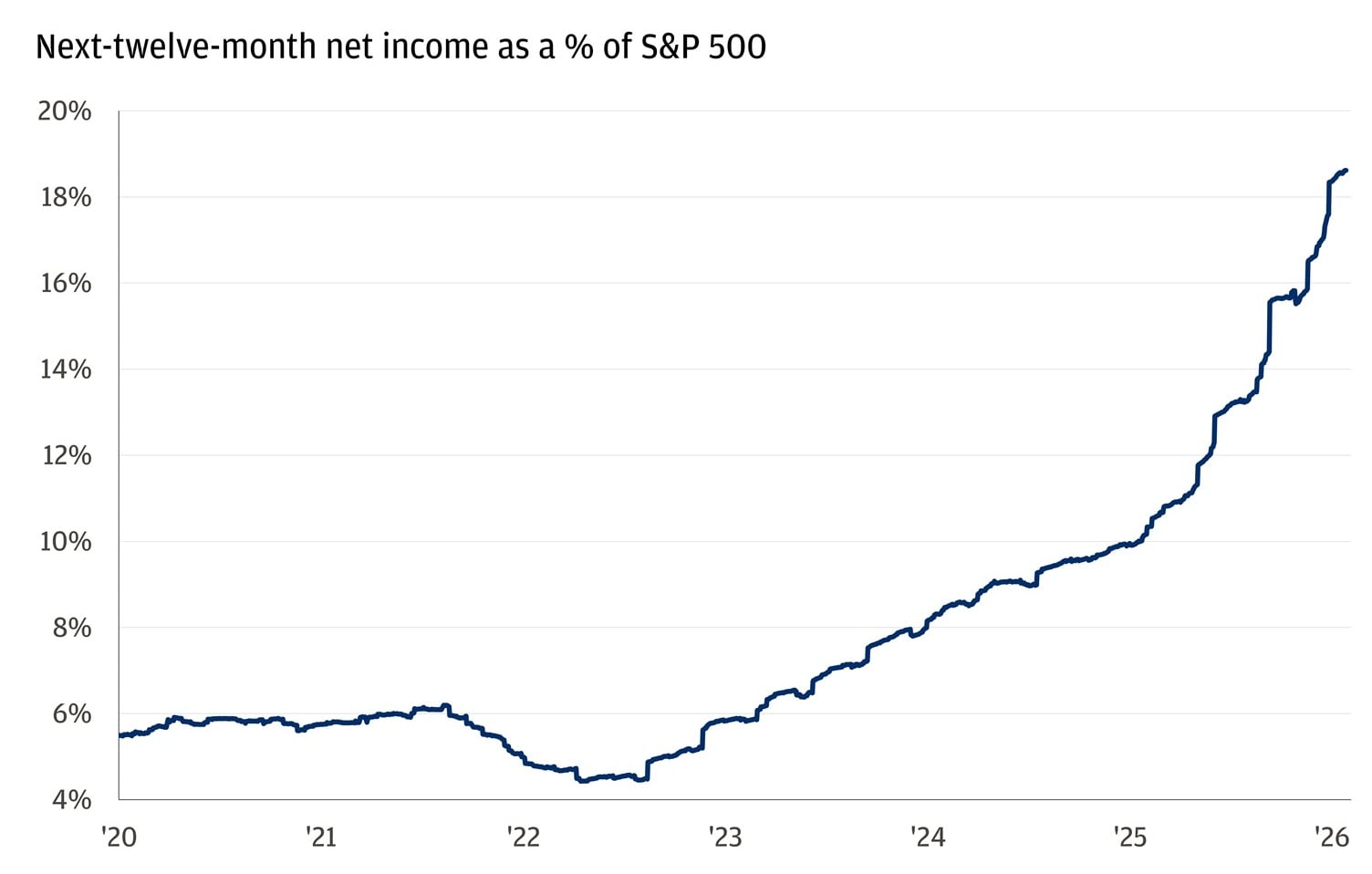
A lot of attention this year has gone to chips and memory. Companies like Sandisk, TSMC, and SK Hynix are up sharply, and the semis index is up +39% YTD as semi net income is becoming a more significant contributor to the S&P 500.
Semi net income has accelerated
But performance hasn’t been confined to a small corner of the market. Across the full AI value chain, the theme has been working. An analysis conducted of five different AI baskets containing 148 companies spanning the AI ecosystem (data centers, chips, memory, cooling, hyperscalers, electrification, software, etc.) revealed the following results:
- YTD, 70% of names are up.
- The median company is up over 20%, outperforming the S&P 500 YTD by about 10 points.
- Eight of the 11 sectors are represented, and 40% of names are ex-tech.
- Divided by subindustry, over two-thirds of subgroups are positive.
In other words, AI is showing up as a distributed theme across the value chain.
AI isn’t the only success story
AI and the AI supply chain are important drivers, but they’re not the only thing working.
The most obvious non-AI driver this year has been geopolitics: With the conflict in the Middle East, energy is the top-performing sector in the S&P 500 so far this year, supported by elevated energy prices. That is an idiosyncratic driver but could reverse.
Beyond that, there are more sustainable themes contributing to performance. Near-shoring remains top of mind, and industrials is a leading sector – driven not only by AI narratives, but also by a broader shift toward domestic and regional investment. Certain subsectors within healthcare and financials have performed well, as have certain materials. As Q2 earnings season ramps up, we expect 10 of 11 sectors to post positive earnings growth (six of those in double digits).
Ultimately, AI is likely to be a success story for the entire market. If someone said, “I’m worried the email trade is taking over the market,” it might sound strange – the same goes for mobile. Those technological advancements became inseparable from corporate productivity and profitability. Over time, AI will become inseparable from the broader market as well. We’re just not there yet.
Ready to take the next step in investing?
We offer $0 commission online trades, intuitive investing tools and a range of advisor services, so you can take control of your financial future.
What does this mean for your portfolio?
The AI story is real and will likely be an integral part of portfolios in the years to come. But diversification, and the inherent importance it has for achieving your long-term goals, is still critical.
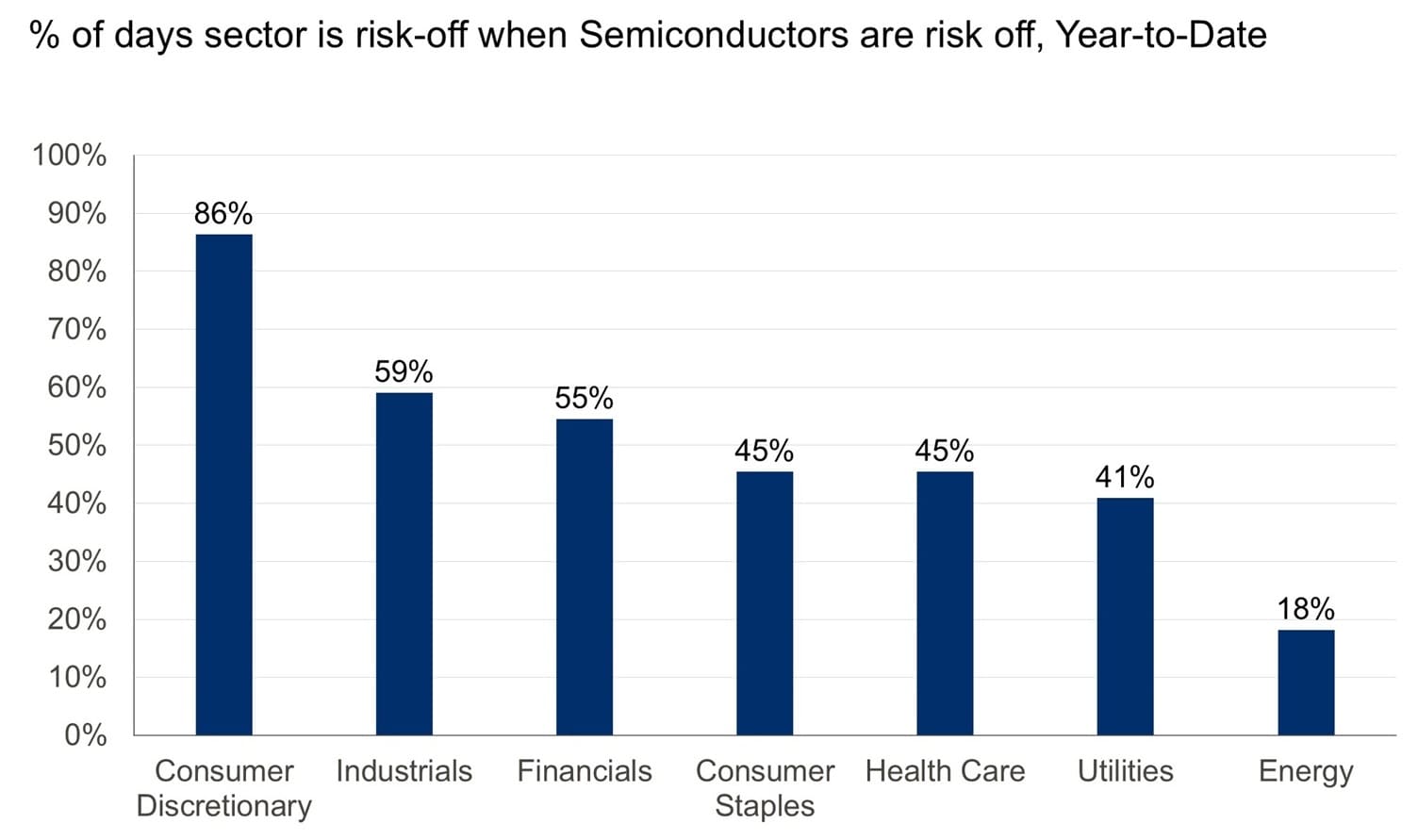
One encouraging development over the past year is that when semis were “risk-off” (defined as one-month rolling compounded daily returns that are less than -5%), other sectors in the S&P 500 weren’t necessarily risk-off too. From a portfolio construction standpoint, this is positive: On days when the semi trade hasn’t worked, other parts of the portfolio have, on average, held up better.
Semis selloff ≠ market selloff
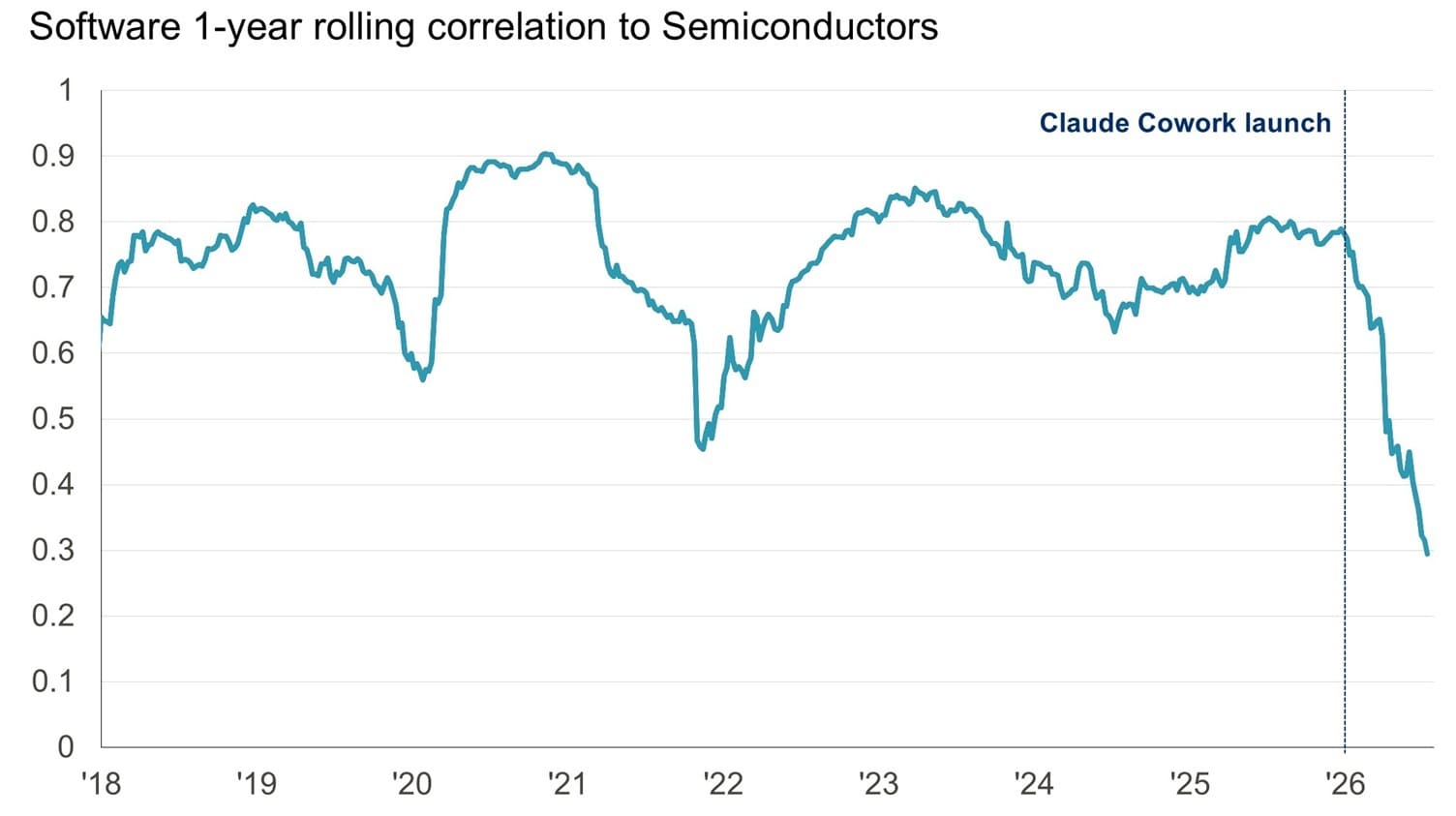
There’s also more breadth: YTD, the average stock is up more than the market-cap-weighted index. And importantly, the market is also not tech-blind – that is, not all tech is being treated equally. After years of nearly perfect correlation between semis and software, the two assets have become much less correlated over the past year as markets reassess who wins in an AI world. Once Claude Cowork came out, it became increasingly clear that parts of traditional software could be challenged as AI capabilities improve.
Post Claude Cowork, Software and Semi correlations have plunged
Another divergence emerging more recently is within the hyperscalers. Hyperscaler capex has been the engine of the AI trade for the past few years: Hyperscalers spend, the market rewards them for impressive growth and the broader AI universe benefits alongside them. But markets are increasingly wary of sustained high spend as these behemoths gradually draw down their cash flows.
Alphabet’s earnings results are a clear example. Despite delivering impressive cloud revenue and a continued ballooning backlog, investors focused on the other side of the equation: Management again guided capex higher and reported its first negative quarter of free cash flow since its IPO. We’re seeing the market become more critical – and more discriminating – across hyperscalers as investors try to separate AI winners from losers. Long-term, the success (or failure) of the hyperscalers to generate an acceptable return on investment on their heavy capex investments will likely be correlated with the returns of the AI ecosystem.
Ultimately, we think we’re only in the early innings of the AI tech cycle as AI has become much more useful in agentic form. Over time, AI’s reach will continue to grow and extend well beyond technology alone.
All market and economic data as of 07/24/2026 are sourced from Bloomberg Finance L.P. and FactSet unless otherwise stated.
You're invited to subscribe to our newsletters
We'll send you the latest market news, investing insights and more when you subscribe to our newsletters.