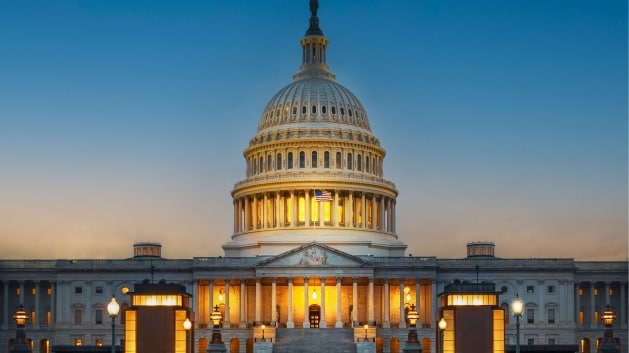
Supreme Court invalidates Trump’s tariffs, Trump announces new 15% ‘global tariff’ – Here’s what that means for the stock market

Editorial staff, J.P. Morgan Wealth Management
- On Friday, February 20, 2026, the Supreme Court invalidated President Donald Trump’s tariffs that were enacted under the International Emergency Economic Powers Act (IEEPA).
- In a press briefing later that day, President Trump announced a new 10% “global tariff” under Section 122 of the Trade Act of 1974. The next day, he announced on social media that he plans to raise the tariff to 15%.
- The high court stated that the IEEPA “does not authorize the president to impose tariffs.” Even so, the decision doesn’t immediately end trade policy uncertainty.
- U.S. equities markets were up slightly after the decision was published as investors digested the possibility of stronger corporate earnings. By Monday morning, February 23, they were down on the news of the 15% tariff.
- Investors may want to focus on a buy-and-hold strategy while watching to see which industries could benefit from lower trade barriers.

On February 20, the Supreme Court invalidated President Trump’s tariffs that were enacted under the International Emergency Economic Powers Act (IEEPA) in a 6–3 majority ruling. The decision, authored by Chief Justice John Roberts, stated that the IEEPA does not give the president the power to impose tariffs.
“The president asserts the extraordinary power to unilaterally impose tariffs of unlimited amount, duration and scope,” Roberts wrote. However, there is “no statute” in which Congress has said that the IEEPA could be used to impose tariffs, Roberts added.
The decision does not apply to all tariffs, leaving in place those that Trump implemented via other laws, such as tariffs on aluminum and steel.
Markets were up slightly after the news, rebounding from where they started the day on the heels of the latest PCE (personal consumption expenditures) inflation report and the GDP (gross domestic product) report, which showed sticky inflation and slower-than-expected growth.
Trump responded to the decision in a press briefing later that day, saying, “Other alternatives will now be used to replace the ones that the court incorrectly rejected,” before announcing that he would sign an executive order for a 10% “global tariff” under Section 122 of the Trade Act of 1974.
“Today I will sign an order to impose a 10% global tariff under Section 122 over and above our normal tariffs already being charged,” Trump said. Tariffs applied under Section 122 can last for 150 days. Any extension beyond that period would need congressional approval.
However, Trump said the next day in a post on social media that he plans to raise that tariff to 15%: “I, as President of the United States of America, will be, effective immediately, raising the 10% Worldwide Tariff on Countries, many of which have been ‘ripping’ the U.S. off for decades, without retribution (until I came along!), to the fully allowed, and legally tested, 15% level.”
While Trump announced the higher tariff on social media, he did not officially modify the presidential proclamation to raise the rate to 15% as of Monday morning. Even with a potential new 15% global tariff, many countries will still see a cut to levies they pay to the United States. Some trading partners will see no change.
The stock market’s reaction to Trump’s tariffs
Last year, when the Trump administration rolled out one of the most aggressive tariff programs in modern U.S. history, markets reacted strongly. The S&P 500 dropped nearly 5% in a single session, wiping out roughly $2.4 trillion in market value. Technology stocks led the decline, pulling the Nasdaq 100 sharply lower. International markets also weakened as investors reassessed global growth expectations and the potential for retaliatory trade measures.
At the same time, some investors moved toward safer assets as traders reassessed earnings expectations. Treasury yields fell as demand for bonds increased. Futures markets priced in higher expectations for interest rate cuts, and the U.S. dollar weakened. Commodity prices also slipped as traders worried about slower economic activity.
Historically, stock prices aren’t friendly to tariffs since they function as a tax on global business activity, lowering profits and making long-term planning harder. Even when tariffs aim to protect domestic industries, their short-term effects often show up first in earnings expectations.
But markets were resilient in 2025, with the S&P 500 ending the year up more than 17%, mostly driven by artificial intelligence (AI). This shows that tariffs did not have as significant of an impact on the index as was anticipated earlier in the year.
When the Supreme Court struck down the tariffs on February 20, markets reacted once again – but this time in a positive direction. The S&P 500, Dow Jones Industrial Average and Nasdaq all saw positive movement intraday on Friday, February 20, though gains were small. U.S. treasury yields inched higher across maturities, and the U.S. dollar also increased in value compared with other currencies – all signs that investors are taking the tariff news favorably.
However, by Monday morning, markets were down, reacting to the news of a 15% global tariff. Treasury yields were little changed, while the U.S. dollar inched lower over the weekend before moving slightly higher Monday morning.
If the ruling ultimately results in lower tariffs, certain industries could benefit. For example, manufacturing companies that depend on imported products and consumer goods producers facing higher input costs may see some relief. But the market impact will likely depend less on the court’s decision itself and more on where trade policy settles in the future.
Ready to take the next step in investing?
We offer $0 commission online trades, intuitive investing tools and a range of advisor services, so you can take control of your financial future.
How tariffs work in the United States
Tariffs are taxes placed on imported goods. When a product enters the United States from another country, the importer pays that tax to the U.S. federal government. The exact amount depends both on what the product is and on how the tariff is structured. Tariffs can put pressure on foreign producers, but U.S. companies often take the financial hit. In turn, importers may have to raise prices for retailers, who then pass on some or all of those costs to consumers. As a result, tariffs can cause financial strain for both businesses and individuals.
Here’s an example of how tariffs work: Let’s say a retailer imports a home appliance for $500. After a tariff is imposed, the cost of importing the product increases to $575. To protect its margins, the retailer raises the shelf price to $650. Nothing about the product itself changed – only the tax attached to it.
New research from the Federal Reserve Bank of New York found that roughly 90% of tariffs in 2025 were passed on to U.S. businesses and consumers. And new data from the Senate Joint Economic Committee found that families have already paid $1,700 each in tariff costs since President Trump took office in that same year.
The future of tariffs and the stock market
Trade policy rarely resets overnight, so the Supreme Court’s ruling doesn’t mean tariffs will automatically disappear. Some tariffs may be reduced or removed, while others could remain in place or be renegotiated. Governments often use tariffs as leverage in broader trade discussions, which means policy changes can unfold unevenly across countries and industries in the future.
Markets often react in two stages. Initial relief from reduced trade barriers can lift stocks, especially in industries that benefit from lower costs and improved trade flows. Over time, though, investor focus begins to return to the details: which tariffs are still in place, whether any new ones have emerged and how various companies have adapted. As the answers to those questions become more obvious – and as investors reassess earnings, inflation risks and long-term growth expectations – markets may begin to settle.
Short-term market swings can be uncomfortable, but reacting too quickly tends to do more harm than good. For most long-term investors, staying invested and sticking with a buy-and-hold approach may still be the most reliable strategy.
At the same time, it can be useful to watch how different sectors respond. Companies that benefit from lower input costs or smoother trade conditions may gain momentum, while others may continue to face pressure. Reviewing your sector exposure helps you stay informed without having to abandon your long-term plans.
The bottom line
Tariffs remain an important economic policy tool for the current U.S. administration. The Supreme Court’s ruling weakens Trump’s tariff program, but it doesn’t remove all trade uncertainty from the market. Indeed, investors have already seen just how quickly tariffs can influence stocks, bonds, currencies and entire sectors.
Going forward, markets may respond not only to court decisions but also to how trade policy evolves in practice. For investors, the game plan hasn’t really changed: Stay diversified, avoid reactionary decisions and focus more on long-term fundamentals than day-to-day headlines. And if you need guidance, consider working with a J.P. Morgan financial professional to ensure your investment strategy aligns with your goals.
You're invited to subscribe to our newsletters
We'll send you the latest market news, investing insights and more when you subscribe to our newsletters.