US inflation print increased less than expected in May: Here’s what that means for investors

Global Investment Strategist

May 2025’s inflation print was a welcome sign for investors, with Consumer Price Index (CPI) growth landing cooler than expected in May. The headline CPI, which measures the overall change in price of consumer goods and services, increased 0.1% (versus consensus expectations of 0.2%) in May and 2.4% (in-line with consensus expectations) over the past year.
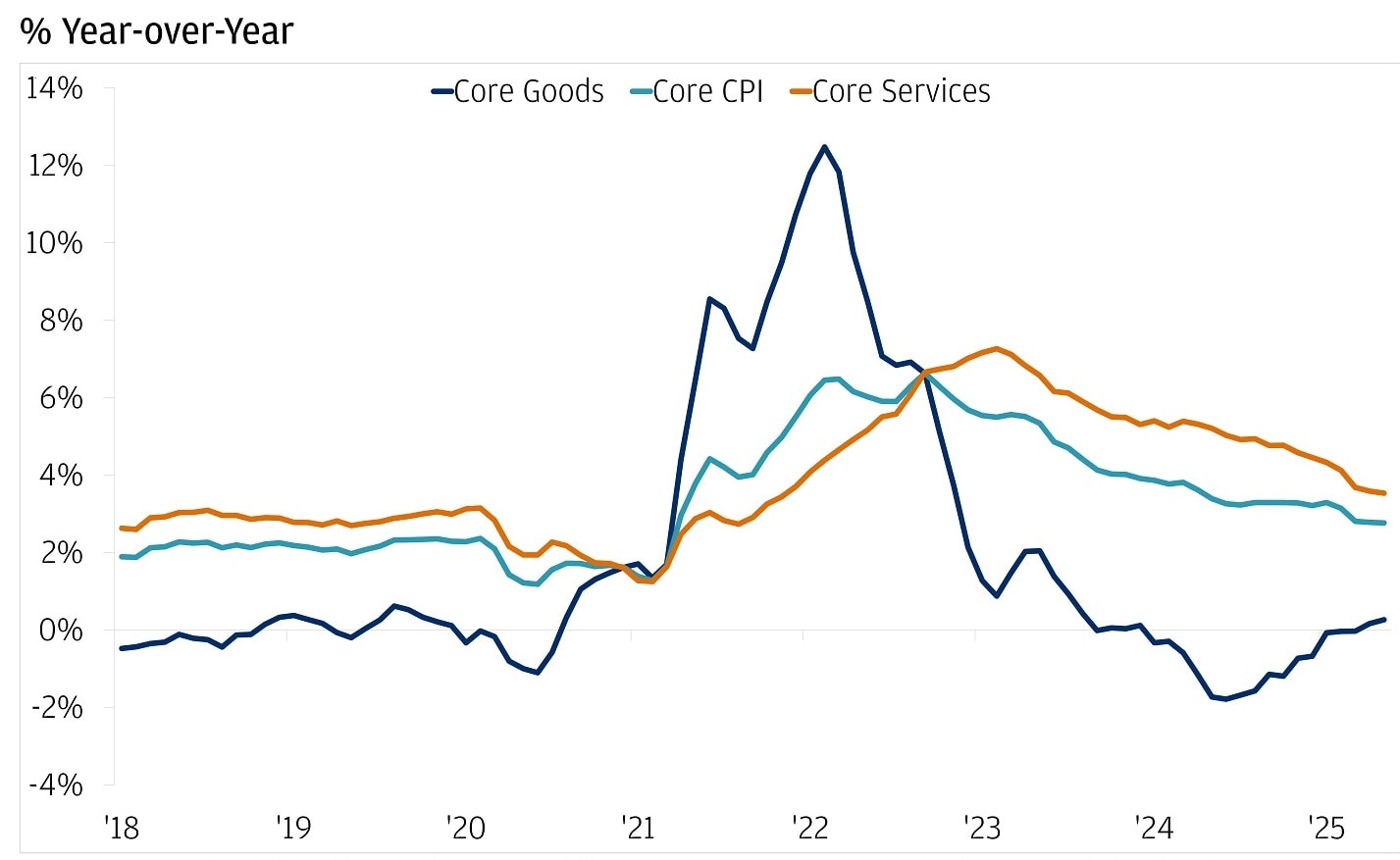
Core CPI, which can be a better gauge of underlying inflation trends because it excludes food and energy, which can be very volatile, also rose just 0.1% in May and 2.8% over the last year. That reading also came in below expectations of a 0.2% increase month-over-month and a 2.9% increase year-over-year. These softer-than-anticipated readings are a signal that inflation isn’t yet rising at a notable pace in the wake of recently enacted tariffs.
Consumer Price Inflation
How are tariffs impacting inflation?
While it’s still too early to draw definitive conclusions, tariff collections are running at three times the monthly pace in May 2025 relative to May 2024, and the lack of meaningful pass through to broad consumer prices suggests that businesses are (at least for now) absorbing a decent amount of the extra costs from tariffs.
An outstanding question is how much heat companies are willing to take before tariffs start to put pressure on profit margins and the businesses start passing these costs onto consumers. Recent regional Federal Reserve surveys indicate that more than half of those businesses impacted by tariffs expect to raise prices within the first three months. Indeed, retailers, such as Walmart and Target, and carmakers, including Ford and Subaru, have warned of higher prices in the coming months.
Work with an advisor
Our advisors can provide ongoing financial advice on how your portfolio can adapt to the changes in the market, your life and your goals.
Services inflation remains stable in May
Notably, as core goods remained relatively stable, services inflation continued to moderate. Services inflation, which measures the prices for services like health care, entertainment and shelter, rose just 0.2% in May. This is a slightly softer pace compared to both its six- and 12-month averages and can be primarily attributed to the continued deceleration of housing price growth year-over-year.
The trajectory of services inflation will be important to monitor in the coming quarters given that services make up a significant part of the inflation basket. If services (predominantly housing) can continue their disinflationary trend, they may act as an offset to firmer goods prices resulting from tariffs.
How does May’s CPI reading impact our economic outlook?
We expect the impact from higher tariffs will be more visible in consumer prices over the summer and we are closely watching to see where tariff rates settle following the expiry of the 90-day pause on July 9. However, for the time being, a relatively steady inflation picture is welcome news for the Federal Reserve as it limits near-term urgency to change policy rates. We expect that the Federal Reserve will hold rates steady during the June meeting next week, as the Federal market Open Committee continues to “wait and see” how the impact of tariffs eventually feeds into consumer prices and the labor market.
For investors, we continue to see the importance of building portfolios that are diversified across asset classes and geographies to be resilient to any which way the trade policy picture evolves.
As always, consult with a J.P. Morgan advisor to better understand how this data could affect your investing portfolio.
Explore ways to invest
Take control of your finances with $0 commission online trades, intuitive investing tools and a range of advisor services.