
Frequently asked questions
Get answers to your most common questions.
Overview and pricing
J.P. Morgan Self-Directed Investing is an online brokerage account that lets you place your own trades and invest in stocks, exchange-traded funds (ETFs), mutual funds, options and fixed income.
Online trades for stocks, ETFs and options are commission-free. Options contract and other fees may apply. See our pricing page for full details. There is also no minimum balance to open a J.P. Morgan Self-Directed Investing account.
With J.P. Morgan Wealth Management, you can open a J.P. Morgan Self-Directed Investing online brokerage account where you can trade stocks, ETFs, mutual funds, options and fixed income.
J.P. Morgan Self-Directed Investing offers several account types: general investment, traditional IRA, Roth IRA, UTMA (Uniform Transfer to Minors Act)/custodial and trust accounts. To find out which account type is best for your investment goals, explore our investment account type comparison.
Once you choose your account type, you’ll have to confirm personal details such as your Social Security Number, employer’s name and address (if applicable) and an identification document such as a driver’s license or state ID.
Once you give us those details, we’ll let you know when your account is open or email you a status update within 1 business day.
You can place a trade by going to the Investments by J.P. Morgan menu and choosing Trade. Then, decide what asset class you want to trade: stocks and ETFs, mutual funds, options, fixed income or Premium Deposit.
See Investing Insights for articles and tips to help you get started on your investing journey.
You can place trades during market or extended hours or queue orders for the following trading session.
Stocks, ETFs, mutual funds and options
- Market hours are 9:30 AM ET to 4 PM ET on trading days.
- Extended hours are 7:30 AM ET to 5:45 PM ET for select stocks and ETFs.
- You can queue orders outside of market hours with the exception of 1:59 AM to 6:15 AM ET.
Fixed income
- Market hours are 8:30 AM to 5 PM ET on trading days.
Yes, you can add margin to a J.P. Morgan Self-Directed Investing account. You can only add margin to one of your J.P. Morgan investment accounts. In a margin account, you'll be able to trade and hold stocks, ETFs, mutual funds, options and fixed income.
Margin accounts cannot trade or hold cash-secured puts, recurring investments or J.P. Morgan Premium Deposit.
When you sell a security, the cash from that sale generally settles in 1 business day. You can check the settlement date for your trades in Transactions. Keep in mind that trades will not settle on trading holidays.
Opening your account
To open a Self-Directed Investing account, you need to be at least 18 years old and have a valid Social Security number and U.S. home address. We may also ask you for your valid driver's license or state-issued ID. Apply now for a Self-Directed Investing account.
You can open a Self-Directed Investing account right now, even if you’re not already a Chase bank customer.
J.P. Morgan Self-Directed Investing is a brokerage account that gives you full control to manage your investments on your own and offers retirement (Traditional and Roth IRA) accounts and non-retirement accounts (General investment and UTMAs).
No, there is no minimum amount required to open a J.P. Morgan Self-Directed Investing account. Apply now for a Self-Directed Investing account.
We save your application for 30 days. To continue working on your application, please sign in to the Chase Mobile® app or chase.com.
- On mobile:
Tap More > Open an account > Application Status. - On web:
Open the menu in the top left corner of your Chase dashboard. Under Explore Products, choose Application status, then select See your pending investment account applications to view your Application Status page.
In your web browser, open the menu in the top left corner of your Chase dashboard. Under ‘Explore Products’, choose ‘Application status’, then choose ‘See your pending investment account applications’ to see your Application Status page.
If your application isn't on the Application Status page and you haven’t received a submission email, then there may have been an error. If you need help, call us at 1-800-392-5749, Monday-Friday 8 AM to 9 PM and Saturday 9 AM to 5 PM ET.
An individual retirement account (IRA) is intended to hold assets for your retirement.
There are 2 types of IRAs: Traditional and Roth. They have different tax benefits and different rules.
Apply to open a J.P. Morgan Self-Directed Investing IRA here.
To open an IRA with a J.P. Morgan advisor, please fill out our form.
You can learn more about IRAs here (PDF).
J.P. Morgan Self-Directed Investing accounts can only be opened as personal accounts.
You can open a Self-Directed Investing account here.
If you have questions, you can call us at 1-800-392-5749, Monday-Friday 8 AM to 9 PM and Saturday 9 AM to 5 PM ET.
We’ll review your application within 1 business day and will reach out if we have any questions. You’ll get an email letting you know when your account is open or if further action is required.
You’ll need your Social Security or other eligible Taxpayer Identification Number (TIN),[WU1.1][GU1.2] employer’s name and mailing address, and an identification document such as a driver’s license or state ID. Individual Taxpayer Identification Number (ITIN) or Employer Identification Number (EIN) are not eligible.
Yes, you can open an account with one other applicant. To open a joint account online, both applicants must already have an existing joint Chase bank account or J.P. Morgan investing account together. If you do not have an existing joint account through Chase or J.P. Morgan, please visit a Chase branch for assistance in opening the account.
If you have questions about your J.P. Morgan Self-Directed Investing account, please call us at 1-833-542-1013 Monday-Friday 8 AM to 9 PM and Saturday 9 AM to 5 PM ET.
You can learn more about J.P. Morgan investment products here.
To open a J.P. Morgan Self-Directed Investing online, apply here.
You can also go to a Chase branch and speak with a J.P. Morgan advisor about our investment products.
Stocks and ETFs
You can place trades using the following order types:
- Market: Executes at the next available market price.
- Limit: Set a maximum or minimum price at which you're willing to buy or sell the security.
- Market on close: Execute as close as possible to the next closing price.
- Stop: Set a price to trigger a market order to buy or sell the security.
- Stop limit: Set a price to trigger a limit order to buy or sell the security.
You can't trade, transfer or hold cryptocurrencies directly in a J.P. Morgan Self-Directed Investing account. However, you can find and trade cryptocurrency ETFs.
You cannot directly participate in the primary share issuance of an IPO. However, starting at 7 AM ET on the day an IPO's shares are listed on public exchanges, you can queue limit orders in advance of most IPOs by searching for their tickers. Your order will become eligible for execution once the shares begin trading.
Keep in mind, IPO shares do not typically become available for trading on exchanges when the market opens. Trading may begin at any time during the trading day, but the exact timing varies by security. You may not be able to queue orders for all IPOs before trading begins on the day they're listed.
Keep in mind that newly listed securities may experience price volatility as they begin trading in public markets. Investors should be aware of the potential for a wide variance between the public offering price and the initial trading price once secondary market trading begins.
You can buy fractional shares for eligible stocks and ETFs. You can place market orders with fractional shares using a share amount up to 5 decimal places or a dollar amount starting at $5. You can place orders during market hours (9:30 AM to 4 PM ET) on trading days.
Extended hours trading offers you the chance to react to events before and after regular market hours, such as earnings reports and activity in international markets.
You can place orders in the extended hours trading session for eligible stocks and ETFs from 7:30 AM to 5:45 PM ET. All extended hours orders must be limit orders with a day time in force. Orders can also be queued for the following extended hours trading session. Extended hours trading uses extended live pricing available from 6:15 to 9:30 AM ET for pre-market and 4 to 8 PM ET for after-hours.
Extended hours orders generally do not participate in opening and closing auctions for NYSE, NASDAQ or other exchanges. Orders placed for the extended hours session that do not execute by the end of the session at 5:45 PM will be canceled unless trading is halted before that time.
While extended hours trading offers more time to invest, it may come with higher volatility and lower liquidity. Before you get started, see the risks of extended hours trading.
Some companies share profits by paying dividends to investors, usually in cash but sometimes as shares of stock or other assets. You can choose what to do with your dividends for your whole account or for a single position.
- Reinvest: We'll use your dividend earnings to buy additional shares or units of the same security.
- Pay in cash: You'll receive the dividend payment as cash in your investment account.
You can update your settings by going to Automatic reinvestments.
You can place trades during market or extended hours or queue orders for the following trading session.
Stocks, ETFs, mutual funds and options
- Market hours are 9:30 AM ET to 4 PM ET on trading days.
- Extended hours are 7:30 AM ET to 5:45 PM ET for select stocks and ETFs.
- You can queue orders outside of market hours with the exception of 1:59 AM to 6:15 AM ET.
Fixed income
- Market hours are 8:30 AM to 5 PM ET on trading days.
You can trade certain over-the-counter (OTC) stocks or American Depository Receipts (ADRs) in J.P. Morgan Self-Directed Investing, with a few exceptions:
- Penny stock purchases aren't allowed. A penny stock is any security trading below $5.00 that isn't listed on a major U.S. exchange.
- You can't buy securities classified as Expert Market. We will cancel open buy orders if a security moves to the Expert Market tier. Sell orders may be accepted on a best-efforts basis and can execute at prices that differ from the last market price. Please contact us if you want to liquidate an existing position.
When you sell a security, the cash from that sale generally settles in 1 business day. You can check the settlement date for your trades in Transactions. Keep in mind that trades will not settle on trading holidays.
Mutual funds
See the full list of mutual funds available to trade in J.P. Morgan Self-Directed Investing accounts.
You can't buy Class-C mutual funds in J.P. Morgan Self-Directed Investing accounts.
For questions about mutual funds available for managed accounts, please call us Monday to Friday 8 AM to 9 PM ET, or contact your financial advisor.
Some mutual funds have load types that could lead to an estimated sales charge. Depending on the fund, the following load types can apply:
- Front-end loads are sales charges that investors pay when first buying into a mutual fund.
- Back-end loads, sometimes referred to as contingent deferred sales charges (CDSC), are sales charges that investors pay when selling a mutual fund. A back-end load is usually a percentage of the value of the shares being sold. This amount may decrease over a 5-to-10-year period on average.
- Load-waived means that the funds do not have sales charges when buying or selling mutual funds because the fund manager waives them and may charge other fees instead.
- No-load means there are no sales charges on mutual fund holdings because the investment company distributes shares directly instead of through a secondary party.
All of the mutual funds available to trade in J.P. Morgan Self-Directed Investing accounts are no-load or load-waived.
Some mutual funds charge a short-term redemption fee if you sell your shares before the end of the fund’s required holding period. Funds charge this fee to discourage short-term trading.
Some mutual funds, usually Class B shares, may have a contingent deferred sales charge (CDSC) if you sell shares within a specified number of years after you buy them. The CDSC is also called a back-end load or sales charge. This fee is usually a percentage of the value of the shares sold. This amount may decrease over a 5-to-10-year period on average.
Some companies share profits by paying dividends to investors, usually in cash but sometimes as shares of stock or other assets. You can choose what to do with your dividends for your whole account or for a single position.
- Reinvest: We'll use your dividend earnings to buy additional shares or units of the same security.
- Pay in cash: You'll receive the dividend payment as cash in your investment account.
You can update your settings by going to Automatic reinvestments.
When you sell a security, the cash from that sale generally settles in 1 business day. You can check the settlement date for your trades in Transactions. Keep in mind that trades will not settle on trading holidays.
You can't trade non-U.S. mutual funds in your J.P. Morgan Self-Directed Investing account. You may trade mutual funds that hold international securities but are listed on U.S. exchanges.
Options
Options are financial contracts that give investors the right to buy or sell an underlying asset, such as a stock, at a set strike price before or on an expiration date. Options trading may help investors manage risk, generate income or pursue financial opportunities based on market conditions.
Level 1 strategies require investors to either own at least 100 shares of the underlying security or hold the equivalent cash. These strategies have a similar risk level to owning the underlying security.
Level 1 strategies
- covered calls
- cash-secured puts
- protective puts
Keep in mind that accounts with margin are not allowed to sell puts as a cash-secured strategy. In addition to level 1 strategies, level 2 strategies allow investors to speculate on potential increases or decreases in the price of an underlying security without owning the shares or holding equivalent cash. These strategies may carry an increased risk of loss if the market does not move as anticipated.
Level 2 strategies
- long calls
- long puts
You cannot trade an option the day it's set to expire.
You cannot currently trade options that expire midweek. You can only trade options that expire on Fridays.
You cannot currently trade multi-leg option strategies with a J.P. Morgan Self-Directed Investing account. We only support single-leg options strategies.
You cannot currently trade index options with a J.P. Morgan Self-Directed Investing account.
You cannot currently trade non-standard options with a J.P. Morgan Self-Directed Investing account.
Non-standard options are options that are subject to special adjustments that can result from an underlying company reorganization, stock split, merger, special dividend, etc. Often, non-standard options represent a different deliverable than the standard 100 shares per contract; in other instances, they may represent the acquisition or distribution of different securities or cash. You can learn more about individual non-standard options at the Characteristics and Risks of Standardized OptionsOpens overlay.
Options contracts that are in-the-money on the day they expire are automatically exercised; option contracts that are out-of-the-money on the day they expire are worthless.
If your account does not have enough funds to cover the cost of exercising or assigning the option, or if your account cannot hold the resulting position, we may take action on the position on your behalf, such as closing your position. For more details, see the J.P. Morgan Self-Directed Investing Option Agreement (PDF).
You’ll receive an email notification once your options contracts have been assigned or exercised. You can also see assigned or exercised options on Positions the day they’re exercised
Please call the Service Center at 1-800-392-5749 to make your request.
Please call the Service Center at 1-800-392-5749 to make your request.
Recurring investing
Recurring investing lets you schedule automated repeating purchases of stocks, exchange-traded funds (ETFs) or mutual funds using a dollar-cost averaging strategy. Recurring investing does not guarantee a profit or protect against a loss.
Here are the steps to set up a recurring investment:
- Choose an investment account and funding source. To fund a recurring investment, you may choose an internal bank account, external bank account or use available cash in the same investment account.
- Choose an eligible stock, ETF or mutual fund.
- Choose the recurring investment amount and the trade frequency.
You can fund your recurring investment using your available balance from an internal bank account, an external bank account or cash available to trade in the same investment account you’re scheduling the recurring investment. Funds from external bank accounts will be withdrawn 1 business day prior to each trade date. Be sure to have cash available in your funding account before every recurring investment.
Dollar-cost averaging is an investing strategy used to manage risk by investing your money in equal amounts at regular intervals. By planning a fixed dollar amount and a regular interval in advance, regardless of the price, you will typically buy more shares when prices are lower and buy fewer when prices rise. Through dollar-cost averaging, you can build your position on a consistent basis. Dollar-cost averaging does not guarantee a profit or protect against a loss.
Setting up and maintaining your recurring investments is free. However, you should carefully consider any charges, expenses or minimum investment amounts associated with a mutual fund before you invest. For ETFs, J.P. Morgan Securities LLC imposes a minimum investment requirement. For both ETFs and mutual funds, please read the fund prospectus before investing. To get a copy of the fund’s prospectus, visit the fund manager’s website.
You can set up recurring investments with J.P. Morgan Self-Directed Investing cash accounts. For mutual fund recurring investments, you can also use Self-Directed IRAs and most Full-Service Brokerage accounts that are eligible for online trading. Margin accounts are not eligible to hold recurring investments at this time.
Any recurring investment that would exceed your annual IRA contribution limit will not be made, and we'll pause your recurring investment until the beginning of the next calendar year.
You can schedule an investment weekly, twice per month, monthly, every 3 months, every 6 months and yearly.
Yes, you can edit, pause or cancel recurring investments.
For recurring mutual fund investments, you can modify, cancel or pause your investment up to 3 business days before your next trade date.
For recurring stock and ETF investments funded from an internal bank or J.P. Morgan Self-Directed Investing account, you can modify, cancel or pause your investment up to 1 day before your next trade date.
For recurring stock and ETF investments funded from an external bank account, you can modify, cancel or pause your investment up to 2 business days before your next trade date.
Mutual funds
Some mutual funds have a minimum initial investment requirement to invest in the fund. You must first meet the initial investment to set up a recurring investment.
For Full-Service Brokerage accounts, if the fund’s minimum initial investment amount is under $100, we will impose a $100 minimum investment amount. If the fund has a minimum subsequent investment amount that’s less than $100, we will institute a $100 minimum recurring amount
For J.P. Morgan Self-Directed Investing accounts, if the fund does not have a minimum subsequent investment amount, we will impose a $1 minimum recurring amount.
You can see a mutual fund’s minimum initial investment amount when setting up your recurring investment or check the fund’s prospectus before investing. To get a copy of the fund’s prospectus, visit the fund manager’s website.
Stocks or ETFs
There’s no minimum initial investment requirement for stocks and ETFs, but we impose a $5 minimum recurring amount.
Margin
Margin trading lets you borrow funds from J.P. Morgan Securities LLC to buy more securities than you could with your cash alone. The investments you hold are used as collateral for the loan, and we charge interest on the funds you borrow.
In a cash account, you can only buy investments with your own money. With a margin account, you can borrow funds from J.P. Morgan Securities LLC to increase your buying power.
While margin trading can lead to greater profits, it also comes with the risk of increased losses. There is a risk of losing more than your initial investment if your account value declines, and you’re still responsible for repaying the borrowed amount plus any accrued interest.
To learn more about the risks associated with margin, see the Margin Risk Disclosure.
With a J.P. Morgan Self-Directed Investing margin account, you can trade and hold stocks, ETFs, mutual funds, options and fixed income products.
Most equities, ETFs, mutual funds and fixed‑income products are eligible for margin lending. However, eligibility and lending values for certain securities are determined by J.P. Morgan Securities LLC’s house requirements.
In addition, some securities or asset types may carry additional restrictions or higher maintenance requirements, which may change at any time at the firm’s sole discretion without notice.
There are significant risks associated with trading on margin. For example, you can lose more than initially invested since borrowed money magnifies losses, rapid price fluctuations brought on by market volatility might result in large losses and interest rates on margin loans are variable and may increase. It is important that you fully understand the risks before adding margin to your account.
- You can lose more funds than you deposit in the margin account. A decline in the value of securities that are purchased on margin may require you to provide additional funds to J.P. Morgan Securities LLC (JPMS) to avoid the forced sale of those securities or other securities or assets in your account(s).
- JPMS can force the sale of securities or other assets in your account(s). If the equity in your account falls below the maintenance requirements or the firm's higher "house" requirements, JPMS can sell the securities or other assets in any of your accounts held at the firm to cover the margin deficiency. You also will be responsible for any shortfall in the account after such a sale.
- JPMS can sell your securities or other assets without contacting you. Some investors mistakenly believe that a firm must contact them for a margin call to be valid, and that the firm cannot liquidate securities or other assets in their accounts to meet the call unless the firm has contacted them first. This is not the case. Most firms will attempt to notify their customers of margin calls, but they are not required to do so. However, even if a firm has contacted a customer and provided a specific date by which the customer may meet a margin call, the firm can still take necessary steps to protect its financial interests, including immediately selling the securities without notice to the customer.
- You are not entitled to choose which securities or other assets in your account(s) are liquidated or sold to meet a margin call. Because the securities are collateral for the margin loan, JPMS has the right to decide which securities to sell in order to protect its financial interests.
- JPMS can increase its "house" maintenance margin requirements at any time and is not required to provide advance written notice. These changes often take effect immediately and may result in the issuance of a maintenance margin call. Your failure to satisfy the call may cause JPMS to liquidate or sell securities in your account(s).
- You are not entitled to an extension of time on a margin call. While an extension of time to meet margin requirements may be available to customers under certain conditions, a customer does not have a right to the extension.
To learn more about the risks associated with margin, see the Margin Risk Disclosure.
There are two primary categories of margin requirements:
- Initial Reg T: The amount of funds required to purchase a security in a margin account at the time of the trade. The requirement is currently 50% of the purchase price for listed equity securities. Additionally, margin regulations require you to have a minimum margin account equity of $2,000 when placing orders on margin. If you do not have $2,000 of account equity, you must pay for the purchase in full.
- Maintenance margin: The minimum amount of equity you need to maintain after margin borrowing is established. If your account's equity drops below this threshold, you must deposit cash or transfer securities with sufficient maintenance lending value, or sell assets. J.P. Morgan Securities LLC may otherwise liquidate your securities to meet the requirement.
Margin requirements are determined by various entities, including the Federal Reserve, FINRA and J.P. Morgan Securities LLC. To buy or hold securities on margin, you must maintain sufficient equity to meet those requirements.
A margin call occurs when you fail to maintain the minimum account equity, known as the maintenance margin, in your margin account. For example, account equity can fall when one or more of your positions has lost value. To restore your equity to the required level, J.P. Morgan Securities LLC will require you to deposit additional funds, transfer cash or marginable securities into the account or sell eligible securities to pay down your loan.
Although less common, a margin call can occur when you do not have enough lending value in your account to meet the initial margin requirement for a new trade.
Buying power is the amount of funds available to purchase securities, including your cash balance and funds borrowed on margin.
By default, the buying power calculation for equity securities assumes the security being purchased is marginable, with a 30% maintenance requirement and a 50% Reg T requirement.
J.P. Morgan Securities LLC may also reduce your buying power for any amount of uncleared funds, pending outgoing money movements, open orders and other events at our discretion.
A concentration is when you invest a significant portion of your portfolio in a single asset or group of common assets. When a single security or group of assets represents a large share of your account holdings—based on factors such as market value, liquidity, industry, or outstanding shares—certain risk factors may be magnified.
To help mitigate this risk, J.P. Morgan Securities LLC applies certain concentration guidelines in a margin account, which may limit the amount you can borrow on a security or on your portfolio. In addition, J.P. Morgan Securities LLC may apply an add‑on to the standard margin requirement for positions in your account to help offset some of the increased risks associated with these holdings.
When you purchase securities on margin, you must repay the borrowed amount along with any accrued interest. Interest is charged monthly and collected on the first of each month.
You can see your margin account’s interest rate details on Positions, which shows the pending interest accrued for the month based on how much you’ve borrowed and displays the rate as an annualized amount. Review the terms and conditions of the J.P. Morgan Self-Directed Investing Margin Agreement (PDF) for more information about how interest is calculated by J.P. Morgan Securities LLC.
Premium Deposit
J.P. Morgan Premium Deposit for Self-Directed Investing is a bank deposit product that is accessed through your brokerage account and earns interest at a rate set by JPMorgan Chase Bank, N.A., based on market conditions. You'll see your Premium Deposit balance next to your positions in the Fixed Income section and on your monthly brokerage statements.
Keep in mind:
- The initial minimum deposit is $50,000.
- Same-day availability applies only if you make a deposit or withdrawal before 4:00 PM ET on a business day. If the deposit or withdrawal is made after 4:00 PM ET, it will be available the next business day.
- Premium Deposit isn't a sweep. Funds aren't automatically accessed to settle trades or reduce a debit balance or margin loan on your eligible account.
- Income from Premium Deposit balances is fully taxable.
- Rates and features, such as minimum and maximum deposit amounts, may differ if you purchase through a J.P. Morgan advisor.
- Availability: J.P. Morgan Premium Deposit for Self-Directed Investing provides same-day availability if you enter a transaction before 4:00 PM ET on a business day. Transactions submitted after 4:00 PM are available the next day.
- Keep in mind: Premium Deposit isn’t intended for daily or recurring expenses or frequent trade settlement. It isn’t a sweep. Funds won’t be accessed automatically to settle trades or reduce a debit or margin loan on your eligible account. - Transfers: Transfers from brokerage accounts to any bank account follow current procedures and timeframes. Allow enough lead time to withdraw funds for transfers or wires.
Any Self‑Directed Investing client can use Premium Deposit.
- Access: Go to your investments dashboard and choose the "Trade" icon to access J.P. Morgan Premium Deposit for Self‑Directed Investing.
- Set amount: Indicate the amount you want to place. The initial minimum deposit is $50,000.
- Monitor: View Premium Deposit for Self-Directed Investing (JPMPD) alongside your investment positions. Your cash will be ready for same‑day withdrawal.
JPMorgan Chase Bank, N.A. sets the rate on Premium Deposit for Self‑Directed Investing based on the overall rate environment and the competitive landscape. The rate may change at any time with market conditions. The rate may differ if you purchase Premium Deposit through a J.P. Morgan advisor.
- Where it appears: Premium Deposit balances show in the fixed income section of your account and on your monthly brokerage statements online and in the mobile app.
- Activity: Deposits, withdrawals and interest payments appear alongside other investment activity. You won’t receive a separate statement from JPMorgan Chase Bank, N.A., for Premium Deposit balances.
- Taxes and differences: Income from Premium Deposit balances is fully taxable. Rates and features like minimum and maximum deposit may differ if you purchase through a J.P. Morgan advisor.
Fixed income
Bonds are the most common type of fixed income securities. A bond represents a loan to the issuer (e.g., a corporation or government) for a certain period of time. In exchange, the issuer typically pays the bond holder interest until the bond matures. When the bond matures, the issuer repays the bond at its face value (or par value).
These are the main types of bonds:
- Treasury bonds are issued by the U.S. government and are generally considered very safe.
- Corporate bonds are issued by companies. Their risk varies, as reflected by a credit rating.
- Municipal bonds are issued by states, their agencies and subdivisions, such as counties and municipalities.
- Agency bonds are issued by federally-sponsored agencies, although these investments aren’t guaranteed by the federal government.
- Zero coupon bonds are bonds issued at a deep discount to their face value but pay no interest.
Certificates of deposit (CDs) are savings certificates offered by banks and credit unions that typically offer a predetermined interest rate over a specified period. CDs earn income by locking in an interest rate that is paid back in fixed, regular payments or at maturity. CDs held in a J.P. Morgan brokerage account are eligible for FDIC insurance. You can currently trade new issue and secondary market brokered CDs.
Accrued interest is any interest earned on a fixed income security that hasn’t been paid out. Interest accrues daily, and a buyer owes any accrued interest from the last coupon payment up to the trade settlement date to the previous owner.
Face or “par” value is generally the amount the issuer (e.g., a corporation or government) is required to pay the bondholder when a bond matures. Face value stays the same over time.
The market value of bonds and stocks is determined by the buying and selling activity of all investors on the open market. A bond can be purchased for more or less than its par value, depending on market sentiment. Upon maturity, the bondholder is paid the par value, regardless of the purchase price.
The coupon rate is the stated rate of interest paid on a bond. The yield to maturity is the annual rate of return you earn if you hold a bond to maturity.
The main factors that impact the prices of fixed income securities include:
- interest rate changes
- default or credit risk
- secondary market liquidity risk.
Since bonds are issued based on prevailing interest rates, changes in the rates have an impact on their market value. Interest rates and bond prices have an inverse relationship. As interest rates go up, bond prices generally fall. Let’s say you purchased a $500 bond that pays a 6% rate of interest. If interest rates rise to 7%, new bonds issued by the same company would become more attractive because investors stand to earn 1% more in interest. Investors aren’t likely to buy your bond unless you discount it. On the flip side, you would benefit from a drop in interest rates because your bonds would be more desirable to potential buyers.
Credit or default risk is the second factor that impacts bond prices. The issuer may go out of business and may not be able to pay its interest rate and principal obligations. Issuers of high-yield bonds have a lower credit rating and are in greater risk of default. To make up for the higher risk, these bonds will pay higher interest rates. Credit rating agencies provide ratings to help investors weigh the risk associated with these bonds.
Most bonds are traded over-the-counter (OTC), which means that trades are not made on an exchange, but usually between two parties. If a bond has few buyers and sellers, there is liquidity risk, meaning an investor may not be able to sell a bond quickly enough to prevent or minimize a loss in value.
An investment grade security has a relatively low risk of default. Only companies rated at 'BBB-' or higher by Standard and Poor's or Baa3 by Moody's are considered investment grade. Anything below those ratings is considered non-investment grade and carries a higher risk of default.
A zero coupon is a bond that doesn’t pay interest until it reaches maturity. An investor receives one payment, which includes principal and interest, when the bond matures.
Unlike a zero coupon, a regular bond pays interest at regular intervals but also pays the bond’s face value to the bondholder at maturity.
When you sell a security, the cash from that sale generally settles in 1 business day. You can check the settlement date for your trades in Transactions. Keep in mind that trades will not settle on trading holidays.
You cannot trade non-U.S. securities in your J.P. Morgan Self-Directed Investing account.
Ultimate Rewards
Chase credit card holders will have the ability to redeem their ultimate rewards points as cash back into eligible J.P. Morgan Investment accounts
- Eligible cards: All Chase Freedom cards, All Chase Ink Cards, and All Chase Sapphire cards including Chase Sapphire for Business.
- Eligible investment account: Self-Directed Investing General investment, UTMA, and Trust accounts; You can also invest your points in a taxable brokerage account held with a J.P. Morgan advisor.
- Redemption value: 100 points = $1
- Processing: Redemptions before 4:30pm ET on business days typically process the same day; otherwise, the next business morning
To redeem your Ultimate Rewards points into an eligible J.P. Morgan Investment account:
- Log in to Chase.com or the Chase Mobile app. Go to “Benefits & Travel,” then “Rewards” or “Redeem Rewards,” and select “Invest Your Points.”
- Choose the card to redeem from (if you have more than one).
- Select your eligible investment account and the amount to redeem. If you don’t have an eligible account, you’ll need to open one.
- Review and submit. Your points will be deposited as cash, typically available to invest within 3 business days.

Earn up to $1,000 when you open and fund an online investing account
Get rewarded when you open and fund a J.P. Morgan Self-Directed Investing account by transferring cash or investments from an eligible external account - including rolling over a 401(k) or other retirement account.
Offer expires 10/21/2026.
Learn more about Self-Directed Investing
Discover the latest features, pricing and how J.P. Morgan Wealth Management can help you find new investment opportunities.
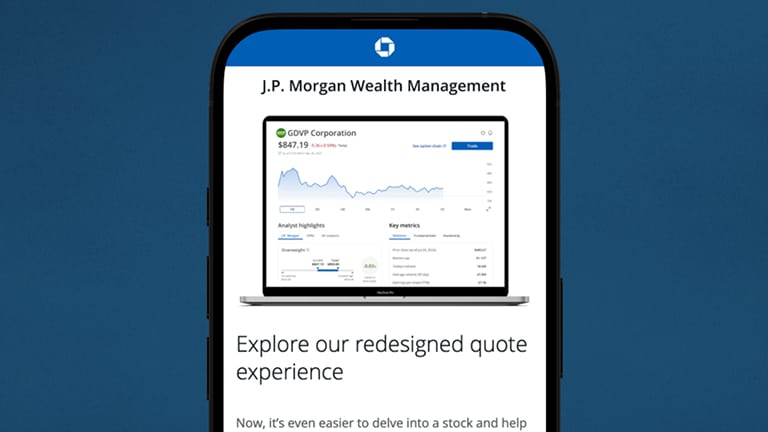
Explore our latest features and tools
Simplify your investing with powerful tools and intuitive features built for online investors.

Transparent pricing
We offer unlimited $0 commission online trades on stocks, ETFs, options, mutual funds, money market funds and treasuries.
Discover investment opportunities
J.P. Morgan Wealth Management offers a wide range of investments, so you can decide what fits your needs.