The case against gold and why it’s wrong

Global Investment Strategist

By Kriti Gupta and Justin Biemann
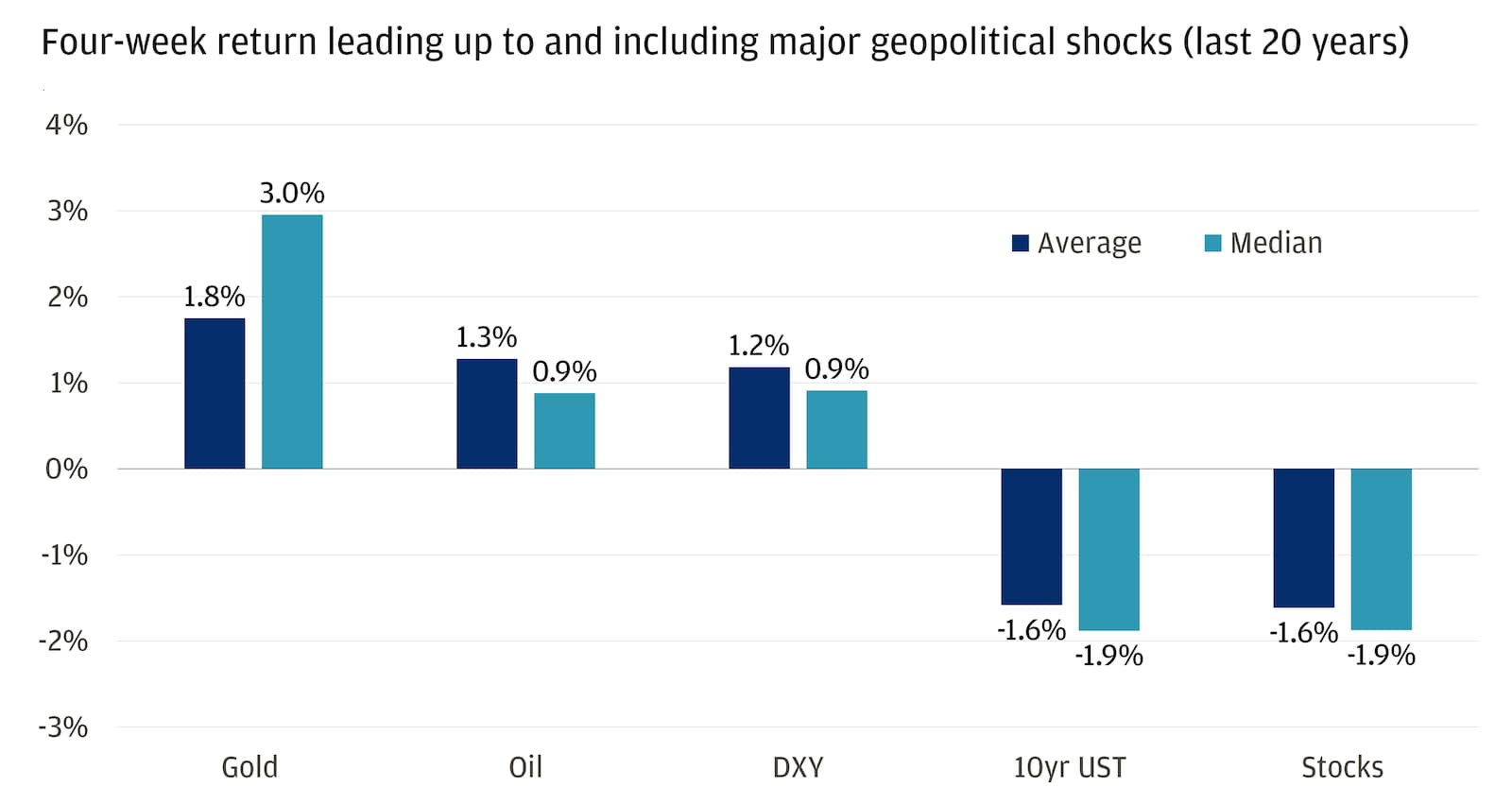
Gold has had a ferocious rally over the last five years, skyrocketing over 170%. There’s a laundry list of reasons why, but the biggest driver may be a new era of geopolitical volatility and fragmentation incentivizing investors to buy the precious metal. Now add on worries about currency debasement, growth, inflation and irresponsible fiscal finances that haven’t been fully reflected in sovereign assets, and it’s no wonder that gold has been a popular asset for investors during times of stress. The precious metal has averaged a return of 1.8% and a median of 3.0% during major geopolitical shocks, outperforming other asset classes.
Gold has done well amid geopolitically risky environments
Past performance is no guarantee of future results. It is not possible to invest directly in an index.
Sources: J.P. Morgan Private Bank, Bloomberg Finance L.P., Haver Analytics. Data as of April 30, 2024. Note: The timeframe of the analysis is January 1985 to April 2024. Geopolitical Risk (GPR) Index used to isolate geopolitical shocks with standard deviation greater than 2. For consecutive series of data points exceeding 2 standard deviations, first data point is used. Analysis is based on average weekly data. DXY stands for the U.S. Dollar Index, S&P 500 Total Return used for stocks. 10yr UST stands for 10-year U.S. Treasury Bond total return. Prices/price returns for used for gold, oil and DXY.
So what could stop gold’s rally?
Ready to take the next step in investing?
We offer $0 commission online trades, intuitive investing tools and a range of advisor services, so you can take control of your financial future.
Risk: No more central bank buying
The biggest driver of gold prices has been central banks. Net purchases of gold have doubled since before Russia’s war on Ukraine began in 2022. Central banks have fueled demand for the precious metal in efforts to diversify reserves away from the U.S. dollar after the U.S. froze Russian assets. The top five largest holders of gold outside of the International Monetary Fund are the United States, Germany, Italy, France and Russia. What if that structural demand from global central banks waned? Or worse, what if central banks wanted to outright sell the commodity?
It has happened before. From 1999 to 2002, the United Kingdom carried out a series of public auctions to sell over 50% of its gold holdings and diversify its reserves into foreign currencies. During the same time frame, Switzerland voted to delink the Swiss franc from gold. Gold prices fell 13% in the three months following the U.K.’s announcement – a move equivalent to a roughly $650 drop in today’s terms. The selling only stopped after several central banks signed The Washington Agreement on Gold to coordinate and cap large, price-moving gold sales. The agreement lapsed in 2019 as central banks largely became buyers of gold, not sellers. In theory, that means gold sales by central banks are still possible – as is plateauing demand.
Rest assured, it’s unlikely to happen. At least, not anytime soon. Here’s why.
As of 2025, gold has made up approximately 19% of emerging market reserves, relative to around 47% of developed markets reserves. Among the emerging markets piling into the precious metal, China stands out amid its peers. Both an emerging market and a U.S. competitor, the country has actively been rotating its reserve assets into gold. China is the seventh largest custodian of gold holdings in the world, but the metal only make up 8.6% of its reserves, according to the World Gold Council. If the trend continues, China has a lot more gold reserve purchases in the pipeline. And it’s not alone. Poland, India and Brazil have also been driving the structural demand.
For G10 central banks, there has been no indication that gold sales are being considered. Even for the Federal Reserve, it would first require large legislative changes and a major break with over a century of precedent. Furthermore, in 2025, 95% of central banks expected global gold holdings to increase, with 5% saying they would remain unchanged and none of the respondents expecting a decrease, according to a YouGov/World Gold Council poll.
Risk: Retail investors turn their backs
Don’t forget retail investors. They’ve been flocking to the metal too. These new buyers are often building a position as a hedge against rising geopolitical risks and macro uncertainty. While this pattern has contributed to the increase in prices, there is another side to the story. New investors could drop the metal as quickly as they picked it up if risks die down or another hedge emerges. The volatility at the end of January paints a clear picture. Gold shot up 20% in a week before crashing by the same margin in two days. Some investors would point to the episode as an example of short-term investors driving prices.
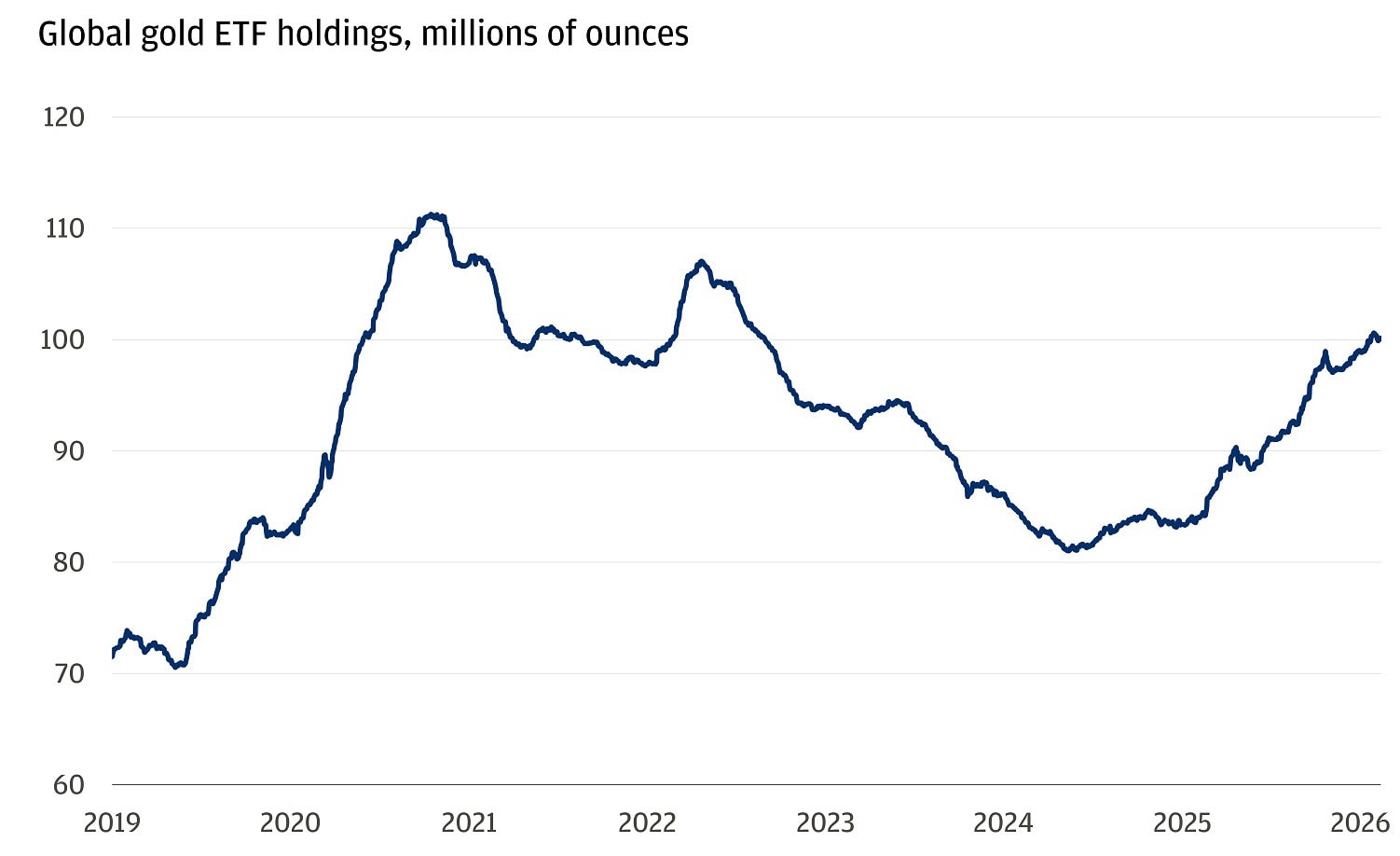
To examine this argument, take a step back. Retail activity is high but not outrageous compared to history. Exchange-traded fund (ETF) holdings of gold (a good proxy for retail interest) stand at approximately 100 million ounces, the equivalent of only around 8% of global central bank holdings. It’s still below the record of roughly 110 million ounces recorded in 2020, and while it could increase, retail activity isn’t in a position to set prices over the long term.
Retail investor demand is still in line with history
Source: Bloomberg Finance L.P. Data as of February 12, 2026.
In addition to hedging against short-term geopolitical risks, gold is a long-term diversifier. It’s an asset that can protect against inflation, outperform during drawdowns and reduce overall portfolio volatility given its relatively low correlation to other assets.
All market and economic data as of 02/13/2026 are sourced from Bloomberg Finance L.P. and FactSet unless otherwise stated.
You're invited to subscribe to our newsletters
We'll send you the latest market news, investing insights and more when you subscribe to our newsletters.