Why you may benefit from tax-loss harvesting

Managing Director, Head of Wealth Planning and Advice, J.P. Morgan Wealth Management

Not all investments can be winners all the time. But there may be a bright side: your losses may help you lower your tax bill through a fairly straightforward tax strategy known as tax-loss harvesting.
Of course, you’ll need to plan in advance and consult with a tax professional to ensure this strategy is a good fit. Here are some considerations.
What is tax-loss harvesting?
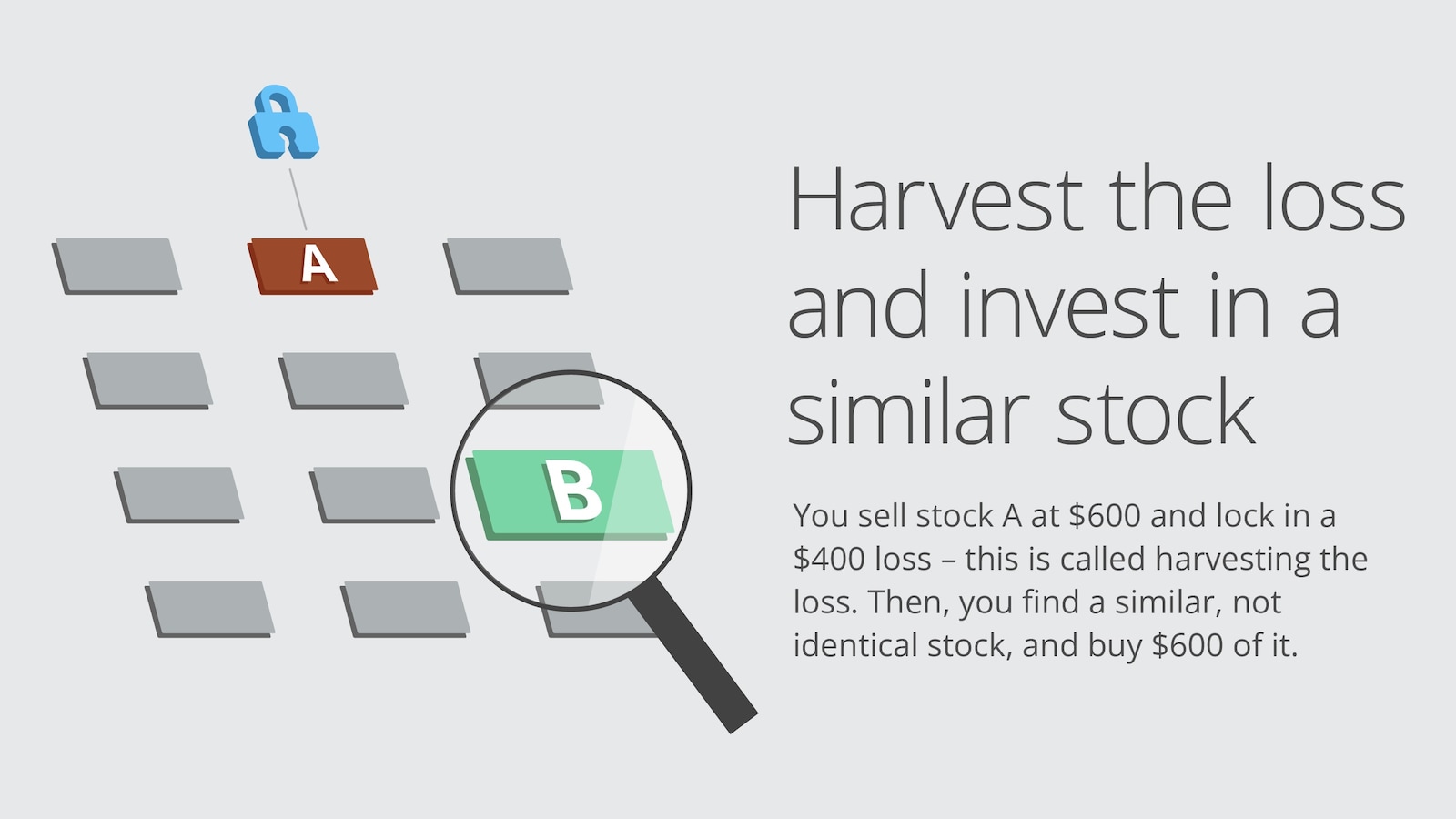
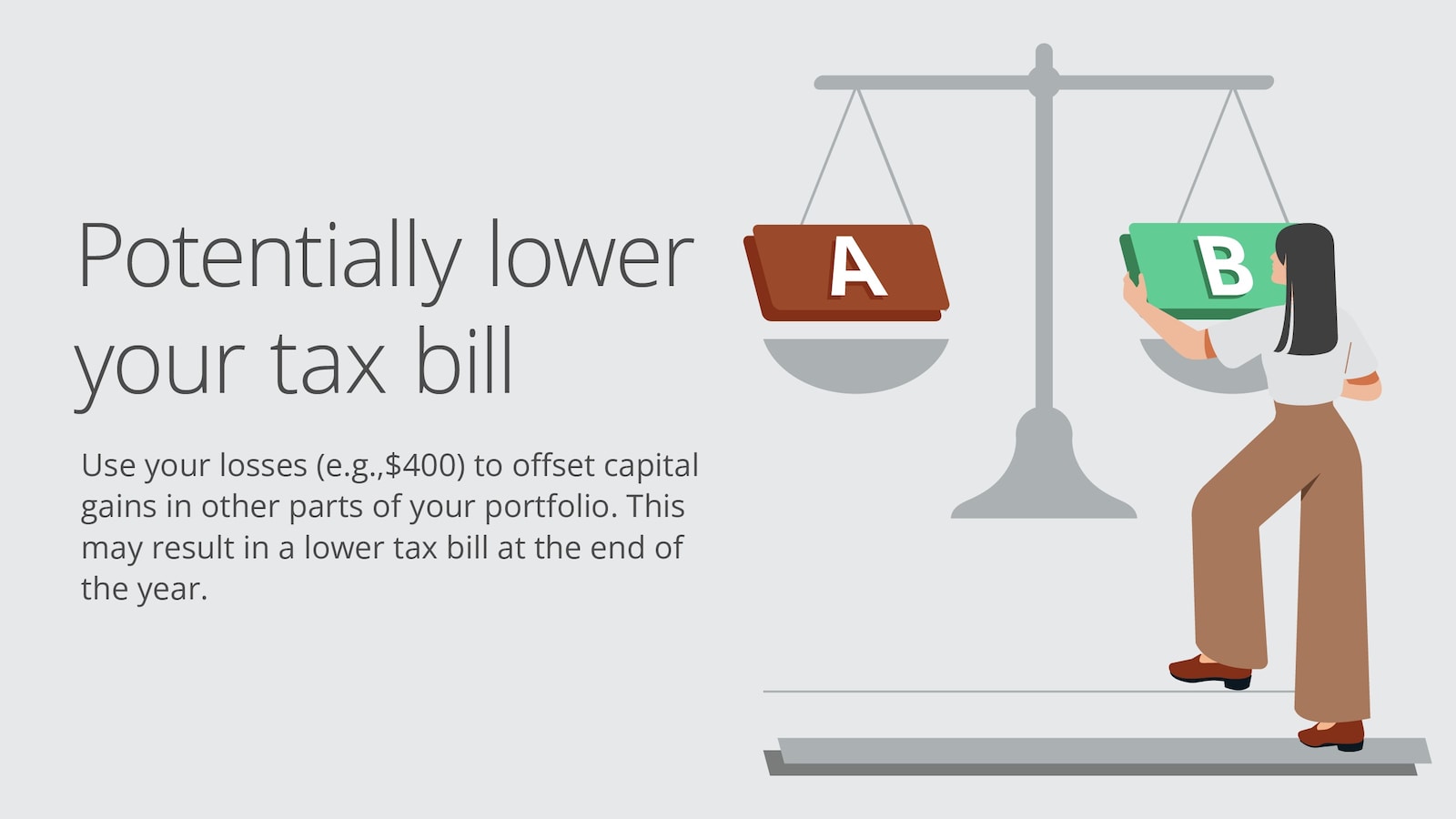
Tax-loss harvesting means selling securities that have embedded losses – that is, you paid more for them than they’re currently worth. Once you sell, those losses may be available to offset capital gains from other parts of your portfolio, or from other capital assets you own for which you have realized, or may want to realize, taxable gain.
If properly done, tax-loss harvesting could effectively reduce or eliminate capital gains tax on gains you realize in the same tax year. In addition, an individual with more capital losses than capital gains in a tax year can use up to $3,000 of the unused losses to offset ordinary income and can carry forward unused losses to use against future gains.
How tax loss harvesting works

Get up to $1,000
When you open a J.P. Morgan Self-Directed Investing account, you get a trading experience that puts you in control and up to $1,000 in cash bonus.
Beware of ‘wash sales’
If you have a loss in a security that you still want to own, you can repurchase the security – but be careful not to trigger a “wash sale,” which will cause your loss to be disallowed in the year it is realized.
In general, a wash sale occurs when you purchase for a loss a “substantially identical” replacement security within 30 days before or 30 days after the sale date. If you purchase a substantially identical replacement security within that time period, the loss will be disallowed; instead, the disallowed loss is generally added to the tax basis of the replacement security, deferring the loss until you sell the replacement. (For example, if you sell stock at a loss on December 1, the wash-sale rule could be triggered if you buy a replacement security any time between November 1 and December 31.) Special rules may apply in cases where some, but not all, of the shares of the original security are sold.
What is a replacement security?
A replacement security doesn’t have to be exactly identical to the sold security to trigger a wash sale. Rather, a wash sale can be triggered if a replacement security is only “substantially” identical.
For example, if you are selling a stock at a loss, a wash sale can be triggered if the replacement is that same stock, or a call option on the same stock, or a number of other securities that are similar enough to the sold stock that the IRS deems to be substantially identical. Similarly, if you are selling a bond for a loss, the more different your replacement bond is (e.g., maturity date, coupon, etc.), the more likely it is that your loss will be allowed and that the replacement bond will not trigger a wash sale.
You should consider consulting with your tax advisor to determine whether a replacement security may be “substantially identical” to the sold security.
How can you remain exposed to the market without triggering a wash sale?
You can “double up” on the security more than 30 days before you intend to sell it (and keep the newly purchased portion), or you can wait for at least 30 days after you sell it to repurchase it. Since doubling up heightens your exposure to the security for the period before you sell the loss portion, you need to be sure that the increased concentration is appropriate for you.
Alternatively, you could purchase a substitute that is not substantially identical to the sold security. Possible substitutes may be stocks that trade similarly (e.g., you sell a consumer staples stock for a loss and purchase a different consumer staples stock to replace it), or market proxies (you sell a large-cap U.S. stock for a loss and purchase an index fund or exchange-traded fund (ETF) that follows the appropriate index), so long as such substitutes are not “substantially identical.”
Note that if any of the replacement securities appreciate in value and you sell them before you have held them for over a year, any gain will be short term and therefore taxed at ordinary income rates.
To make sure you can fully benefit from tax-loss harvesting, you may want to speak with your accountant.
Invest your way
Not working with us yet? Find a J.P. Morgan Advisor or explore ways to invest online.
Managing Director, Head of Wealth Planning and Advice, J.P. Morgan Wealth Management