What are the federal income tax brackets for 2027?

Editorial staff, J.P. Morgan Wealth Management
- The 2027 federal income tax brackets apply to income earned in 2027, for which taxpayers will generally file returns in 2028.
- Federal tax brackets determine the rates applied to portions of your taxable income. The income ranges for each bracket are adjusted annually for inflation.
- The standard deduction for single filers is $16,600 for 2027, a $500 increase from 2026, while married couples who file jointly have a standard deduction of $33,200 in 2027, up $1,000 from the year prior.
- The top tax rate of 37% will apply to taxable income above $661,375 for single filers and $793,650 for married couples filing jointly in 2027 – thresholds that are roughly 3.2% higher than in 2026.

The IRS released the federal income tax brackets for the 2027 tax year in November 2026. These brackets apply to income earned in 2027, meaning most taxpayers will file returns according to these tax brackets in 2028.
Returns you file in 2027 will be based on the 2026 tax brackets.
Federal income tax brackets set the income ranges taxed at each marginal rate. Moving into a higher tax bracket doesn’t raise the rate on all your taxable income – you pay the higher rate only on the portion that falls within that bracket.
2027 federal income tax brackets
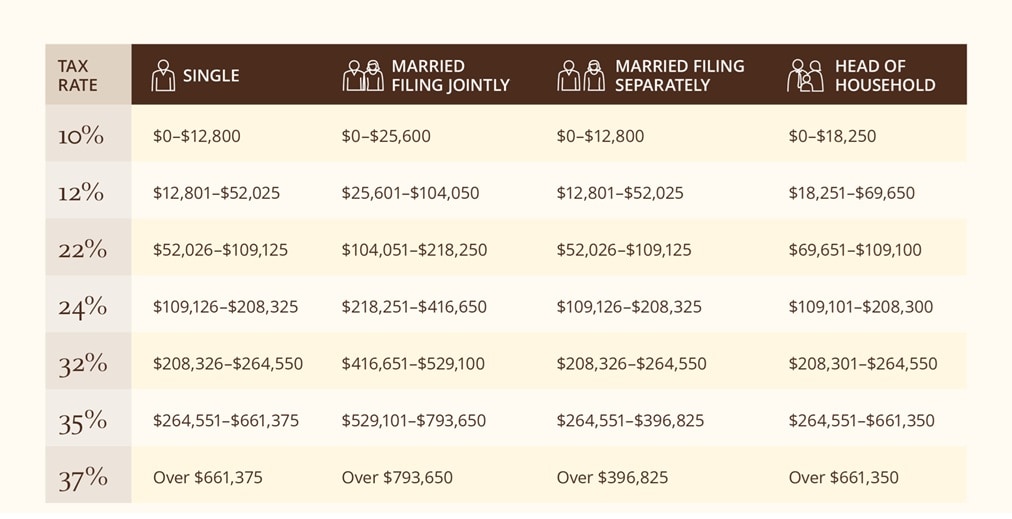
The table above shows the 2027 marginal federal income tax rates and the taxable income to which each rate applies.
Here’s a hypothetical example for illustrative purposes only: Say you’re a single filer with $90,000 of taxable income in 2027. You’d be taxed as follows:
- 10% on your first $12,800, owing $1,280
- 12% on the next $39,225, owing $4,707
- 22% on the remaining $37,975, owing $8,354.50
In total, your federal income tax bill would be about $14,341.50, an effective rate of roughly 16% on your taxable income. Tax credits and other taxes may affect what you ultimately owe.
Interested in working with an advisor?
Work 1:1 with our advisors to help build a personalized financial strategy that’s built around you.
What is my tax bracket?
Your federal tax bracket depends on your taxable income and filing status in a given tax year.
Taxable income
Taxable income is generally your gross income minus certain adjustments (such as deductible IRA or HSA contributions) and either the standard deduction or your itemized deductions. Pre-tax payroll contributions, such as to a 401(k) or employer health plan, typically also reduce the income that's subject to federal income tax. So, even if your gross income matches a higher bracket range, your taxable income may not.
If you’re estimating your 2027 taxes, you may need to use projected income and deductions until you receive all the relevant tax documents, which may not arrive until early 2028.
Consider reviewing your eligibility for certain tax deductions and credits and speak with a tax professional if you have any questions.
Tax filing status
Your tax filing status determines which column in the above table applies to your income.
- Single: Single filers are individuals who are unmarried, divorced or legally separated under a divorce or separate maintenance decree, on the last day of the year and don’t qualify for another filing status.
- Head of household: These are filers who are considered unmarried on the last day of the year and have paid more than half the cost of keeping up a home for the year, while having a qualifying person live with them for more than half the year. If you’re a caregiver for an aging parent and claim them as a dependent, for example, you may be able to file as head of household even if your parent does not live with you provided you pay more than half the cost of keeping up their main home.
- Married filing jointly: These are filers who are married and agree to file a joint tax return.
- Married filing separately: These are filers who are married and choose to file separate tax returns.
- Qualifying surviving spouse: Generally, these are filers whose spouse died during one of the two prior tax years, who have not remarried and who have a dependent child or stepchild living with them in a home for which they pay more than half the cost. Qualifying surviving spouses generally use the married-filing-jointly tax brackets and standard deduction.
The bottom line
Federal income tax brackets are tied to inflation, so they tend to increase year to year. As the thresholds rise, some of your income may be taxed at a lower marginal rate – even if your taxable income stays the same.
Some tax deductions and credits are adjusted for inflation, too. For tax year 2027, the standard deduction will increase to $16,600 for single filers and $33,200 for married couples filing jointly – up $500 and $1,000 from 2026, respectively.
For tax year 2027, the maximum Child Tax Credit will increase by $100 to $2,300 per qualifying child. The maximum refundable amount (known as the Additional Child Tax Credit, ACTC) will also increase by $100, to $1,800. These adjustments generally apply to tax returns filed in 2028.
Other inflation-adjusted amounts include the annual gift tax exclusion and the estate and gift tax basic exclusion amount, the Earned Income Tax Credit and the qualified transportation fringe benefit.
Frequently asked questions about 2027 federal income tax brackets
No. Federal income tax brackets apply only to federal income tax; they don’t determine the state or local income taxes you may owe. State and local tax rules, rates and filing requirements can differ from federal rules, and not every location imposes an income tax. For details that apply to you, check your state’s taxation or revenue agencyOpens overlay and your municipal government’s website.
For tax year 2027, the standard deduction will be $16,600 for single filers and $33,200 for married couples filing jointly. Compare the amount you can claim in eligible itemized deductions with the standard deduction for your filing status. If your itemized deductions are higher, itemizing may reduce your taxable income more; otherwise, you may want to take the standard deduction when you file your taxes. If you’re unsure, consider consulting a tax professional.
If you’re married on December 31, the IRS generally considers you married for the entire tax year. You’ll typically file as married filing jointly or married filing separately, and your filing status determines which tax brackets apply. The two statuses have different income thresholds and may affect how deductions and credits are claimed. Your choice can depend on your individual circumstances, so consider consulting a tax professional if you’re unsure which status is appropriate.
Invest your way
Not working with us yet? Find a J.P. Morgan Advisor or explore ways to invest online.